
Isometric handgrip training at 30% maximal voluntary contraction,
does it really help with Lower office systolic pressure under supervised training?
research showsGrade C with 50 points. In a 12-week supervised, home, and no-exercise trial, omnibus group-by-time tests were SBP P=.041 and DBP P=.049, but a specific adjusted pairwise effect and 95% CI were unavailable. In the same study, 24-hour ambulatory SBP and DBP were null, P=.650 and P=.340.
ads claimA few minutes of gripping is portrayed as lowering blood pressure all day or replacing medication.
Useful facts when choosing a product
- A representative protocol used 30% MVC, four two-minute holds, three times weekly.
- Supervised results cannot be transferred to unsupervised home use.
- Ambulatory pressure was null in the same trial.
Chamgap Semantic Classification Code
Permanent code issued
X.isometric-handgrip-training.behavioral.office-systolic-blood-pressure.reduce.no-exerciseBehaviors, exposures and policies > Isometric handgrip training at 30% maximal voluntary contraction > Behavioral delivery > Lower office systolic pressure under supervised training > Reduction claim > No exercise
Codex retrospectively verified the principal intervention, delivery, population, endpoint, and comparator from the existing reviewed verdict and issued a permanent semantic code. Secondary outcomes on the page are not transferred as separate claims. The code identifies the intervention and claim; it never contains the evidence grade, score, or safety result.
Exact Claim Classification
These independent facets prevent evidence from different forms, routes, populations, effects, and comparators from being mixed.
| Intervention class | X · Behavior, exposure, or policy |
|---|---|
| Canonical ingredient or intervention | Isometric handgrip training at 30% maximal voluntary contraction |
| Source or part used | Plant source not applicable; specified behavior or training |
| Formulation or processing | Isometric handgrip training at 30% maximal voluntary contraction |
| Route | Behavioral delivery |
| Dose | Isometric handgrip training at 30% maximal voluntary contraction |
| Duration | 12 weeks |
| Population | 72 treated participants with hypertension randomized |
| Effect or condition | Lower office systolic pressure under supervised training |
| Primary endpoint | Twelve-week office, central, and 24-hour ambulatory pressure |
| Comparator | No exercise |
| Duplicate-detection key | isometric-handgrip-training|behavioral|72 treated participants with hypertension randomized|office-systolic-blood-pressure|12 weeks |
What the research actually shows
Trials compared supervised or home training with 5% MVC sham, no exercise, or aerobic control. Office, home, and 24-hour averages were not pooled as one outcome.
Why this is classified as C (50)
An office-SBP signal is limited by a surrogate outcome, missing pairwise precision, small trials, attrition, and null ambulatory evidence, giving C with 50 points.
Counterpoint. A significant three-arm DBP omnibus test does not identify an adjusted pairwise difference or demonstrate day-long benefit.
Rejudgment record. Cross-check applied — Separated supervised from home training and office from home and ambulatory pressure without converting an omnibus test into a pairwise effect
| Endpoint | S | Surrogate marker - laboratory or imaging measures |
| Replication | R1 | Single confirmatory trial |
| Independence | I2 | Decisive evidence is publicly or non-profit funded |
| Effect size | EX | The clinical size of the effect could not be judged |
Stored derived and displayed grades match; this is not a current recalculation or validity check (C).
Sub-claim grades by effect
This ingredient is marketed for several effects. A single overall grade blends strong and weak claims together, so each effect is graded separately here. The overall grade reflects the strongest disconfirming or core claim.
| Effect (sub-claim) | Grade | Basis |
|---|---|---|
| Lower supervised office SBP | C | Small trials support the direction, but precise adjusted pairwise effects are incomplete. |
| Lower 24-hour ambulatory pressure | D | Key and later trials were null. |
Cross-check — AI research and Codex final gate
Evidence Table
| Study | Design | Sample | Funding | Endpoint | Result | Weight |
|---|---|---|---|---|---|---|
| Farah BQ et al. 2018 | Three-arm supervised, home, and no-exercise randomized trial | 72 treated participants with hypertension randomized | Brazilian public/academic support | Twelve-week office, central, and 24-hour ambulatory pressure | Office SBP P=.041 and DBP P=.049; ambulatory SBP P=.650 and DBP P=.340 | Key measurement-setting comparison |
| Palmeira AC et al. 2021 | Twelve-week randomized controlled trial | 63 participants | Brazilian public primary-care research | Office and ambulatory pressure | Office SBP interaction positive; DBP and ambulatory pressure null | Direct support and qualifier |
| 2024 home handgrip trial | Randomized home-training trial in older adults | 84 participants | Academic support | Ambulatory and office pressure | Ambulatory and between-group office pressure were null | Contrary home-training evidence |
Receipt — 3 References
All 3 cited sources were verified for existence at the original page (as of 2026-09-07).
Final verification and publication gate: Codex · Evidence date: 2026-09-07 · Corrections: none
Cite this verdict
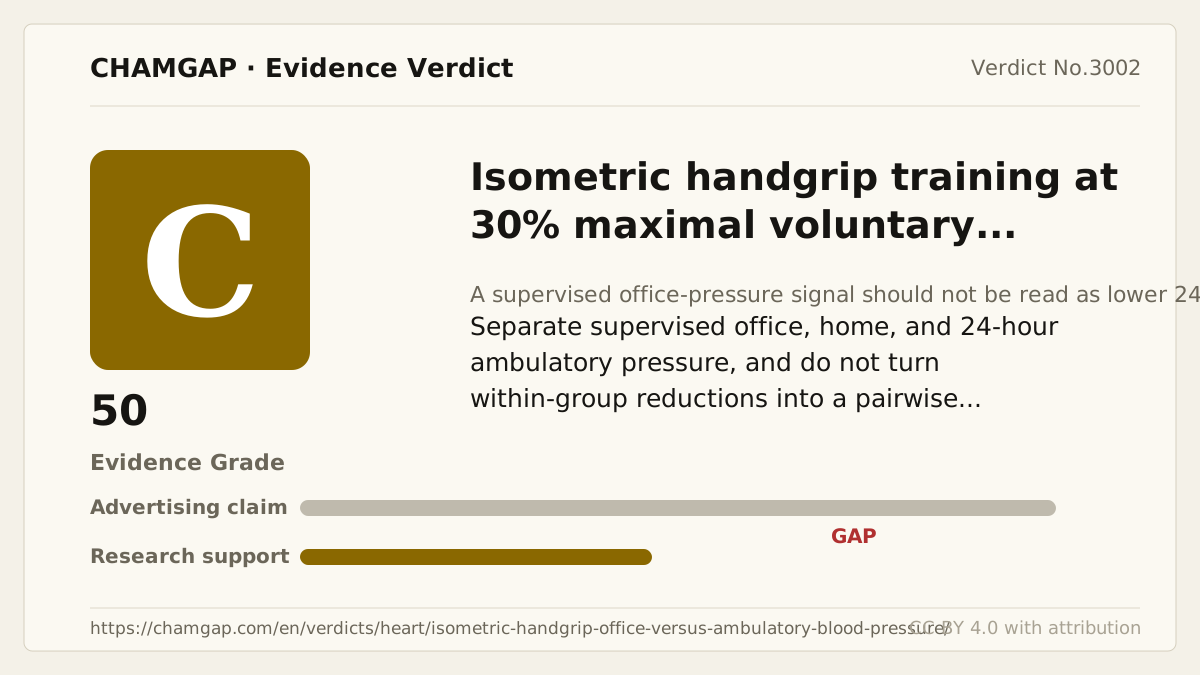
[Chamgap] Isometric Handgrip for Office Blood Pressure—Twenty-Four-Hour Ambulatory Pressure Was Null — Evidence Grade C·50. 3 cited sources checked. Source: https://chamgap.com/en/verdicts/heart/isometric-handgrip-office-versus-ambulatory-blood-pressure/ · CC BY 4.0CC BY 4.0 — free to use with attribution; do not distort grades, numbers, or verdict meaning.
What this document does and does not do
Chamgap is an information source. It reports what research has and has not confirmed; it does not tell readers what to take or buy. That decision belongs to readers and, when needed, medical or legal professionals. This verdict reflects literature available up to the search date and may change as new research appears. Nothing here is medical advice.