
Intensive lifestyle intervention,
does it really help with Prevention of major cardiovascular events in adults with overweight or obesity and type 2 diabetes?
research showsThe Look AHEAD intensive lifestyle intervention improved weight and selected risk factors but missed its primary cardiovascular-event endpoint, yielding D. All 5,145 randomized participants were analyzed by intention to treat. The composite of cardiovascular death, nonfatal myocardial infarction, nonfatal stroke, or hospitalization for angina occurred in 403 versus 418 participants, HR 0.95 (95% CI 0.83 to 1.09), P=0.51. The intervention was stopped early for futility. The confidence interval still allows as much as a 17% relative benefit, so the requirements for repeated refutation and exclusion of meaningful benefit needed for F are not met.
ads claimMarketing can expand true improvements in weight and glucose into proof that myocardial infarction and stroke are prevented. The trial directly measuring those events found no significant reduction.
Useful facts when choosing a product
- The intensive arm combined calorie reduction, at least 175 minutes of moderate activity weekly, and frequent individual and group counseling, targeting at least 7% weight loss in year one.
- Verdict 1424, which is B with 77 points, concerns five-year medication-free diabetes remission after Roux-en-Y gastric bypass; verdict 1454, which is B with 69 points, concerns long-term medication-free remission after sleeve gastrectomy. Verdict 1436, which is C with 54 points, concerns postmeal glucose after walking. Intervention intensity and endpoints differ from this cardiovascular-event verdict.
- Weight loss occurred, but physical weight change and prevention of cardiovascular events are separate claims.
Chamgap Semantic Classification Code
Candidate index · review held
X.intensive-lifestyle-intervention.behavioral.major-cardiovascular-events-with-overweight-or-obesity-and-type-2-diabetes.prevent.UNKBehaviors, exposures and policies > Intensive lifestyle intervention > Behavioral delivery > major cardiovascular events with overweight or obesity and type 2 diabetes > Occurrence-prevention claim > Unknown
An automated migration candidate, not an issued permanent code; exact claim scope remains under review. This machine-generated migration candidate helps retrieval but is not a permanent assignment. The original verdict ID and URL remain authoritative.
What the research actually shows
Look AHEAD randomized 5,145 adults with overweight or obesity and type 2 diabetes to intensive intervention, 2,570, or education control, 2,575, and analyzed all by intention to treat. The centrally adjudicated primary cardiovascular composite occurred in 403 versus 418 participants, 1.83 versus 1.92 per 100 person-years, HR 0.95 (95% CI 0.83 to 1.09), P=0.51. The intervention was stopped for futility at a median 9.6 years rather than the planned maximum 13.5 years. The four-year report showed improvements in weight, fitness, and selected risk factors, but these were not the clinical-event primary endpoint.
Why this is classified as D (34)
The publicly funded 5,145-participant hard-endpoint trial failed with HR 0.95 and P=0.51. It is a single pivotal trial with one early-stopping flaw, and CI 0.83 to 1.09 retains clinically meaningful benefit, so C0 gives D rather than F, with 34 points.
Counterpoint. Lifestyle intervention can still be used for weight, fitness, function, and risk-factor goals. Cardiovascular-event prevention also requires comprehensive treatment of proven risks such as blood pressure, lipids, glucose, and smoking.
Rejudgment record. Cross-check applied — A large publicly funded trial missed its cardiovascular composite primary endpoint and stopped for futility; the lower confidence bound of 0.83 permits 17% relative benefit, giving C0 rather than F
| Endpoint | H | Hard endpoint - actual events such as death |
| Replication | R1 | Single confirmatory trial |
| Independence | I2 | Decisive evidence is publicly or non-profit funded |
| Effect size | E0 | Null |
| Precision | C0 | The confidence interval leaves room for benefit |
Stored derived and displayed grades match; this is not a current recalculation or validity check (D).
Sub-claim grades by effect
This ingredient is marketed for several effects. A single overall grade blends strong and weak claims together, so each effect is graded separately here. The overall grade reflects the strongest disconfirming or core claim.
| Effect (sub-claim) | Grade | Basis |
|---|---|---|
| Reduction in the major cardiovascular composite | D | The primary endpoint failed with HR 0.95 and P=0.51. |
| Prevention of nonfatal myocardial infarction and stroke | D | The clinical-event results did not establish significant prevention. |
| Prevention of cardiovascular death | D | A component outcome does not overturn failure of the prespecified composite. |
Cross-check — AI research and Codex final gate
Evidence Table
| Study | Design | Sample | Funding | Endpoint | Result | Weight |
|---|---|---|---|---|---|---|
| Look AHEAD Research Group. 2013 | Multicenter randomized controlled long-term clinical-event trial | 5,145 randomized and analyzed by intention to treat (2,570 intensive and 2,575 control) | Public United States federal funding led by NIDDK and other NIH institutes with CDC support; selected food and equipment donations | First cardiovascular death, nonfatal myocardial infarction, nonfatal stroke, or hospitalization for angina | 403 versus 418 events, HR 0.95 (95% CI 0.83 to 1.09), P=0.51; the primary endpoint failed and the intervention stopped for futility. | Decisive large hard-endpoint trial |
| Look AHEAD Research Group. 2010 | Four-year surrogate and risk-factor analysis of the same randomized trial | Original 5,145 randomized participants with available follow-up by visit | Public NIDDK, NIH, and CDC funding | Weight, fitness, glucose, blood pressure, and lipid risk factors | Weight, fitness, and selected risk factors improved in the intensive arm, but these were not the cardiovascular-event primary endpoint. | Scope of positive surrogate outcomes |
Receipt — 2 References
All 2 cited sources were verified for existence at the original page (as of 2026-07-24).
Final verification and publication gate: Codex · Evidence date: 2026-07-24 · Corrections: none
Cite this verdict
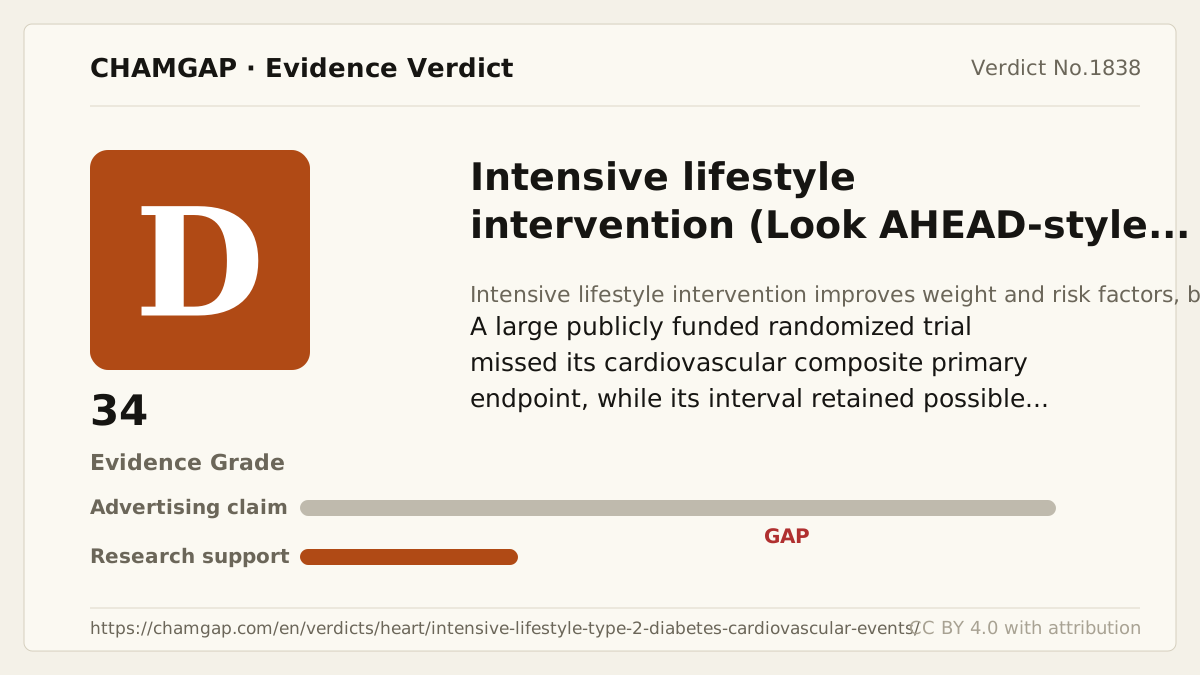
[Chamgap] Intensive lifestyle intervention x cardiovascular-event prevention in overweight adults with type 2 diabetes — Evidence Grade D·34. 2 cited sources checked. Source: https://chamgap.com/en/verdicts/heart/intensive-lifestyle-type-2-diabetes-cardiovascular-events/ · CC BY 4.0CC BY 4.0 — free to use with attribution; do not distort grades, numbers, or verdict meaning.
What this document does and does not do
Chamgap is an information source. It reports what research has and has not confirmed; it does not tell readers what to take or buy. That decision belongs to readers and, when needed, medical or legal professionals. This verdict reflects literature available up to the search date and may change as new research appears. Nothing here is medical advice.