
Influenza vaccination,
does it really help with Reduced cardiovascular events over one year?
research showsThe grade is B. In the randomized double-blind IAMI trial, the 12-month primary composite of all-cause death, new myocardial infarction, or stent thrombosis occurred in 67 patients (5.3%) with vaccine and 91 (7.2%) with saline placebo, HR 0.72 (95% CI 0.52-0.99). The trial stopped for COVID-19 after 2,571 of a planned 4,372 participants, creating a risk of exaggerated benefit.
ads claimVerdict 721 is A with 86 points for preventing symptomatic laboratory-confirmed influenza, and verdict 1126 is B with 77 points for added efficacy of high-dose vaccine in adults 65 or older. This verdict concerns cardiovascular secondary prevention immediately after infarction.
Useful facts when choosing a product
- Vaccination occurred within 72 hours of angiography, PCI, or admission.
- The primary composite included death, infarction, and stent thrombosis.
- Recruitment stopped at 2,571 rather than the planned 4,372.
Chamgap Semantic Classification Code
Candidate index · review held
M.seasonal-inactivated-influenza-vaccine-given-shortly-after-myocardial-infarction.UNK.cardiovascular-events-over.reduce.placeboMedicinal interventions > Seasonal inactivated influenza vaccine given shortly after myocardial infarction > Unknown > cardiovascular events over > Reduction claim > Placebo
An automated migration candidate, not an issued permanent code; exact claim scope remains under review. This machine-generated migration candidate helps retrieval but is not a permanent assignment. The original verdict ID and URL remain authoritative.
What the research actually shows
The sample-size plan required 2,186 per arm, 4,372 total, but the trial ended early for COVID-19 after only 2,571 participants had been randomized. The monitoring board stopped recruitment because COVID-19 would suppress influenza transmission and add deaths that complicated interpretation. Stent thrombosis could not routinely be assessed in Bangladeshi participants, and 13.2% of placebo recipients obtained outside influenza vaccination.
Why this is classified as B (72)
A large hard-outcome trial was positive, but there is no exact independent replication and premature stopping is one avoidable limitation, giving B with 72 points.
Counterpoint. The positive composite does not prove recurrent infarction prevention by itself.
Rejudgment record. Cross-check applied — Direct review of IAMI target and analyzed samples, stopping reason, composite components, and funding statement
| Endpoint | H | Hard endpoint - actual events such as death |
| Replication | R1 | Single confirmatory trial |
| Independence | I1 | Mixed funding sources |
| Effect size | E+ | Meets the clinically important threshold |
Stored derived and displayed grades match; this is not a current recalculation or validity check (B).
Sub-claim grades by effect
This ingredient is marketed for several effects. A single overall grade blends strong and weak claims together, so each effect is graded separately here. The overall grade reflects the strongest disconfirming or core claim.
| Effect (sub-claim) | Grade | Basis |
|---|---|---|
| Reduced 12-month composite of death, infarction, or stent thrombosis | B | The IAMI primary outcome was 5.3% versus 7.2%. |
| Reduced recurrent myocardial infarction alone | D | Rates were 2.0% versus 2.4%, HR 0.86, and not significant. |
| Reduced 12-month all-cause mortality after myocardial infarction with influenza vaccination | B | The IAMI component was 2.9% versus 4.9%, HR 0.59, but came from the same prematurely stopped trial. |
Cross-check — AI research and Codex final gate
Evidence Table
| Study | Design | Sample | Funding | Endpoint | Result | Weight |
|---|---|---|---|---|---|---|
| IAMI | Investigator-initiated multinational randomized double-blind saline-placebo trial | 2,571 randomized; 2,532 modified intention-to-treat; target 4,372 | Swedish Heart-Lung Foundation, Danish Heart Foundation, ALF Grants, Nyckelfonden, and an unrestricted Sanofi Pasteur grant plus study vaccine | All-cause death, new myocardial infarction, or stent thrombosis at 12 months | 67 (5.3%) versus 91 (7.2%), HR 0.72 (0.52-0.99), P=0.040 | Pivotal large randomized trial with premature stopping |
Receipt — 2 References
All 2 cited sources were verified for existence at the original page (as of 2026-08-06).
Final verification and publication gate: Codex · Evidence date: 2026-08-06 · Corrections: none
Cite this verdict
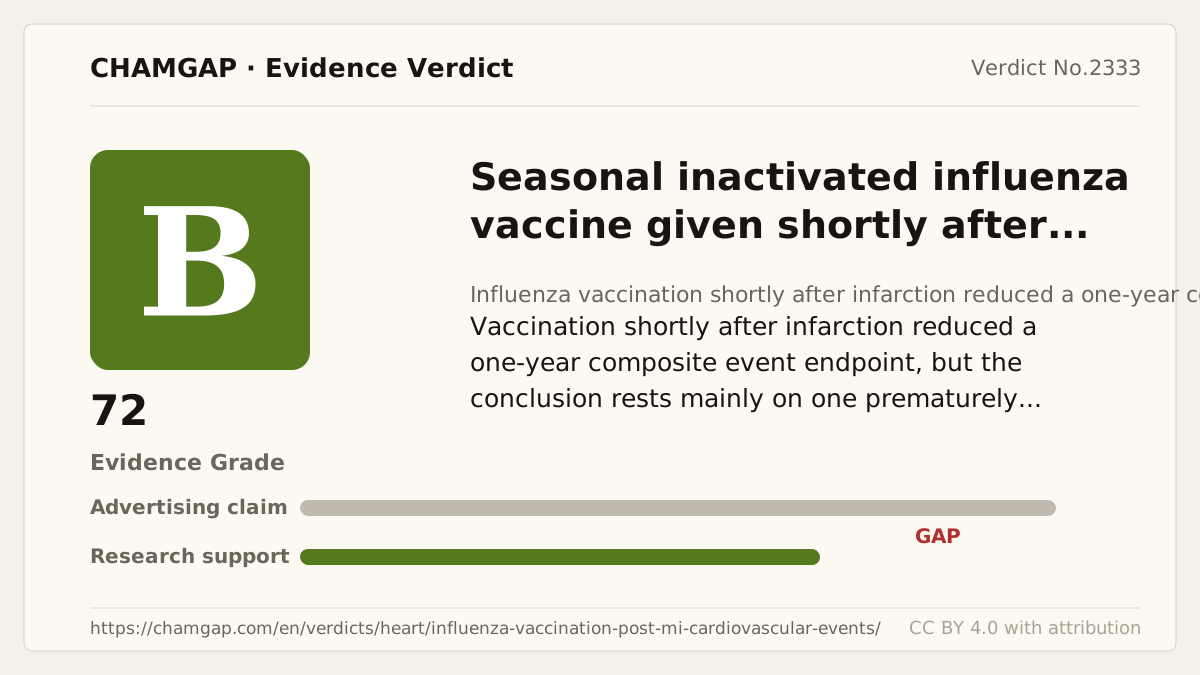
[Chamgap] Influenza vaccination x cardiovascular events after myocardial infarction — Evidence Grade B·72. 2 cited sources checked. Source: https://chamgap.com/en/verdicts/heart/influenza-vaccination-post-mi-cardiovascular-events/ · CC BY 4.0CC BY 4.0 — free to use with attribution; do not distort grades, numbers, or verdict meaning.
What this document does and does not do
Chamgap is an information source. It reports what research has and has not confirmed; it does not tell readers what to take or buy. That decision belongs to readers and, when needed, medical or legal professionals. This verdict reflects literature available up to the search date and may change as new research appears. Nothing here is medical advice.