
Implantable loop recorder screening,
does it really help with Prevention of stroke or systemic arterial embolism in older adults at elevated stroke risk?
research showsThe grade is D. LOOP randomized 6,004 participants and included all 6,004 in the actual intention-to-treat primary analysis. Atrial fibrillation detection rose to 31.8% versus 12.2%, and anticoagulation initiation rose to 29.7% versus 13.1%, but the marketed health outcome of stroke or systemic arterial embolism was 4.5% versus 5.6%, HR 0.80, 95% CI 0.61 to 1.05, P=0.11, so the primary endpoint failed. Because the interval still allows as much as a 39% relative benefit, this is D rather than F.
ads claimThe fact that continuous long-term monitoring detects more arrhythmia cannot be translated directly into stroke prevention. A screening strategy must reduce patient-important events after all downstream treatment steps, not merely increase diagnostic yield.
Useful facts when choosing a product
- An implantable loop recorder is a subcutaneous device that records electrocardiographic rhythm over long periods to capture intermittent arrhythmias.
- In LOOP, atrial fibrillation detection increased to 31.8% versus 12.2%, and anticoagulation initiation increased to 29.7% versus 13.1%.
- The stroke or systemic arterial embolism primary endpoint failed in the 6,004-participant intention-to-treat analysis, P=0.11.
Chamgap Semantic Classification Code
Candidate index · review held
P.implantable-loop-recorder-screening-with-continuous-electrocardiographic-monitoring-and-anticoagulation-after-atrial-fibrillation-detection.diagnostic.stroke-or-systemic-arterial-embolism-at-elevated-stroke-risk.prevent.UNKProcedures, devices and tests > Implantable loop recorder screening with continuous electrocardiographic monitoring and anticoagulation after atrial fibrillation detection > Diagnostic or screening > stroke or systemic arterial embolism at elevated stroke risk > Occurrence-prevention claim > Unknown
An automated migration candidate, not an issued permanent code; exact claim scope remains under review. This machine-generated migration candidate helps retrieval but is not a permanent assignment. The original verdict ID and URL remain authoritative.
What the research actually shows
LOOP analyzed all 6,004 randomized participants, 1,501 versus 4,503, and found stroke or systemic arterial embolism in 67/1,501 (4.5%) versus 251/4,503 (5.6%), HR 0.80 (95% CI 0.61 to 1.05), P=0.11. Atrial fibrillation detection was 31.8% versus 12.2%, and anticoagulation initiation was 29.7% versus 13.1%. LOOP is the only hard-outcome confirmatory trial of an implantable-recorder strategy. STROKESTOP used screening invitations and intermittent ECG, with a composite outcome of 5.45 versus 5.68 events per 100 person-years, HR 0.96 (0.92 to 1.00), P=0.045; its estimate lies within the LOOP confidence interval. SCREEN-AF randomized 856 participants but its primary endpoint was atrial fibrillation detection, 5.3% versus 0.5% at six months, not a clinical event. Thus hard-outcome confirmation is neither repeated nor conflicting.
Why this is classified as D (34)
The large, long-term trial used blinded event adjudication and hard outcomes, leaving no listed design flaw. Its primary endpoint was null, but the 95% CI lower bound of 0.61 still allowed as much as 39% relative benefit, giving D with 34 points rather than F.
Counterpoint. Net benefit may remain possible in a higher-risk subgroup or under a longer atrial fibrillation threshold, but subgroup signals cannot upgrade the overall primary analysis.
Rejudgment record. Cross-check applied — The 6,004-participant hard-outcome intention-to-treat primary analysis failed, but its 95% confidence interval retained up to 39% relative benefit and therefore did not precisely refute the claim
| Endpoint | H | Hard endpoint - actual events such as death |
| Replication | R1 | Single confirmatory trial |
| Independence | I1 | Mixed funding sources |
| Effect size | E0 | Null |
| Precision | C0 | The confidence interval leaves room for benefit |
Stored derived and displayed grades match; this is not a current recalculation or validity check (D).
Sub-claim grades by effect
This ingredient is marketed for several effects. A single overall grade blends strong and weak claims together, so each effect is graded separately here. The overall grade reflects the strongest disconfirming or core claim.
| Effect (sub-claim) | Grade | Basis |
|---|---|---|
| Reduction of stroke or systemic arterial embolism | D | The primary endpoint failed with HR 0.80 and P=0.11. |
| Increased detection of atrial fibrillation | C | Detection increased to 31.8% versus 12.2%, but evidence comes from one trial with mixed public and manufacturer funding. |
| Increased initiation of anticoagulation after screening | C | Initiation was 29.7% versus 13.1%, but this did not establish fewer clinical events. |
Cross-check — AI research and Codex final gate
Evidence Table
| Study | Design | Sample | Funding | Endpoint | Result | Weight |
|---|---|---|---|---|---|---|
| Svendsen JH et al. 2021 LOOP | Prospective randomized open-label blinded-endpoint hard-outcome trial | 6,004 randomized, 1,501 versus 4,503, with all 6,004 in the primary intention-to-treat analysis | Mixed public and nonprofit funding, including Innovation Fund Denmark, plus an unrestricted grant from Medtronic | Stroke or systemic arterial embolism | Rates were 4.5% versus 5.6%, HR 0.80, 95% CI 0.61 to 1.05, P=0.11; the primary endpoint failed. | Pivotal large hard-outcome evidence |
| Diederichsen SZ et al. 2017 LOOP design paper | Prospective design report for a large randomized screening-strategy trial | 6,000 planned and 6,004 ultimately randomized | Mixed Danish public or nonprofit funding and Medtronic support | Effect of atrial fibrillation screening followed by anticoagulation on stroke or systemic embolism | Prespecified a clinical event, rather than diagnostic yield, as the primary endpoint. | Endpoint and analysis-plan verification |
Receipt — 2 References
All 2 cited sources were verified for existence at the original page (as of 2026-07-24).
Final verification and publication gate: Codex · Evidence date: 2026-07-24 · Corrections: none
Cite this verdict
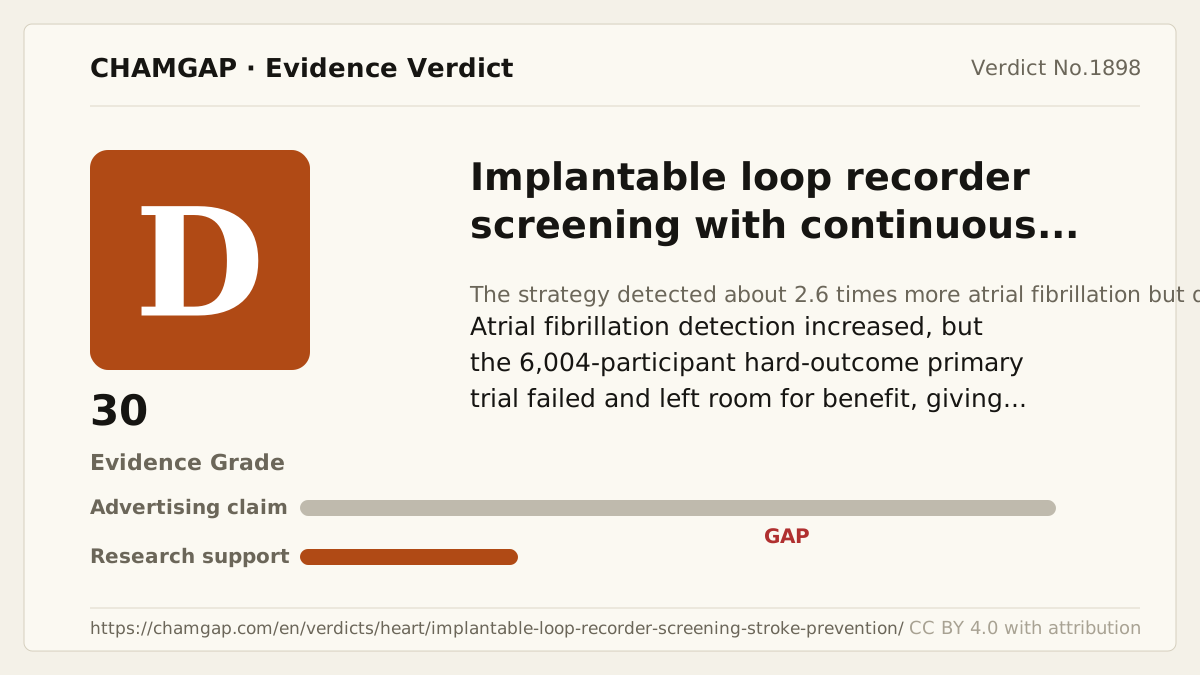
[Chamgap] Implantable loop recorder screening x stroke prevention — Evidence Grade D·34. 2 cited sources checked. Source: https://chamgap.com/en/verdicts/heart/implantable-loop-recorder-screening-stroke-prevention/ · CC BY 4.0CC BY 4.0 — free to use with attribution; do not distort grades, numbers, or verdict meaning.
What this document does and does not do
Chamgap is an information source. It reports what research has and has not confirmed; it does not tell readers what to take or buy. That decision belongs to readers and, when needed, medical or legal professionals. This verdict reflects literature available up to the search date and may change as new research appears. Nothing here is medical advice.