
Implantable cardioverter-defibrillator,
does it really help with Reduced all-cause mortality in patients at least 40 days after myocardial infarction with LVEF of 30% or less?
research showsAn implantable cardioverter-defibrillator is rated A for reducing all-cause mortality in selected patients at least 40 days after myocardial infarction with a left ventricular ejection fraction of 30% or less. MADIT-II randomized 1,232 patients and reduced mortality over a mean of 20 months from 19.8% with conventional therapy to 14.2% with an ICD (HR 0.69, 95% CI 0.51 to 0.93). SCD-HeFT in a broader low-LVEF heart-failure population and meta-analyses of 10 to 11 primary-prevention trials independently reinforce the mortality benefit. Current guidance, however, uses at least 40 days after myocardial infarction and also requires guideline-directed medical therapy and a reasonable expectation of meaningful survival beyond one year, so the finding does not automatically apply to every patient just 40 days after infarction. Infection, lead or device complications, inappropriate shocks, and psychological burden remain separate safety issues.
ads claimAn ICD does not normalize the heart or treat progression of heart failure; it detects and terminates lethal ventricular arrhythmias to prevent sudden death. Saying that everyone with a low ejection fraction lives longer once 40 days have passed omits the current 40-day threshold, optimization of medical therapy, functional status, comorbidity, life expectancy, and patient preferences.
Useful facts when choosing a product
- An ICD is implanted under the skin and continuously monitors rhythm, delivering antitachycardia pacing or a shock for dangerous ventricular tachycardia or fibrillation.
- Primary-prevention assessment usually waits at least 40 days after myocardial infarction, reassesses LVEF after guideline-directed heart-failure therapy, and considers whether meaningful survival beyond one year is expected.
- An ICD does not replace heart-failure medication, coronary disease treatment, or lifestyle management and requires battery replacement, device checks, and remote monitoring.
- Pocket infection, bleeding, pneumothorax, lead failure or displacement, inappropriate shocks, pain, anxiety, and driving or occupational restrictions can occur and belong in shared decision making.
Chamgap Semantic Classification Code
Candidate index · review held
P.implantable-cardioverter-defibrillator.device.all-cause-mortality-at-least-after-myocardial-infarction-with-lvef-of-30-percent-or-less.reduce.MULTIProcedures, devices and tests > Implantable cardioverter-defibrillator > Device delivered > all-cause mortality at least after myocardial infarction with LVEF of 30% or less > Reduction claim > Multiple: primary unresolved
An automated migration candidate, not an issued permanent code; exact claim scope remains under review. This machine-generated migration candidate helps retrieval but is not a permanent assignment. The original verdict ID and URL remain authoritative.
What the research actually shows
Moss and colleagues randomized 1,232 patients with prior myocardial infarction and LVEF of 30% or less in MADIT-II, 742 to an ICD and 490 to conventional therapy. At a mean of 20 months, mortality was 14.2% versus 19.8%, with HR 0.69. Greenberg and colleagues found that sudden cardiac death fell to 3.8% from 10.0%, HR 0.33, while nonsudden death did not significantly change. Bardy and colleagues randomized 2,521 patients with stable NYHA class II or III heart failure and LVEF of 35% or less in SCD-HeFT; the ICD reduced mortality by 23% relatively and 7.2 percentage points absolutely at five years, providing reinforcement that included ischemic disease. A meta-analysis of 11 trials and 8,567 patients estimated an all-cause mortality HR of 0.76 in ischemic heart disease. The 2022 AHA/ACC/HFSA guideline recommends an ICD to reduce total mortality for appropriately treated NYHA class I patients at least 40 days after myocardial infarction with LVEF of 30% or less and expected meaningful survival beyond one year.
Why this is classified as A (90)
MADIT-II directly reduced all-cause mortality from 19.8% to 14.2%, HR 0.69, in selected patients with prior myocardial infarction and LVEF of 30% or less. SCD-HeFT and meta-analyses of multiple primary-prevention trials showed consistent benefit in related low-LVEF populations. Randomized attribution to the device, a hard mortality endpoint, and guideline convergence support A with 90 points. The null early-post-infarction DINAMIT result restricts application to at least 40 days, while device complications remain separate safety concerns.
Counterpoint. Even eligible patients should discuss competing nonarrhythmic mortality, infection risk, values concerning shocks, and plans for deactivation near the end of life. Declining implantation or later deactivation can be reasonable when aligned with patient goals.
Rejudgment record. New verdict — Centered the verdict on the direct all-cause mortality reduction and clear randomized attribution to ICD therapy in MADIT-II, confirmed independent reinforcement from SCD-HeFT, multiple primary-prevention trial meta-analyses, and AHA/ACC/HFSA guidance, and restricted application to at least 40 days because DINAMIT was null in the early post-infarction period
Sub-claim grades by effect
This ingredient is marketed for several effects. A single overall grade blends strong and weak claims together, so each effect is graded separately here. The overall grade reflects the strongest disconfirming or core claim.
| Effect (sub-claim) | Grade | Basis |
|---|---|---|
| Reduced all-cause mortality in selected post-infarction patients with LVEF of 30% or less | A | MADIT-II was positive on a direct hard endpoint and SCD-HeFT plus multi-trial meta-analyses reinforce it. The separate 6-to-40-day acute period was null, so current application begins at least 40 days after infarction. |
| Reduced sudden cardiac death | A | The MADIT-II mode-of-death analysis found a reduction from 10.0% to 3.8%, HR 0.33, and lower tachyarrhythmic mortality in SCD-HeFT supports the same mechanism. |
| Reduced all-cause mortality within 40 days after myocardial infarction | D | The independent large DINAMIT trial found no all-cause mortality benefit, so stable-phase primary-prevention evidence cannot be extended to the acute period. Infection and inappropriate shocks remain separate safety issues. |
Cross-check — AI research and Codex final gate
Evidence Table
| Study | Design | Sample | Funding | Endpoint | Result | Weight |
|---|---|---|---|---|---|---|
| Moss AJ et al. 2002 MADIT-II | Multicenter randomized device trial versus conventional therapy | 1,232 patients with prior myocardial infarction and LVEF of 30% or less; 742 ICD and 490 control | Supported by Guidant Corporation | Death from any cause | At a mean of 20 months, mortality was 14.2% versus 19.8%, HR 0.69 (95% CI 0.51 to 0.93; P=0.016). | Core hard-endpoint trial matching the claim |
| Bardy GH et al. 2005 SCD-HeFT | Multicenter randomized placebo- and amiodarone-controlled primary-prevention trial | 2,521 patients with NYHA class II or III heart failure and LVEF of 35% or less; 52% ischemic | Led by the United States NHLBI with support including Medtronic and Wyeth-Ayerst | Death from any cause | The ICD reduced relative mortality by 23% and absolute five-year mortality by 7.2 percentage points versus placebo. | Independent large supportive trial in a related population |
| Shun-Shin MJ et al. 2017 | Systematic review and meta-analysis of 11 primary-prevention randomized trials | 8,567 patients with left ventricular dysfunction; 5,439 with ischemic heart disease | Academic study; authors disclosed relevant industry research and consulting relationships | All-cause mortality | In ischemic heart disease, the all-cause mortality HR with an ICD was 0.76 (95% CI 0.60 to 0.96). | Multi-trial consistency check |
| Heidenreich PA et al. 2022 AHA/ACC/HFSA guideline | Evidence-based heart-failure clinical practice guideline | Full randomized evidence base for heart-failure drugs and devices | AHA, ACC, and HFSA professional societies | Post-infarction ICD selection and reduction in total mortality | Recommends an ICD at least 40 days after myocardial infarction for LVEF of 30% or less, NYHA class I, guideline-directed therapy, and expected meaningful survival beyond one year. | Scope and consensus confirmation |
| Hohnloser SH et al. DINAMIT | Randomized controlled trial of an ICD versus medical therapy 6 to 40 days after myocardial infarction | 674 participants | Detailed funding information was not reported in the PubMed abstract | All-cause mortality | There was no all-cause mortality benefit, HR 1.08 (95% CI 0.76 to 1.55; P=0.66). Fewer arrhythmic deaths were offset by more nonarrhythmic deaths. | Direct null randomized evidence defining the early post-infarction boundary |
Receipt — 7 References
All 7 cited sources were verified for existence at the original page (as of 2026-07-24).
Final verification and publication gate: Codex · Evidence date: 2026-07-24 · Corrections: none
Cite this verdict
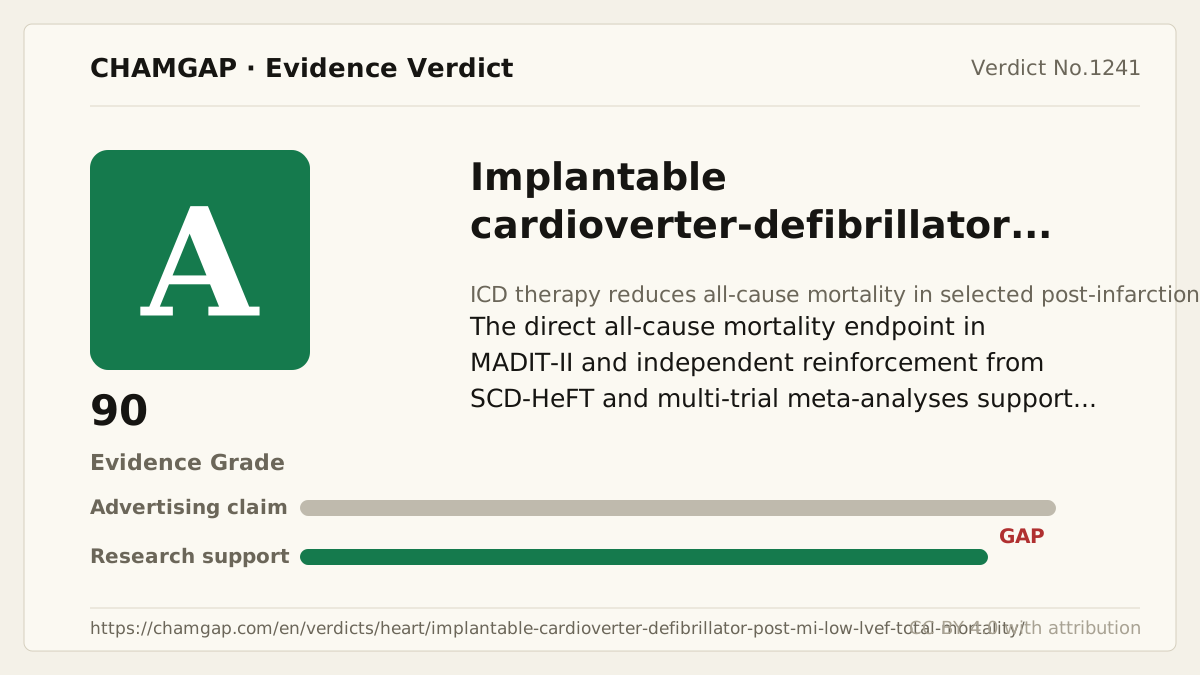
[Chamgap] Implantable cardioverter-defibrillator x reduced all-cause mortality after myocardial infarction with low LVEF — Evidence Grade A·90. 7 cited sources checked. Source: https://chamgap.com/en/verdicts/heart/implantable-cardioverter-defibrillator-post-mi-low-lvef-total-mortality/ · CC BY 4.0CC BY 4.0 — free to use with attribution; do not distort grades, numbers, or verdict meaning.
What this document does and does not do
Chamgap is an information source. It reports what research has and has not confirmed; it does not tell readers what to take or buy. That decision belongs to readers and, when needed, medical or legal professionals. This verdict reflects literature available up to the search date and may change as new research appears. Nothing here is medical advice.