
Hydralazine/isosorbide dinitrate,
does it really help with Reduced all-cause mortality and heart-failure hospitalization in Black patients with severe HFrEF receiving standard therapy?
research showsFixed-dose hydralazine/isosorbide dinitrate is rated B with 72 points: it reduced all-cause mortality and first heart-failure hospitalization in Black patients with severe HFrEF receiving standard therapy, but the evidence rests on a single trial. A-HeFT randomized 1,050 participants to placebo or the fixed combination and stopped early after mortality was 6.2% versus 10.2%, a 43% relative reduction with hazard ratio 0.57. First heart-failure hospitalization was 16.4% versus 22.4%, a 33% relative reduction. Because the only cited trial is the NitroMed-funded A-HeFT (the second citation is a practice guideline, not a new trial) and no replication by different investigators with different funding has been confirmed, axis 2 is R1 and the grade is capped at B.
ads claimCalling it an essential mortality drug for every patient with heart failure exceeds the evidence. The direct B evidence concerns symptomatic severe HFrEF in Black patients despite standard therapy, and it does not replace foundational ARNI, beta-blocker, MRA, or SGLT2-inhibitor treatment.
Useful facts when choosing a product
- Each BiDil tablet contains isosorbide dinitrate 20 mg and hydralazine hydrochloride 37.5 mg; prescription dosing is generally titrated from a lower dose toward three-times-daily administration.
- It is added to standard HFrEF therapy and should not be used to replace or stop foundational guideline-directed treatment without clinical direction.
- Headache, dizziness, tachycardia, hypotension, and nausea are common, and hydralazine can cause a lupus-like syndrome.
- Combining a nitrate with a PDE5 inhibitor or riociguat can cause severe hypotension and is contraindicated; this fixed heart-failure combination is distinct from nitroglycerin for angina.
Chamgap Semantic Classification Code
Candidate index · review held
M.hydralazine-isosorbide-dinitrate.UNK.all-cause-mortality-and-heart-failure-hospitalization-in-black-patients-with-severe-hfref-receiving-standard-therapy.reduce.MULTIMedicinal interventions > Hydralazine/isosorbide dinitrate > Unknown > all-cause mortality and heart-failure hospitalization in Black patients with severe HFrEF receiving standard therapy > Reduction claim > Multiple: primary unresolved
An automated migration candidate, not an issued permanent code; exact claim scope remains under review. This machine-generated migration candidate helps retrieval but is not a permanent assignment. The original verdict ID and URL remain authoritative.
What the research actually shows
Taylor and colleagues randomized 1,050 Black patients with NYHA class III to IV heart failure to fixed-dose isosorbide dinitrate/hydralazine or placebo in addition to standard therapy. All-cause mortality was 6.2% versus 10.2% (HR 0.57), and first heart-failure hospitalization was 16.4% versus 22.4%; the trial stopped early for the mortality difference. The 2022 AHA/ACC/HFSA guideline recommends this combination to improve symptoms and reduce morbidity and mortality in self-identified Black patients with NYHA class III to IV HFrEF receiving optimal therapy.
Why this is classified as B (72)
A-HeFT was a 1,050-participant placebo-controlled randomized trial showing all-cause mortality HR 0.57 and a 33% relative reduction in first heart-failure hospitalization attributable to the fixed combination. However, it is the only cited trial, and no replication by different investigators with different funding has been confirmed, so axis 2 is R1 and the grade is capped at B with 72 points. The VA-funded V-HeFT I showed the same direction in general HFrEF (two-year mortality 25.6% versus 34.3%, P<0.028), but its Black-patient benefit is a post-hoc subgroup analysis. Manufacturer funding stands, yet under the prescription-drug large hard-endpoint RCT exception the axis 3 cap is not applied; hypotension and lupus-like reactions are separate safety issues.
Counterpoint. Use should match the directly studied and guideline population: self-identified Black patients with NYHA class III to IV HFrEF receiving optimized foundational therapy.
Rejudgment record. New verdict — Centered the assessment on the drug-specific placebo-controlled all-cause mortality and first heart-failure hospitalization endpoints in A-HeFT, but because A-HeFT is the only cited trial and replication by different investigators with different funding has not been confirmed, applied the axis 2 R1 cap of B (the axis 3 cap is waived under the prescription-drug large hard-endpoint RCT exception)
| Endpoint | H | Hard endpoint - actual events such as death |
| Replication | R1 | Single confirmatory trial |
| Independence | I0 | Evidence comes only from manufacturer studies |
| Effect size | E+ | Meets the clinically important threshold |
Stored derived and displayed grades match; this is not a current recalculation or validity check (B).
Sub-claim grades by effect
This ingredient is marketed for several effects. A single overall grade blends strong and weak claims together, so each effect is graded separately here. The overall grade reflects the strongest disconfirming or core claim.
| Effect (sub-claim) | Grade | Basis |
|---|---|---|
| Reduced all-cause mortality | A | A-HeFT found 6.2% versus 10.2%, HR 0.57, a 43% relative reduction. |
| Reduced first heart-failure hospitalization | A | It fell from 22.4% to 16.4%, a 33% relative reduction. |
| Improved quality of life | B | The quality-of-life component of the A-HeFT composite also improved versus placebo. |
Cross-check — AI research and Codex final gate
Evidence Table
| Study | Design | Sample | Funding | Endpoint | Result | Weight |
|---|---|---|---|---|---|---|
| Taylor AL et al. 2004 A-HeFT | Multicenter randomized double-blind placebo-controlled trial | 1,050 self-identified Black patients with NYHA class III to IV heart failure | NitroMed and academic investigators | All-cause death, first heart-failure hospitalization, and quality-of-life composite | Mortality 6.2% versus 10.2%, HR 0.57; first hospitalization 16.4% versus 22.4%, a 33% relative reduction. | Drug-specific large hard mortality endpoint |
| Heidenreich PA et al. 2022 AHA/ACC/HFSA guideline | Systematic evidence review and clinical practice guideline | Randomized HFrEF evidence | AHA, ACC, and HFSA | Symptoms, morbidity, and mortality | Recommends the combination in self-identified Black patients with NYHA class III to IV HFrEF receiving optimal therapy. | Applicability and standard-treatment context |
Receipt — 2 References
All 2 cited sources were verified for existence at the original page (as of 2026-08-11).
Final verification and publication gate: Codex · Evidence date: 2026-08-11 · Corrections: 1
Correction log — 1
Corrections applied to this verdict, in chronological order. Changes are logged, not erased.
- 2026-08-11 · Grade correction for unmet independent-replication requirement — Of the cited evidence, the only clinical trial was the NitroMed-funded A-HeFT (NCT00047775); the second citation is the 2022 AHA/ACC/HFSA practice guideline, not a new trial. Chamgap's A requires axis 2 R2 (multiple RCTs by different investigators with different funding), and no independent RCT has retested this combination in Black patients with severe HFrEF — the VA-funded V-HeFT I (general HFrEF, two-year mortality 25.6% versus 34.3%, P<0.028) showed the same direction, but its Black-patient benefit is a post-hoc subgroup analysis. Axis 2 is R1, capping the grade at B. The axes were recorded as B·H·R1·I0·E+·B1 (the axis 3 cap waived under the prescription-drug large hard-endpoint RCT exception) and 72 points were assigned. The effect itself (all-cause mortality 6.2% versus 10.2%, HR 0.57; first heart-failure hospitalization 16.4% versus 22.4%) is not disputed. Confirmed in the 2026-08-11 internal audit (workflow verification plus concurring Codex cross-check). (grade A→B)
Cite this verdict
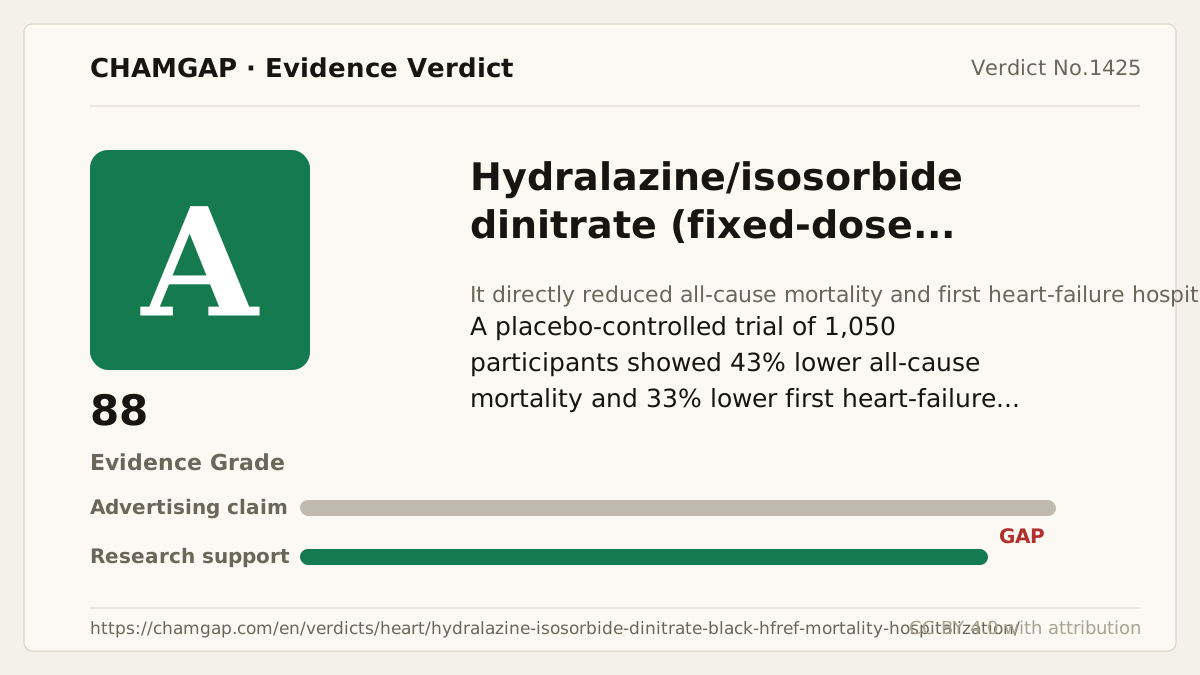
[Chamgap] Hydralazine/isosorbide dinitrate x lower mortality and hospitalization in Black patients with severe HFrEF — Evidence Grade B·72. 2 cited sources checked. Source: https://chamgap.com/en/verdicts/heart/hydralazine-isosorbide-dinitrate-black-hfref-mortality-hospitalization/ · CC BY 4.0CC BY 4.0 — free to use with attribution; do not distort grades, numbers, or verdict meaning.
What this document does and does not do
Chamgap is an information source. It reports what research has and has not confirmed; it does not tell readers what to take or buy. That decision belongs to readers and, when needed, medical or legal professionals. This verdict reflects literature available up to the search date and may change as new research appears. Nothing here is medical advice.