
Household HEPA air purifier,
does it really help with Lower systolic blood pressure?
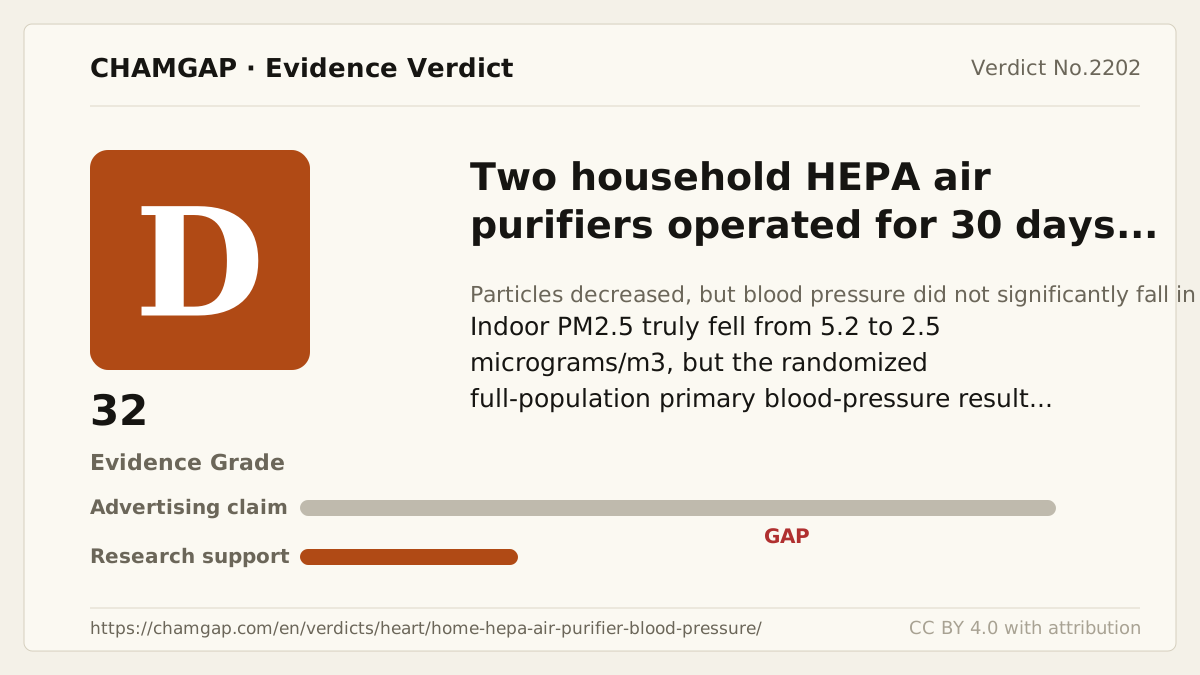
research showsThe grade is D with 28 points. A sham-controlled crossover trial randomized 156 participants and analyzed 154 after two postrandomization medication-history exclusions. The full-population co-primary blood-pressure result was 117.7 mmHg with HEPA versus 118.2 mmHg with sham, adjusted difference -0.5 mmHg (95% CI -2.4 to 1.3; P=0.56). Only the subgroup starting at 120 mmHg or above showed -3.0 mmHg (-6.0 to -0.1), which cannot establish benefit for everyone.
ads claimRemoving particles and lowering every user's blood pressure are different claims. Sham-period indoor PM2.5 was already only 5.2 micrograms/m3, so the result cannot be assumed to apply to high-pollution episodes in Korea.
Useful facts when choosing a product
- Directly measured 24-hour mean PM2.5 was 3.9 outdoors, 5.2 indoors with sham, and 2.5 micrograms/m3 indoors with HEPA.
- Sham units were the same devices with filters removed; runtime was about 99% in 45 monitored homes.
- Verdict 1758 is D with 35 points and evaluates allergic-rhinitis symptoms rather than blood pressure.
Chamgap Semantic Classification Code
Candidate index · review held
UNK.two-household-hepa-air-purifiers-operated.UNK.systolic-blood-pressure.reduce.shamUnknown > Two household HEPA air purifiers operated > Unknown > Systolic blood pressure > Reduction claim > Sham procedure or device
An automated migration candidate, not an issued permanent code; exact claim scope remains under review. This machine-generated migration candidate helps retrieval but is not a permanent assignment. The original verdict ID and URL remain authoritative.
What the research actually shows
HAFTRAP randomized 156 people in 108 near-highway homes to 30 days of HEPA and 30 days of sham filtration. The sham used the same device with its filter removed, and participants and outcome assessors were masked. Two antihypertensive-medication users were excluded after randomization, leaving 154 in the analysis; period-specific pressure data were available for 153 HEPA and 152 sham observations. Runtime was about 99% in 45 monitored homes. NCT04279249 was registered before study start and listed one-month change in systolic blood pressure and hsCRP as co-primary outcomes. NIEHS and UConn funded the work; Austin Air custom-modified and discounted the devices but reportedly had no role in design, conduct, or analysis. Verdict 1758 is D with 35 points and addresses allergic-rhinitis symptoms, a different endpoint.
Why this is classified as D (28)
The co-primary systolic-pressure outcome was null in the full population, leaving only a short surrogate-outcome subgroup signal, giving D with 28 points.
Counterpoint. D does not deny particle removal. It grades the claim that filtration lowers blood pressure for users generally at already low concentrations.
Rejudgment record. Cross-check applied — Accepted the measured particle reduction but prioritized the null co-primary systolic-pressure result in the full randomized population over a favorable subgroup
| Endpoint | S | Surrogate marker - laboratory or imaging measures |
| Replication | R1 | Single confirmatory trial |
| Independence | I1 | Mixed funding sources |
| Effect size | E0 | Null |
| Precision | C0 | The confidence interval leaves room for benefit |
Stored derived and displayed grades match; this is not a current recalculation or validity check (D).
Sub-claim grades by effect
This ingredient is marketed for several effects. A single overall grade blends strong and weak claims together, so each effect is graded separately here. The overall grade reflects the strongest disconfirming or core claim.
| Effect (sub-claim) | Grade | Basis |
|---|---|---|
| Lower systolic pressure in the full population | D | The overall adjusted difference was -0.5 mmHg and the 95% confidence interval included zero. |
| Lower pressure among participants starting at 120 mmHg or above | C | The subgroup difference was -3.0 mmHg but requires independent replication. |
Cross-check — AI research and Codex final gate
Evidence Table
| Study | Design | Sample | Funding | Endpoint | Result | Weight |
|---|---|---|---|---|---|---|
| Brugge D et al. 2025 HAFTRAP | Sham-controlled randomized crossover trial | 156 randomized; 2 excluded after randomization; 154 analyzed | NIEHS and UConn funding; Austin Air customized and discounted devices | Blood-pressure component of co-primary change in systolic pressure and hsCRP | Overall systolic difference -0.5 mmHg (95% CI -2.4 to 1.3; P=0.56); subgroup starting at 120 mmHg or above -3.0 (-6.0 to -0.1). | Largest recent direct trial with null full-population primary result |
Receipt — 3 References
All 3 cited sources were verified for existence at the original page (as of 2026-08-04).
Final verification and publication gate: Codex · Evidence date: 2026-08-04 · Corrections: none
Cite this verdict
[Chamgap] Household HEPA air purifier x lower blood pressure — Evidence Grade D·28. 3 cited sources checked. Source: https://chamgap.com/en/verdicts/heart/home-hepa-air-purifier-blood-pressure/ · CC BY 4.0CC BY 4.0 — free to use with attribution; do not distort grades, numbers, or verdict meaning.
What this document does and does not do
Chamgap is an information source. It reports what research has and has not confirmed; it does not tell readers what to take or buy. That decision belongs to readers and, when needed, medical or legal professionals. This verdict reflects literature available up to the search date and may change as new research appears. Nothing here is medical advice.