
Home blood-pressure monitoring and telemonitoring,
does it really help with Improved blood-pressure control in treated hypertension?
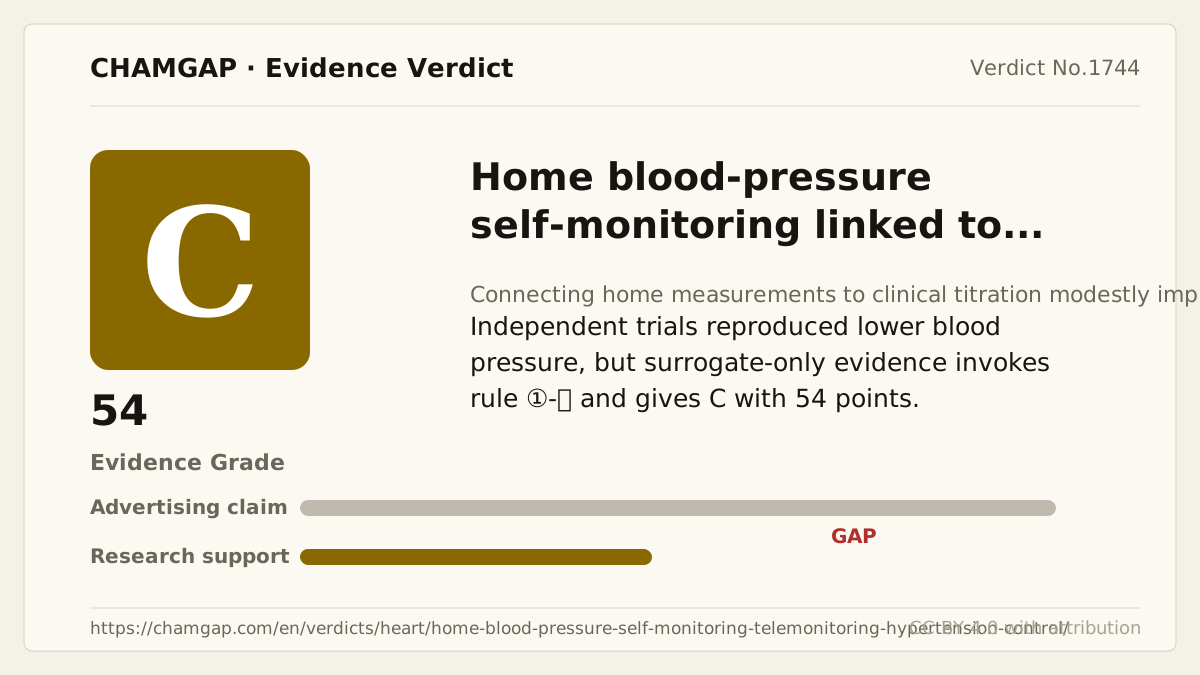
research showsHome monitoring linked to medication titration improves a blood-pressure surrogate but is rated C. TASMINH4 assigned 1,182 participants and analyzed 1,003, finding -3.5 mm Hg (95% CI -5.8 to -1.2) with self-monitoring and -4.7 mm Hg (-7.0 to -2.4) with telemonitoring. There is no direct hard-endpoint evidence of fewer myocardial infarctions, strokes, or deaths, and the investigators stated that the trial was not powered for cardiovascular outcomes. Surrogate-only rule ①-ⓐ therefore caps the grade at C with 54 points.
ads claimMarketing can claim that an app or monitor itself prevents stroke. The evidence shows that a program connected to clinical medication titration modestly lowers a blood-pressure measurement.
Useful facts when choosing a product
- Use a validated upper-arm monitor and repeat readings at consistent times after five minutes of rest.
- Do not change doses because of one high reading; follow thresholds agreed with a clinician.
- Digital access, skills, and data-sharing infrastructure affect effectiveness and equity.
Chamgap Semantic Classification Code
Candidate index · review held
UNK.home-blood-pressure-self-monitoring-linked-to-clinical-care-and-telemonitoring.UNK.blood-pressure-control-in-treated-hypertension.improve.usual-careUnknown > Home blood-pressure self-monitoring linked to clinical care and telemonitoring > Unknown > blood-pressure control in treated hypertension > Improvement claim > Usual care
An automated migration candidate, not an issued permanent code; exact claim scope remains under review. This machine-generated migration candidate helps retrieval but is not a permanent assignment. The original verdict ID and URL remain authoritative.
What the research actually shows
TASMINH4 (McManus 2018, Lancet) assigned 1,182 participants and included 1,003 in the actual 12-month primary analysis. Clinic systolic pressure improved by -3.5 mm Hg (95% CI -5.8 to -1.2) with self-monitoring and -4.7 mm Hg (-7.0 to -2.4) with telemonitoring. HOME BP replicated a blood-pressure reduction. There is no direct hard-endpoint evidence of fewer myocardial infarctions, strokes, or deaths, and the TASMINH4 investigators explicitly stated that the study was not powered to detect cardiovascular outcomes.
Why this is classified as C (54)
Primary endpoints succeeded in two independent randomized trials, but they measured only a blood-pressure surrogate. Rule ①-ⓐ caps the grade at C, with effect size and implementation dependence giving 54 points.
Counterpoint. When linked to structured titration, home monitoring can modestly improve control over usual care.
Rejudgment record. Cross-check applied — Successful 12-month systolic-pressure primary endpoints in independent randomized trials, with rule ①-ⓐ limiting the grade to C because only a blood-pressure surrogate improved and no direct clinical-event benefit was tested
Sub-claim grades by effect
This ingredient is marketed for several effects. A single overall grade blends strong and weak claims together, so each effect is graded separately here. The overall grade reflects the strongest disconfirming or core claim.
| Effect (sub-claim) | Grade | Basis |
|---|---|---|
| Reduced systolic pressure with linked self-monitoring | C | The TASMINH4 primary endpoint succeeded with a -3.5 mm Hg difference. |
| Reduced systolic pressure with telemonitoring | C | The TASMINH4 primary endpoint succeeded with a -4.7 mm Hg difference. |
| Improved control with digitally linked care | C | HOME BP independently replicated the effect, but only on a surrogate. |
Cross-check — AI research and Codex final gate
Evidence Table
| Study | Design | Sample | Funding | Endpoint | Result | Weight |
|---|---|---|---|---|---|---|
| McManus RJ et al. 2018 TASMINH4 | Unmasked three-group randomized controlled trial | 1,182 randomized; 1,003 in the actual primary analysis | United Kingdom NIHR public funding; Omron Healthcare UK provided monitors through an unrestricted grant | Primary endpoint of 12-month clinic systolic blood pressure | Primary endpoint succeeded: -3.5 mm Hg for self-monitoring and -4.7 mm Hg for telemonitoring versus usual care. | Pivotal surrogate-endpoint randomized trial |
| McManus RJ et al. 2021 HOME BP | Unmasked randomized trial with automated primary-endpoint ascertainment | 622 randomized; primary analysis used observed data from 552 and multiple imputation for 70 missing participants | Public funding from the United Kingdom NIHR Programme Grants for Applied Research; not manufacturer led | Primary endpoint of 12-month systolic blood pressure | Primary endpoint succeeded: adjusted between-group difference -3.4 mm Hg (95% CI -6.1 to -0.8). | Independent surrogate-endpoint replication |
Receipt — 2 References
All 2 cited sources were verified for existence at the original page (as of 2026-07-24).
Final verification and publication gate: Codex · Evidence date: 2026-07-24 · Corrections: none
Cite this verdict
[Chamgap] Home blood-pressure monitoring and telemonitoring x improved hypertension control — Evidence Grade C·54. 2 cited sources checked. Source: https://chamgap.com/en/verdicts/heart/home-blood-pressure-self-monitoring-telemonitoring-hypertension-control/ · CC BY 4.0CC BY 4.0 — free to use with attribution; do not distort grades, numbers, or verdict meaning.
What this document does and does not do
Chamgap is an information source. It reports what research has and has not confirmed; it does not tell readers what to take or buy. That decision belongs to readers and, when needed, medical or legal professionals. This verdict reflects literature available up to the search date and may change as new research appears. Nothing here is medical advice.