
Home blood-pressure self-monitoring and self-titration,
does it really help with Reduced office systolic blood pressure in high-risk hypertension?
research showsThe grade is C. TASMIN-SR excluded three erroneous registrations, leaving 552 participants, and analyzed complete 12-month data from 450. Systolic pressure was 128.2 versus 137.8 mm Hg, adjusted difference -9.2 mm Hg (95% CI -12.7 to -5.7). This exceeded the prespecified 5-mm Hg detectable difference, but blood pressure is a surrogate and 18.5% lacked complete 12-month data, giving C with 54 points.
ads claimThis was not a trial of handing out a monitor alone. Participants measured on a schedule and implemented stepwise medication changes agreed with their clinician in advance.
Useful facts when choosing a product
- The intervention combined home monitoring with prespecified medication self-titration.
- Usual care allowed clinicians to adjust treatment when needed.
- Disclosed equipment support for other research was not shown to be trial-product supply in TASMIN-SR.
Chamgap Semantic Classification Code
Candidate index · review held
UNK.home-blood-pressure-self-monitoring-with-prespecified-medication-self-titration.UNK.office-systolic-blood-pressure-in-high-risk-hypertension.reduce.UNKUnknown > Home blood-pressure self-monitoring with prespecified medication self-titration > Unknown > office systolic blood pressure in high-risk hypertension > Reduction claim > Unknown
An automated migration candidate, not an issued permanent code; exact claim scope remains under review. This machine-generated migration candidate helps retrieval but is not a permanent assignment. The original verdict ID and URL remain authoritative.
What the research actually shows
Fifty-nine UK primary-care practices enrolled 555 people; three erroneous registrations were removed immediately, leaving 552. Treatment was unmasked, but the primary outcome was office pressure measured with an automated device. Only 450 had complete 12-month data, so missingness above 15% is one design limitation. No early stopping was reported. Funding came from NIHR Programme Grants for Applied Research, the NIHR National School of Primary Care Research, and an NIHR career development fellowship. Author disclosures included research equipment received from Omron, Lloyds Healthcare, Microlife, and BP TRU, but the article did not establish that those items were supplied for use in TASMIN-SR, so they were not counted as trial-material support.
Why this is classified as C (54)
The pressure difference exceeded the prespecified detectable difference and public funding was confirmed, but a surrogate endpoint, one trial, and 18.5% missing complete data give C with 54 points.
Counterpoint. Self-titration should be interpreted only with training, safety rules, and a clinician-approved medication plan.
Rejudgment record. Cross-check applied — Cross-checked the main article and protocol for the 552-person analysis set, 450 complete cases, multiple imputation, 5-mm Hg design assumption, NIHR funding, and author disclosures
| Endpoint | S | Surrogate marker - laboratory or imaging measures |
| Replication | R1 | Single confirmatory trial |
| Independence | I2 | Decisive evidence is publicly or non-profit funded |
| Effect size | E+ | Meets the clinically important threshold |
Stored derived and displayed grades match; this is not a current recalculation or validity check (C).
Sub-claim grades by effect
This ingredient is marketed for several effects. A single overall grade blends strong and weak claims together, so each effect is graded separately here. The overall grade reflects the strongest disconfirming or core claim.
| Effect (sub-claim) | Grade | Basis |
|---|---|---|
| Reduced systolic blood pressure at 12 months | C | The adjusted difference was -9.2 mm Hg. |
| Reduced cardiovascular events | ? | The trial was not designed to test reduction in clinical events. |
Cross-check — AI research and Codex final gate
Evidence Table
| Study | Design | Sample | Funding | Endpoint | Result | Weight |
|---|---|---|---|---|---|---|
| McManus RJ et al. 2014 TASMIN-SR | Open randomized trial in 59 UK primary-care practices | 555 enrolled; three erroneous registrations removed; 552 analyzed population; 450 with complete 12-month data | NIHR Programme Grants for Applied Research, NIHR National School of Primary Care Research, and an NIHR career development fellowship | Office systolic blood pressure at 12 months | 128.2 versus 137.8 mm Hg, baseline-adjusted difference -9.2 mm Hg (95% CI -12.7 to -5.7); multiple-imputation difference -8.8 mm Hg | Single publicly funded surrogate-endpoint trial with 18.5% incomplete primary data |
Receipt — 2 References
All 2 cited sources were verified for existence at the original page (as of 2026-08-18).
Final verification and publication gate: Codex · Evidence date: 2026-08-18 · Corrections: none
Cite this verdict
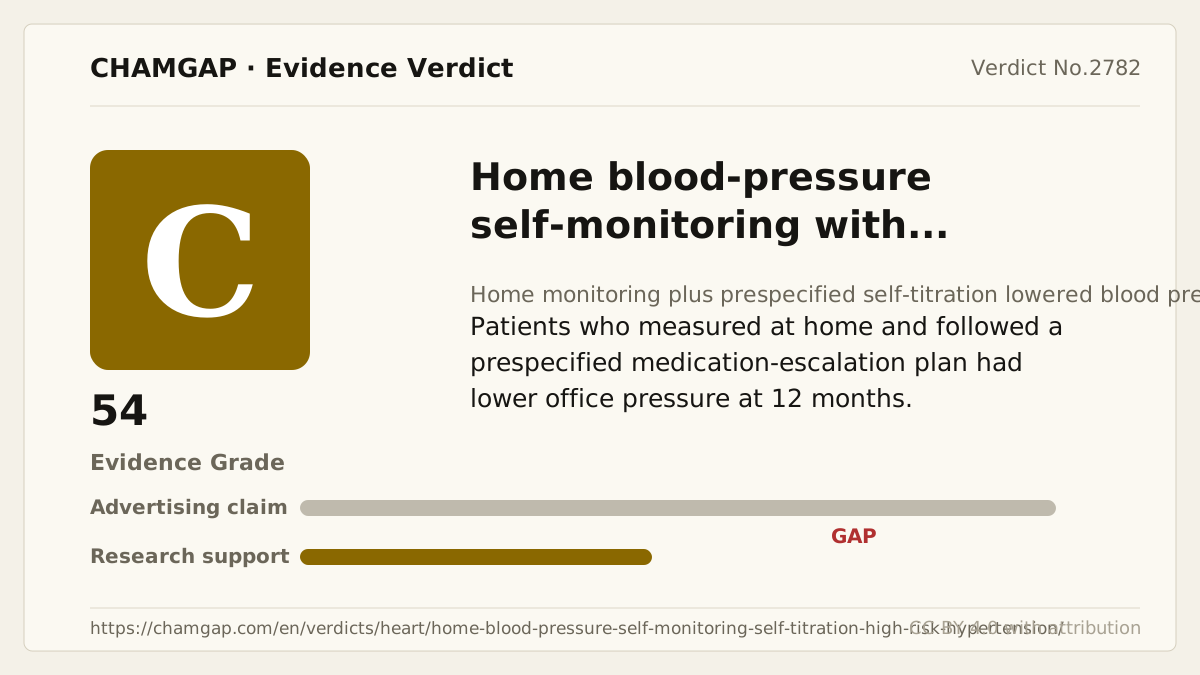
[Chamgap] Home blood-pressure self-monitoring and self-titration x high-risk hypertension — Evidence Grade C·54. 2 cited sources checked. Source: https://chamgap.com/en/verdicts/heart/home-blood-pressure-self-monitoring-self-titration-high-risk-hypertension/ · CC BY 4.0CC BY 4.0 — free to use with attribution; do not distort grades, numbers, or verdict meaning.
What this document does and does not do
Chamgap is an information source. It reports what research has and has not confirmed; it does not tell readers what to take or buy. That decision belongs to readers and, when needed, medical or legal professionals. This verdict reflects literature available up to the search date and may change as new research appears. Nothing here is medical advice.