
Hibiscus tea,
does it really help with Improvement in LDL, total cholesterol, triglycerides, and other blood lipids?
research showsThe grade is C. Three trials of brewed tea pointed in different directions, but none reported confidence intervals for between-group change. The meta-analysis combined brewed tea with capsules and powders and provided no brewed-tea-only pooled effect, so clinical magnitude for the beverage cannot be calculated.
ads claimPure hibiscus calyx is not Camellia sinensis and is not inherently a caffeine source, but that composition fact does not prove cholesterol lowering. Trial-product caffeine was not measured. Verdict 169 is C with 58 points for blood pressure, a different indication.
Useful facts when choosing a product
- The 2011 regimen prepared a two-glass portion twice daily, but glass volume was not reported.
- Pure hibiscus calyx is not a tea-leaf ingredient; trial-product caffeine was not measured.
- The paper states 15 mg, about two spoons; a unit error is plausible, so no precise dose conversion was made.
Chamgap Semantic Classification Code
Candidate index · review held
F.hibiscus-tea-brewed-from-hibiscus-sabdariffa-calyces.food.ldl-total-cholesterol-triglycerides-and-other-blood-lipids.improve.MULTIFoods and beverages > Hibiscus tea brewed from Hibiscus sabdariffa calyces > Food consumption > LDL, total cholesterol, triglycerides, and other blood lipids > Improvement claim > Multiple: primary unresolved
An automated migration candidate, not an issued permanent code; exact claim scope remains under review. This machine-generated migration candidate helps retrieval but is not a permanent assignment. The original verdict ID and URL remain authoritative.
What the research actually shows
There were three brewed-tea trials. Mozaffari-Khosravi 2009 used black tea as an active control, and Mohagheghi 2011 also used black tea. Hajifaraji 2018 centered lifestyle guidance in both groups and lacked an adequate placebo tea, which the paper acknowledged as a limitation. All trials had fewer than 200 participants. The 2011 article literally states "15 mg, about two spoons," but a unit error is plausible, so no precise dose conversion was made from that value.
Why this is classified as C (50)
Only surrogate markers were measured, three brewed-tea trials differed in direction, and all omitted confidence intervals for between-group change. With no brewed-tea-only pooled magnitude, clinical size cannot be classified; small samples and comparator defects yield C with 50 points.
Counterpoint. This verdict does not merge blood-pressure claims or extract capsules with brewed hibiscus tea lipid effects.
Rejudgment record. Cross-check applied — Mixed-formulation estimates were separated from brewed-tea evidence, and missing between-group change intervals were identified
| Endpoint | S | Surrogate marker - laboratory or imaging measures |
| Replication | R1 | Single confirmatory trial |
| Independence | I2 | Decisive evidence is publicly or non-profit funded |
| Effect size | EX | The clinical size of the effect could not be judged |
Stored derived and displayed grades match; this is not a current recalculation or validity check (C).
Sub-claim grades by effect
This ingredient is marketed for several effects. A single overall grade blends strong and weak claims together, so each effect is graded separately here. The overall grade reflects the strongest disconfirming or core claim.
| Effect (sub-claim) | Grade | Basis |
|---|---|---|
| Lower LDL from brewed hibiscus tea | C | The mixed-formulation meta-analysis had no brewed-tea-only pooled estimate, so effect magnitude cannot be calculated. |
| Improved triglycerides and HDL from brewed hibiscus tea | D | The direct 2011 brewed-tea trial found no benefit, and mixed-formulation pooled estimates were not assigned to brewed tea. |
Cross-check — AI research and Codex final gate
Evidence Table
| Study | Design | Sample | Funding | Endpoint | Result | Weight |
|---|---|---|---|---|---|---|
| Mohagheghi et al. 2011 | Randomized active-tea-controlled trial | 90 randomized, 84 completers analyzed, 42 per arm | Public university funding from Tehran University of Medical Sciences | Blood lipids at day 30 | Hibiscus TG 153.5±59 to 157.5±58 and LDL 130.8±29 to 133.2±26 mg/dL; no between-group benefit | Direct null evidence for brewed tea |
| Ellis et al. 2022 systematic review and meta-analysis | Synthesis of 17 randomized trials, 9 reporting lipids | Mixed tea, capsule, and powder formulations | University of Leeds scholarship and partial BBSRC support | LDL, HDL, total cholesterol, and triglycerides | Mixed pooled estimate for tea, capsules, and powders; no brewed-tea-only pooled estimate | Shows why the mixed-formulation result cannot be assigned directly to brewed tea |
Receipt — 2 References
All 2 cited sources were verified for existence at the original page (as of 2026-08-03).
Final verification and publication gate: Codex · Evidence date: 2026-08-03 · Corrections: none
Cite this verdict
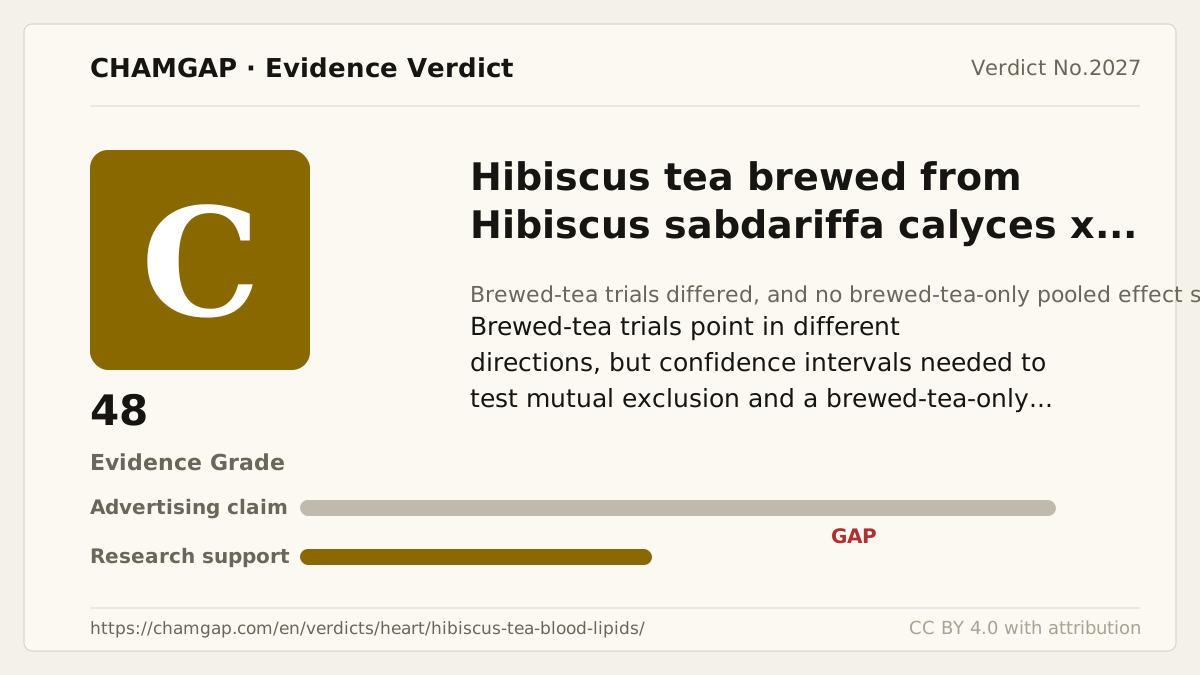
[Chamgap] Hibiscus tea x improved blood lipids — Evidence Grade C·50. 2 cited sources checked. Source: https://chamgap.com/en/verdicts/heart/hibiscus-tea-blood-lipids/ · CC BY 4.0CC BY 4.0 — free to use with attribution; do not distort grades, numbers, or verdict meaning.
What this document does and does not do
Chamgap is an information source. It reports what research has and has not confirmed; it does not tell readers what to take or buy. That decision belongs to readers and, when needed, medical or legal professionals. This verdict reflects literature available up to the search date and may change as new research appears. Nothing here is medical advice.