
Hot-water tub bathing frequency,
does it really help with Lower incidence of cardiovascular disease?
research showsThe grade is C. In a Japanese cohort of 30,076 adults followed for about 20 years, almost-daily tub bathing was associated with a 28% lower hazard of cardiovascular disease than bathing zero to two times weekly. Exposure was self-reported once at baseline, however, and poorer health could itself reduce bathing, leaving reverse causation and residual confounding.
ads claimA transient blood-pressure or circulation response to hot water is not evidence that myocardial infarction or stroke is prevented. This verdict concerns incident cardiovascular events, not a blood-pressure surrogate.
Useful facts when choosing a product
- The reference group was zero to two tub baths weekly, not an almost-never group.
- Frequency was reported once at baseline; temperature, duration, and changes during follow-up were unavailable.
- There were 2,097 cardiovascular events over 538,373 person-years.
- Sensitivity analyses separately excluded events in the first five and ten years.
Chamgap Semantic Classification Code
Candidate index · review held
UNK.habitual-hot-water-tub-bathing.UNK.incidence-of-cardiovascular-disease.reduce.reference-exposureUnknown > Habitual hot-water tub bathing > Unknown > incidence of cardiovascular disease > Reduction claim > Reference exposure
An automated migration candidate, not an issued permanent code; exact claim scope remains under review. This machine-generated migration candidate helps retrieval but is not a permanent assignment. The original verdict ID and URL remain authoritative.
What the research actually shows
The Japan Public Health Center cohort enrolled adults aged 40-59 without cardiovascular disease or cancer in 1990 and followed 30,076 through December 2009. The question asked how often they bathed in a tub each week: less than once, one to two, three to four, or almost every day. Because only 0.7% chose less than once, investigators combined the first two categories into the zero-to-two reference group. Physicians blinded to lifestyle data adjudicated events from medical records. Funding came from the National Cancer Center Research and Development Fund and Japan's Ministry of Health, Labour and Welfare; no competing interests were declared.
Why this is classified as C (56)
Prospective follow-up, adjudicated events, and early-event exclusions are strengths. Single self-reported exposure, health-related avoidance, and residual lifestyle confounding give C with 56 points.
Counterpoint. C does not mean no association. It means that changing bathing frequency has not been shown to cause lower cardiovascular risk.
Rejudgment record. Cross-check applied — Adjudicated events and early-event exclusions in a prospective cohort, balanced against self-reported exposure, reverse causation, and residual confounding
| Endpoint | H | Hard endpoint - actual events such as death |
| Replication | R1 | Single confirmatory trial |
| Independence | I2 | Decisive evidence is publicly or non-profit funded |
| Effect size | E+ | Meets the clinically important threshold |
Stored derived and displayed grades match; this is not a current recalculation or validity check (C).
Sub-claim grades by effect
This ingredient is marketed for several effects. A single overall grade blends strong and weak claims together, so each effect is graded separately here. The overall grade reflects the strongest disconfirming or core claim.
| Effect (sub-claim) | Grade | Basis |
|---|---|---|
| Association with lower total cardiovascular incidence | C | The almost-daily group had HR 0.72, 95% CI 0.62-0.84. |
| Association with lower coronary heart disease incidence | C | HR was 0.65, 95% CI 0.45-0.94. |
| Association with lower stroke incidence | C | HR was 0.74, 95% CI 0.62-0.87, but the ten-year exclusion analysis included the null. |
Cross-check — AI research and Codex final gate
Evidence Table
| Study | Design | Sample | Funding | Endpoint | Result | Weight |
|---|---|---|---|---|---|---|
| Ukai et al. 2020 JPHC cohort | Prospective cohort | 30,076 participants, 538,373 person-years, 2,097 cardiovascular events | Japan National Cancer Center Research and Development Fund and Ministry of Health, Labour and Welfare cancer-research grants | Incident coronary heart disease and stroke | Almost daily versus zero to two weekly: total cardiovascular disease HR 0.72, 95% CI 0.62-0.84 | Large hard-endpoint study with self-reported observational exposure |
Receipt — 1 References
All 1 cited sources were verified for existence at the original page (as of 2026-08-05).
Final verification and publication gate: Codex · Evidence date: 2026-08-05 · Corrections: none
Cite this verdict
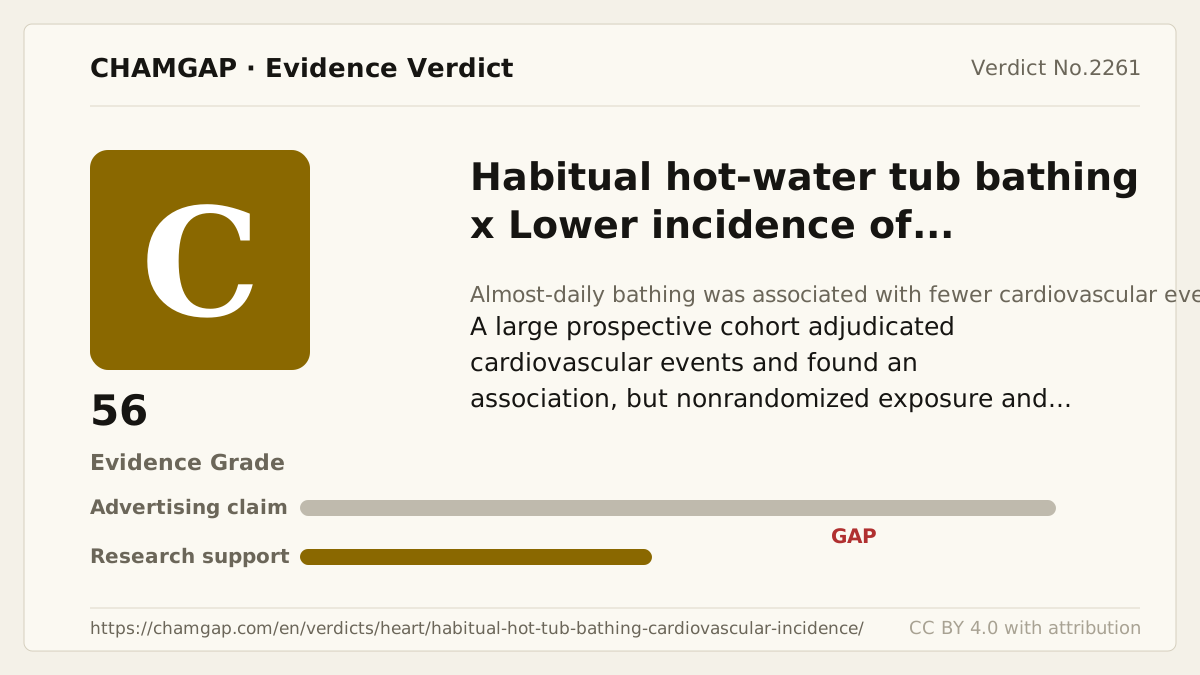
[Chamgap] Hot-water tub bathing frequency x cardiovascular disease incidence — Evidence Grade C·56. 1 cited sources checked. Source: https://chamgap.com/en/verdicts/heart/habitual-hot-tub-bathing-cardiovascular-incidence/ · CC BY 4.0CC BY 4.0 — free to use with attribution; do not distort grades, numbers, or verdict meaning.
What this document does and does not do
Chamgap is an information source. It reports what research has and has not confirmed; it does not tell readers what to take or buy. That decision belongs to readers and, when needed, medical or legal professionals. This verdict reflects literature available up to the search date and may change as new research appears. Nothing here is medical advice.