
Graduated compression stockings,
does it really help with Prevention of post-thrombotic syndrome after a first proximal deep-vein thrombosis?
research showsGraduated compression stockings are graded D because the most rigorous trial did not prevent post-thrombotic syndrome after a first proximal DVT. SOX randomized 806 people to 30-to-40-mmHg stockings or identical-looking active placebo stockings producing less than 5 mmHg at the ankle and analyzed 803 after excluding three ineligible participants. The primary Ginsberg post-thrombotic-syndrome endpoint after six months failed: 14.2% versus 12.7%, adjusted HR 1.13 (95% CI 0.73 to 1.76), P=0.58. The interval leaves room for a 27% risk reduction, so the grade is D rather than F.
ads claimThe fact that compression can immediately change tightness or swelling is expanded into prevention of a long-term post-thrombotic syndrome.
Useful facts when choosing a product
- SOX used 30 to 40 mmHg at the ankle for active stockings and less than 5 mmHg for visually identical placebo stockings. The active sensory control is central to the design.
- For comparison, verdict 1357, which is D with 34 points, concerns leg fatigue and swelling in healthy people who stand for long periods. The population and purpose differ, so its evidence was not transferred.
- For comparison, verdict 1334, which is B with 73 points, concerns rivaroxaban, and verdict 1352, which is B with 74 points, concerns fondaparinux for acute venous thromboembolism treatment and recurrence prevention. Anticoagulant evidence was not pooled with stocking evidence for post-thrombotic syndrome.
Chamgap Semantic Classification Code
Candidate index · review held
P.graduated-elastic-compression-stockings.device.post-thrombotic-syndrome-after-a-first-proximal-deep-vein-thrombosis.prevent.placeboProcedures, devices and tests > Graduated elastic compression stockings > Device delivered > post-thrombotic syndrome after a first proximal deep-vein thrombosis > Occurrence-prevention claim > Placebo
An automated migration candidate, not an issued permanent code; exact claim scope remains under review. This machine-generated migration candidate helps retrieval but is not a permanent assignment. The original verdict ID and URL remain authoritative.
What the research actually shows
SOX randomized 806 people at 24 North American centers and analyzed 803 by modified intention to treat after excluding three ineligible participants. Knee-length 30-to-40-mmHg stockings were compared with identical-looking placebo stockings producing less than 5 mmHg at the ankle, worn daily for two years. The primary Ginsberg PTS endpoint at six months or later was 14.2% versus 12.7%, adjusted HR 1.13 (95% CI 0.73 to 1.76), P=0.58, so it failed. Burgstaller 2016 reviewed five randomized trials and 1,393 participants and found conflict between two small trials reporting reductions of at least 50% and the null SOX trial.
Why this is classified as D (34)
The profile is H, R0, I2, E0, B0, and C0. The large active-placebo primary endpoint failed, but its interval leaves room for 27% risk reduction, yielding D with 34 points.
Counterpoint. Separately from prevention, stockings may be prescribed for established swelling or discomfort, after evaluating arterial circulation and the ability to use them.
Rejudgment record. Cross-check applied — Applied the null SOX primary endpoint against matching low-pressure placebo stockings but used C0 and D because the HR lower bound of 0.73 leaves room for meaningful benefit
| Endpoint | H | Hard endpoint - actual events such as death |
| Replication | R0 | Trials conflict in direction |
| Independence | I2 | Decisive evidence is publicly or non-profit funded |
| Effect size | E0 | Null |
| Precision | C0 | The confidence interval leaves room for benefit |
Stored derived and displayed grades match; this is not a current recalculation or validity check (D).
Sub-claim grades by effect
This ingredient is marketed for several effects. A single overall grade blends strong and weak claims together, so each effect is graded separately here. The overall grade reflects the strongest disconfirming or core claim.
| Effect (sub-claim) | Grade | Basis |
|---|---|---|
| Prevention of post-thrombotic syndrome by Ginsberg criteria | D | The SOX primary endpoint failed. |
| Prevention of post-thrombotic syndrome by Villalta criteria | D | The highest-quality evidence did not establish prevention. |
| Prevention of severe post-thrombotic syndrome | D | Event counts and precision did not establish a definitive benefit. |
Cross-check — AI research and Codex final gate
Evidence Table
| Study | Design | Sample | Funding | Endpoint | Result | Weight |
|---|---|---|---|---|---|---|
| Kahn SR et al. 2014 SOX | Twenty-four-center randomized double-blind active-placebo-controlled trial | 806 randomized and 803 analyzed by modified intention to treat after excluding three ineligible participants | Public funding from the Canadian Institutes of Health Research; Sigvaris supplied stockings for both groups in kind | Incident post-thrombotic syndrome by Ginsberg criteria at six months or later | 14.2% versus 12.7%, adjusted HR 1.13 (95% CI 0.73 to 1.76), P=0.58; primary endpoint failed. | Decisive active-placebo trial |
| Burgstaller JM et al. 2016 | Systematic review of randomized trials | Five randomized trials and 1,393 participants; trial sizes 47 to 803 | Academic research; no separate manufacturer funding stated in the abstract | Incident post-thrombotic syndrome after proximal DVT | Two small trials reported reductions of at least 50%, while SOX was null; heterogeneity precluded pooling. | Assessment of conflicting replication |
Receipt — 2 References
All 2 cited sources were verified for existence at the original page (as of 2026-07-24).
Final verification and publication gate: Codex · Evidence date: 2026-07-24 · Corrections: none
Cite this verdict
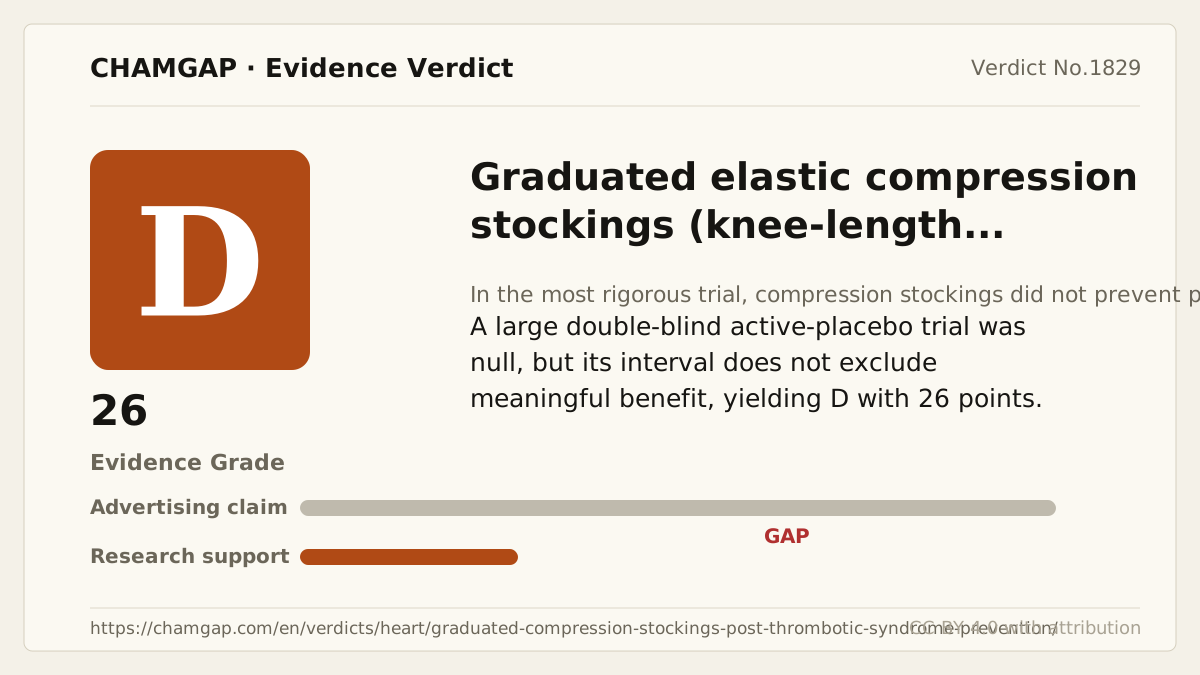
[Chamgap] Graduated compression stockings x post-thrombotic syndrome prevention — Evidence Grade D·34. 2 cited sources checked. Source: https://chamgap.com/en/verdicts/heart/graduated-compression-stockings-post-thrombotic-syndrome-prevention/ · CC BY 4.0CC BY 4.0 — free to use with attribution; do not distort grades, numbers, or verdict meaning.
What this document does and does not do
Chamgap is an information source. It reports what research has and has not confirmed; it does not tell readers what to take or buy. That decision belongs to readers and, when needed, medical or legal professionals. This verdict reflects literature available up to the search date and may change as new research appears. Nothing here is medical advice.