
Fruitflow,
does it really help with Prevention of cardiovascular disease through inhibition of platelet aggregation?
research showsFruitflow is rated C because randomized signals for lower platelet-aggregation surrogates are repeated, but it has not been shown to prevent myocardial infarction or stroke. Trials of 90, 47, and 105 participants reduced aggregation or platelet-activation markers, yet no clinical trial evaluated cardiovascular events. Surrogate evidence is capped at C, and the clinical-event gap yields 44 points.
ads claimMarketing can turn platelet-aggregation inhibition into prevention of clots, heart attacks, and strokes. A surrogate change supports a hypothesis but does not establish cardiovascular prevention or aspirin replacement; EFSA wording is limited to maintenance of normal aggregation and healthy blood flow.
Useful facts when choosing a product
- Fruitflow is a branded water-soluble tomato concentrate, and EFSA evaluated WSTC I or II only for helping maintain normal platelet aggregation. This is not approval as a cardiovascular drug.
- Human studies commonly used the equivalent of 150 mg of standardized ingredient as a single dose or once daily for four weeks. Marketed products require label checks for ingredient amount and additional components.
- Short healthy-volunteer trials were generally well tolerated without clear worsening of clotting time or liver or kidney function, but long-term and high-risk-patient safety remains insufficient.
- People taking antiplatelet or anticoagulant drugs, those with bleeding disorders, or those awaiting surgery should discuss possible overlapping platelet effects with a clinician and should not replace prescribed drugs.
Chamgap Semantic Classification Code
Candidate index · review held
UNK.fruitflow-water-soluble-tomato-concentrate.UNK.cardiovascular-disease-through-inhibition-of-platelet-aggregation.prevent.placeboUnknown > Fruitflow water-soluble tomato concentrate > Unknown > cardiovascular disease through inhibition of platelet aggregation > Occurrence-prevention claim > Placebo
An automated migration candidate, not an issued permanent code; exact claim scope remains under review. This machine-generated migration candidate helps retrieval but is not a permanent assignment. The original verdict ID and URL remain authoritative.
What the research actually shows
A 2006 double-blind crossover trial in 90 people reported lower ex vivo aggregation three hours after a single tomato-extract dose. A 2017 crossover trial in 47 people found that acute Fruitflow had some platelet-test effects similar to one 75-mg aspirin dose, while seven-day aspirin was about three times stronger and plasma clotting times did not change. A 2022 four-week crossover trial in 105 people reduced ADP- and collagen-induced aggregation and activation markers, with reversal after a two-week washout. These studies did not assess cardiovascular events, and early branded-ingredient research included Provexis or DSM interests.
Why this is classified as C (44)
Several randomized crossover trials repeatedly reduced platelet aggregation and activation markers, but all outcomes were surrogates and samples and durations were small. No randomized clinical-event trial showed fewer myocardial infarctions, strokes, or cardiovascular deaths. The surrogate signal is accepted under a C ceiling, yielding 44 points.
Counterpoint. Smoking cessation, blood-pressure, lipid and diabetes control, exercise, and indicated prescription therapy remain the core of cardiovascular prevention. A platelet-test effect does not justify replacing them or using Fruitflow as aspirin.
Rejudgment record. New verdict — Accepted repeated reductions in platelet aggregation and activation in healthy-volunteer randomized trials, while applying the surrogate ceiling because no myocardial-infarction, stroke, or cardiovascular-death clinical-event trial exists
Sub-claim grades by effect
This ingredient is marketed for several effects. A single overall grade blends strong and weak claims together, so each effect is graded separately here. The overall grade reflects the strongest disconfirming or core claim.
| Effect (sub-claim) | Grade | Basis |
|---|---|---|
| Inhibition of platelet aggregation as a surrogate | C | Short-term laboratory effects were repeated in several healthy-volunteer randomized trials. |
| Prevention of cardiovascular events such as myocardial infarction and stroke | ? | No human efficacy trial evaluating cardiovascular events or death with Fruitflow was identified. |
| The EFSA claim guarantees clinical cardiovascular benefit | ? | The EFSA conclusion is limited to normal platelet aggregation and healthy blood flow, not event-prevention evidence. |
Cross-check — AI research and Codex final gate
Evidence Table
| Study | Design | Sample | Funding | Endpoint | Result | Weight |
|---|---|---|---|---|---|---|
| O'Kennedy N et al. 2006 | Randomized double-blind placebo-controlled crossover trial | 90 healthy adults | Provexis-associated research with non-U.S. government support reported | ADP- and collagen-induced ex vivo platelet aggregation three hours after one dose | Both doses reduced platelet aggregation versus placebo. | Key positive surrogate evidence |
| O'Kennedy N et al. 2017 | Randomized double-blind crossover comparative trial | 47 healthy adults | Multiple Provexis employee coauthors | Platelet aggregation, thromboxane, PFA-100, and clotting times | Acute Fruitflow reduced platelet function, while seven-day aspirin was about three times stronger; clinical events were not assessed. | Active-comparator surrogate evidence |
| Tian Z et al. 2022 | Four-week randomized double-blind placebo-controlled crossover trial | 105 healthy middle-aged and older Chinese adults | Chinese public grants and the By-health Research Foundation | Aggregation, P-selectin, activated GPIIbIIIa, PF4, beta-TG, and TXB2 | A 150-mg daily dose reduced multiple platelet markers, with reversal after a two-week washout. | Surrogate replication across duration and population |
Receipt — 4 References
All 4 cited sources were verified for existence at the original page (as of 2026-07-20).
Final verification and publication gate: Codex · Evidence date: 2026-07-20 · Corrections: none
Cite this verdict
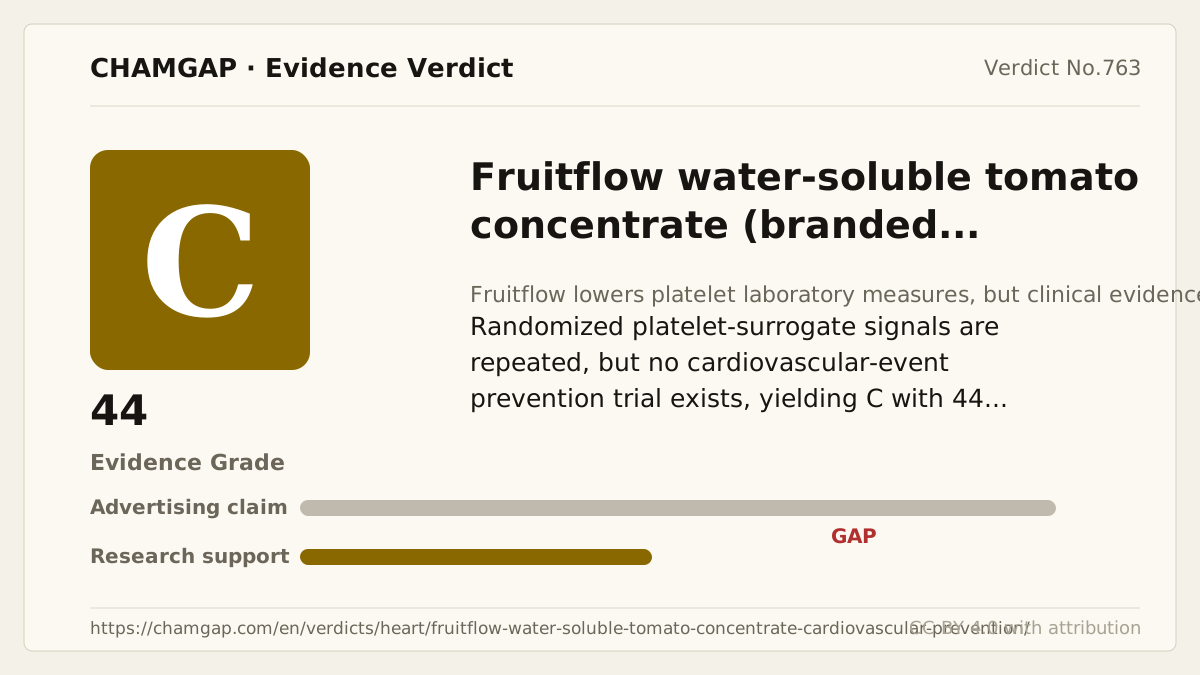
[Chamgap] Fruitflow x prevention of cardiovascular disease through inhibition of platelet aggregation — Evidence Grade C·44. 4 cited sources checked. Source: https://chamgap.com/en/verdicts/heart/fruitflow-water-soluble-tomato-concentrate-cardiovascular-prevention/ · CC BY 4.0CC BY 4.0 — free to use with attribution; do not distort grades, numbers, or verdict meaning.
What this document does and does not do
Chamgap is an information source. It reports what research has and has not confirmed; it does not tell readers what to take or buy. That decision belongs to readers and, when needed, medical or legal professionals. This verdict reflects literature available up to the search date and may change as new research appears. Nothing here is medical advice.