
Forest bathing,
does it really help with Sustained control of hypertension?
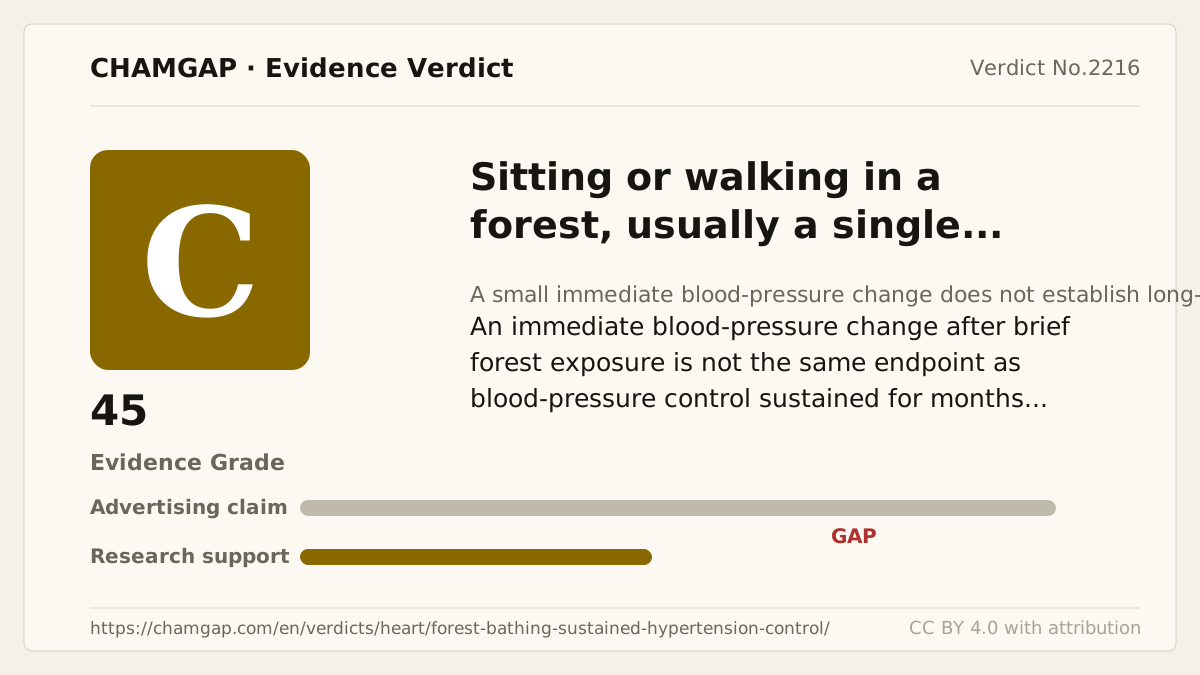
research showsThe grade is C with 46 points. A 2017 synthesis of 20 trials and 732 participants found systolic pressure 3.15 mmHg lower immediately after forest exposure than after nonforest exposure. Seventeen trials were conducted in Japan, and most were immediate crossover comparisons. Only two lasted beyond one day, and an eight-week follow-up after a three-day program found no between-group difference. The acute measurement is real, but sustained hypertension control is unproven.
ads claimA small immediate reading after forest exposure does not establish that medication can be reduced or that hypertension is treated long term. Sustained control requires repeated exposure, home or ambulatory measurements, and longer follow-up.
Useful facts when choosing a product
- The 2017 synthesis found immediate mean differences of -3.15 mmHg systolic and -1.75 mmHg diastolic.
- Seventeen of 20 trials were conducted in Japan, and 15 used crossover designs.
- Only two trials lasted beyond one day, and the eight-week follow-up after a three-day program was null.
Chamgap Semantic Classification Code
Candidate index · review held
X.sitting-or-walking-in-a-forest.environmental.sustained-control-of-hypertension.assess.UNKBehaviors, exposures and policies > Sitting or walking in a forest > Environmental exposure > Sustained control of hypertension > Association or change assessment > Unknown
An automated migration candidate, not an issued permanent code; exact claim scope remains under review. This machine-generated migration candidate helps retrieval but is not a permanent assignment. The original verdict ID and URL remain authoritative.
What the research actually shows
The 2017 review included 20 trials and 732 participants: 15 crossover and five parallel comparisons. Seventeen trials came from Japan, two from Korea, and one from China; controls usually performed the same activity in an urban or nonforest setting. The systolic mean difference was -3.15 mmHg (-4.12 to -2.18; I-squared 1%), and the diastolic difference across 17 trials and 705 participants was -1.75 mmHg (-2.38 to -1.13; I-squared 24%). The funnel plot was nearly symmetric but suggested weak publication bias. The review had Japanese public funding, while funding of all included trials was not verified.
Why this is classified as C (46)
Some acute measurements were positive, but long-term magnitude was not calculable and surrogate, short, small, geographically concentrated evidence gives C with 46 points.
Counterpoint. This verdict does not deny relaxation or mood benefits from visiting forests; it addresses sustained hypertension control.
Rejudgment record. Cross-check applied — Separated acute pooled readings from eight-week follow-up and cross-checked country concentration, controls, heterogeneity, publication bias, and calculability of sustained effects
| Endpoint | S | Surrogate marker - laboratory or imaging measures |
| Replication | R1 | Single confirmatory trial |
| Independence | I1 | Mixed funding sources |
| Effect size | EX | The clinical size of the effect could not be judged |
Stored derived and displayed grades match; this is not a current recalculation or validity check (C).
Sub-claim grades by effect
This ingredient is marketed for several effects. A single overall grade blends strong and weak claims together, so each effect is graded separately here. The overall grade reflects the strongest disconfirming or core claim.
| Effect (sub-claim) | Grade | Basis |
|---|---|---|
| Immediate reduction in systolic blood pressure | C | The pooled mean difference across 20 trials was -3.15 mmHg. |
| Immediate reduction in diastolic blood pressure | C | The pooled mean difference across 17 trials was -1.75 mmHg. |
| Sustained control of hypertension | C | Eight-week follow-up was null, and accessible reporting did not permit calculation of sustained magnitude. |
Cross-check — AI research and Codex final gate
Evidence Table
| Study | Design | Sample | Funding | Endpoint | Result | Weight |
|---|---|---|---|---|---|---|
| Ideno et al. meta-analysis 2017 | Systematic review and meta-analysis of randomized and nonrandomized comparative trials | 20 trials and 732 participants; 15 crossover and five parallel | Japanese Ministry of Health, Labour and Welfare grant; funding of all included trials not verified | Mostly immediate post-exposure systolic and diastolic blood pressure | Systolic -3.15 mmHg (-4.12 to -2.18; I-squared 1%); diastolic -1.75 mmHg (-2.38 to -1.13; I-squared 24%); eight-week follow-up null. | Key evidence showing acute measurements and the long-term gap |
| Siah et al. meta-analysis 2023 | Systematic review and meta-analysis of forest-bathing comparisons | 15 studies reported blood pressure; 13 were pooled | Community Foundation of Singapore Mind the Gap 200 Mental Health Fund | Short-term systolic and diastolic blood pressure | Systolic -1.66 mmHg (-4.30 to 0.97; I-squared 52%); diastolic -3.09 mmHg (-7.52 to 1.34; I-squared 92%). | Later null synthesis |
Receipt — 2 References
All 2 cited sources were verified for existence at the original page (as of 2026-08-04).
Final verification and publication gate: Codex · Evidence date: 2026-08-04 · Corrections: none
Cite this verdict
[Chamgap] Forest bathing x sustained hypertension control — Evidence Grade C·46. 2 cited sources checked. Source: https://chamgap.com/en/verdicts/heart/forest-bathing-sustained-hypertension-control/ · CC BY 4.0CC BY 4.0 — free to use with attribution; do not distort grades, numbers, or verdict meaning.
What this document does and does not do
Chamgap is an information source. It reports what research has and has not confirmed; it does not tell readers what to take or buy. That decision belongs to readers and, when needed, medical or legal professionals. This verdict reflects literature available up to the search date and may change as new research appears. Nothing here is medical advice.