
Finerenone,
does it really help with Reduced composite risk of worsening heart failure and cardiovascular death in heart failure with mildly reduced or preserved ejection fraction?
research showsFinerenone receives B for reducing the composite risk of total worsening heart failure events and cardiovascular death in heart failure with a left ventricular ejection fraction of at least 40%. In the Bayer-sponsored 6,001-participant FINEARTS-HF trial with a median 32-month follow-up, there were 1,083 primary composite events with finerenone and 1,283 with placebo, for a rate ratio of 0.84 (95% CI 0.74 to 0.95). The benefit was driven mainly by fewer total worsening heart failure events (rate ratio 0.82), while cardiovascular death alone was 8.1% versus 8.7%, with a nonsignificant hazard ratio of 0.93 (95% CI 0.78 to 1.11). A large hard-endpoint randomized trial is a major strength, but one pivotal trial, a composite endpoint, and a neutral mortality component support B rather than A.
ads claimMarketing can combine separate heart and kidney indications into a claim that finerenone protects every patient from death. FINEARTS-HF directly established a lower rate of total worsening heart failure events plus cardiovascular death in patients with ejection fraction of at least 40%, not a significant reduction in cardiovascular death alone.
Useful facts when choosing a product
- Finerenone is a selective nonsteroidal mineralocorticoid receptor antagonist supplied as an oral prescription tablet.
- FINEARTS-HF used once-daily target doses of 20 mg or 40 mg according to kidney function, with titration, reduction, or temporary interruption based on serum potassium and estimated glomerular filtration rate.
- Since 2025, the United States indication has included reducing cardiovascular death, heart failure hospitalization, and urgent heart failure visits in adults with left ventricular ejection fraction of at least 40%. This population and evidence base differ from the earlier indication for chronic kidney disease associated with type 2 diabetes.
- Hyperkalemia and worsening renal function are central risks. The product label governs contraindications, laboratory monitoring, and dose modification with potassium-raising drugs or supplements, strong CYP3A4 inhibitors, and impaired kidney function.
Chamgap Semantic Classification Code
Candidate index · review held
UNK.finerenone.oral.composite-risk-of-worsening-heart-failure-and-cardiovascular-death-in-heart-failure-with-mildly-reduced-or-preserved-ejection-fraction.reduce.placeboUnknown > Finerenone > Oral > composite risk of worsening heart failure and cardiovascular death in heart failure with mildly reduced or preserved ejection fraction > Reduction claim > Placebo
An automated migration candidate, not an issued permanent code; exact claim scope remains under review. This machine-generated migration candidate helps retrieval but is not a permanent assignment. The original verdict ID and URL remain authoritative.
What the research actually shows
The phase 3 trial by Solomon and colleagues with the FINEARTS-HF Committees and Investigators enrolled patients with NYHA class II to IV symptoms, elevated natriuretic peptides, and left ventricular ejection fraction of at least 40%. Its primary analysis counted recurrent hospitalizations and urgent visits as total worsening heart failure events alongside cardiovascular death, producing a significant composite result but a neutral cardiovascular-death component. A potassium analysis found that finerenone approximately doubled the hazard of serum potassium exceeding 5.5 mmol/L (HR 2.16), requiring protocol-directed monitoring, dose reduction, and interruption. Evidence for this heart failure indication should be distinguished from FIDELIO-DKD and FIGARO-DKD evidence in chronic kidney disease associated with type 2 diabetes.
Why this is classified as B (73)
The 6,001-participant double-blind trial found a rate ratio of 0.84 for total worsening heart failure plus cardiovascular death and 0.82 for total worsening heart failure, both clinically important results. The evidence nevertheless comes from one manufacturer-sponsored pivotal recurrent-event composite, while cardiovascular death alone had a nonsignificant hazard ratio of 0.93. The single-pivotal-trial, composite-endpoint, and component-discordance criteria yield B with 73 points.
Counterpoint. For an appropriate patient, finerenone can be added to existing therapy to reduce the burden of recurrent hospitalizations and urgent visits. Baseline and follow-up potassium and kidney-function testing must be feasible, and it should not be combined casually with another mineralocorticoid receptor antagonist.
Rejudgment record. New verdict — Accepted the reduction in total worsening heart failure events plus cardiovascular death and in total worsening heart failure events in a 6,001-participant double-blind trial, but applied B because this is one pivotal composite trial and cardiovascular death alone was not significantly reduced
Sub-claim grades by effect
This ingredient is marketed for several effects. A single overall grade blends strong and weak claims together, so each effect is graded separately here. The overall grade reflects the strongest disconfirming or core claim.
| Effect (sub-claim) | Grade | Basis |
|---|---|---|
| Reduction in the composite of total worsening heart failure events and cardiovascular death | B | The rate ratio was 0.84 (95% CI 0.74 to 0.95), but this was one pivotal recurrent-event composite trial. |
| Reduction in total worsening heart failure events | B | There were 842 versus 1,024 events, for a rate ratio of 0.82, demonstrating fewer hospitalizations and urgent visits. |
| Reduction in cardiovascular death alone | D | Rates were 8.1% versus 8.7%, with a nonsignificant hazard ratio of 0.93 (95% CI 0.78 to 1.11). |
Cross-check — AI research and Codex final gate
Evidence Table
| Study | Design | Sample | Funding | Endpoint | Result | Weight |
|---|---|---|---|---|---|---|
| Solomon SD et al.; FINEARTS-HF Committees and Investigators. 2024 | Multinational phase 3 randomized double-blind placebo-controlled trial | 6,001 patients with heart failure and left ventricular ejection fraction of at least 40%; median follow-up 32 months | Sponsored by Bayer | Composite of total worsening heart failure events and cardiovascular death | The composite rate ratio was 0.84 and total worsening heart failure rate ratio was 0.82, while cardiovascular death alone had a nonsignificant hazard ratio of 0.93. | Pivotal large direct hard-endpoint evidence |
| Vardeny O et al. 2025 | Prespecified serum-potassium secondary analysis of FINEARTS-HF | All 6,001 FINEARTS-HF participants | Secondary analysis of a Bayer-sponsored trial | Post-treatment hyperkalemia, hypokalemia, and clinical outcomes | The hazard of serum potassium exceeding 5.5 mmol/L increased to 2.16, while clinical benefit was maintained with protocol-directed monitoring and dose adjustment. | Key safety and monitoring evidence |
Receipt — 2 References
All 2 cited sources were verified for existence at the original page (as of 2026-07-24).
Final verification and publication gate: Codex · Evidence date: 2026-07-24 · Corrections: none
Cite this verdict
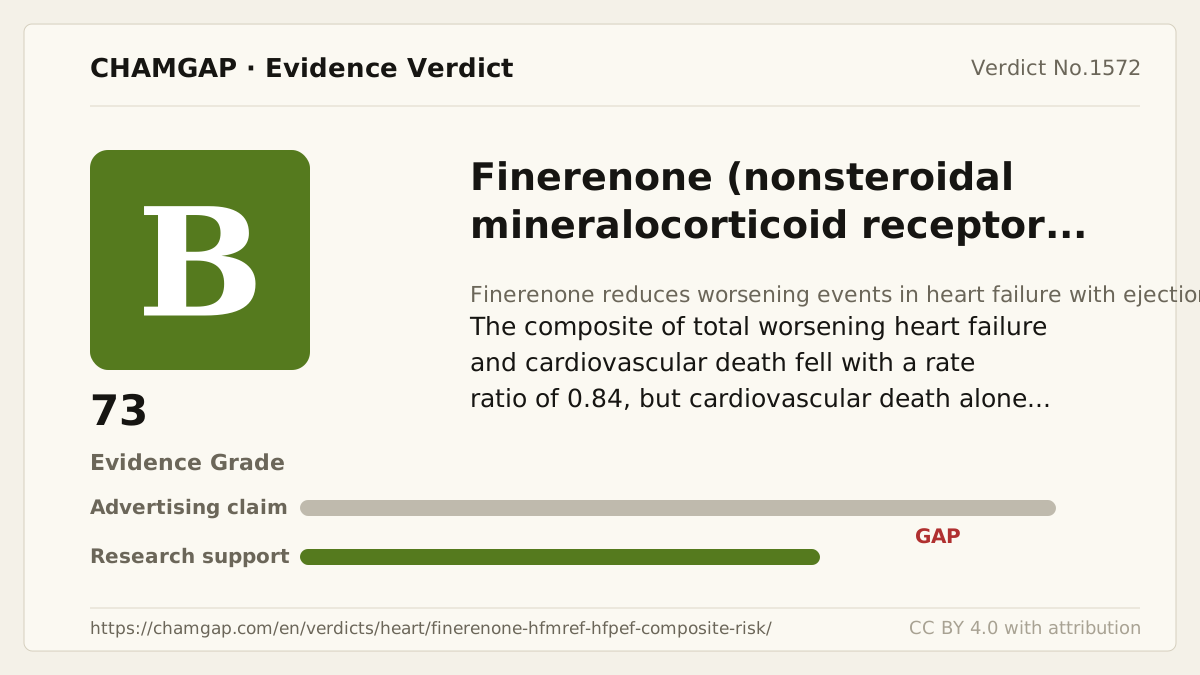
[Chamgap] Finerenone x reduced composite risk of worsening heart failure and cardiovascular death in HFmrEF or HFpEF — Evidence Grade B·73. 2 cited sources checked. Source: https://chamgap.com/en/verdicts/heart/finerenone-hfmref-hfpef-composite-risk/ · CC BY 4.0CC BY 4.0 — free to use with attribution; do not distort grades, numbers, or verdict meaning.
What this document does and does not do
Chamgap is an information source. It reports what research has and has not confirmed; it does not tell readers what to take or buy. That decision belongs to readers and, when needed, medical or legal professionals. This verdict reflects literature available up to the search date and may change as new research appears. Nothing here is medical advice.