
Fenofibrate,
does it really help with Additional prevention of myocardial infarction, stroke, and other cardiovascular events in statin-treated patients with type 2 diabetes?
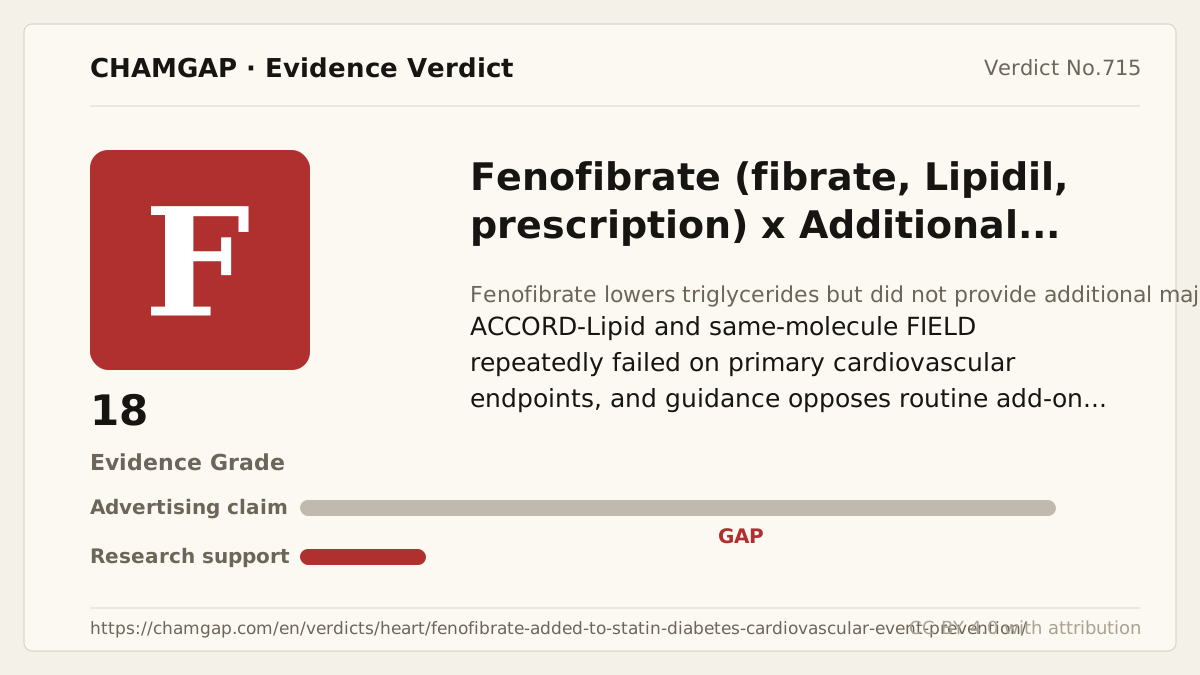
research showsF. The claim that adding fenofibrate to a statin generally prevents additional major cardiovascular events in type 2 diabetes has been repeatedly refuted. ACCORD-Lipid in 5,518 participants was null for primary MACE, with HR 0.92, 95% CI 0.79 to 1.08, and P=0.32. FIELD tested the same molecule in 9,795 participants and also failed on its primary coronary-event endpoint, with HR 0.89, 95% CI 0.75 to 1.05, and P=0.16. The 2026 ADA guidance does not recommend adding a fibrate to statin therapy for cardiovascular risk reduction. Repeated refutation plus guidance against use yields F with 18 points; the high-triglyceride and low-HDL signal is post hoc and hypothesis-generating. PROMINENT studied pemafibrate, a different molecule, and was not counted as repeat fenofibrate evidence.
ads claimLarge triglyceride reductions and HDL increases are equated with additional prevention of myocardial infarction and stroke. ACCORD demonstrates this surrogate-to-outcome disconnect, and a selected dyslipidemia subgroup cannot be generalized to every patient with diabetes.
Useful facts when choosing a product
- Fenofibrate is a prescription fibrate mainly used with dietary measures for hypertriglyceridemia and mixed dyslipidemia, with dosing dependent on product and renal function.
- Adding it to a statin can lower triglycerides further, but additional major cardiovascular-event prevention has not been demonstrated for most patients with type 2 diabetes.
- Myalgia, myopathy, liver-enzyme elevation, gallstones, and pancreatitis can occur, and statin combination therapy and renal impairment warrant greater attention to muscle toxicity.
- Serum creatinine can rise, so renal and liver function should be assessed before and during treatment, and unexplained muscle pain or weakness requires evaluation.
Chamgap Semantic Classification Code
Candidate index · review held
M.fenofibrate.UNK.myocardial-infarction-stroke-and-other-cardiovascular-events-in-statin-treated-patients-with-type-2-diabetes.prevent.MULTIMedicinal interventions > Fenofibrate > Unknown > myocardial infarction, stroke, and other cardiovascular events in statin-treated patients with type 2 diabetes > Occurrence-prevention claim > Multiple: primary unresolved
An automated migration candidate, not an issued permanent code; exact claim scope remains under review. This machine-generated migration candidate helps retrieval but is not a permanent assignment. The original verdict ID and URL remain authoritative.
What the research actually shows
The ACCORD Study Group randomized 5,518 high-risk participants with type 2 diabetes taking open-label simvastatin to masked fenofibrate or placebo. After a mean 4.7 years, annual primary-event rates were 2.2% versus 2.4%, HR 0.92, P=0.32. A possible effect in the high-triglyceride and low-HDL subgroup remains a post hoc signal without an overall effect or confirmation. FIELD randomized 9,795 participants not taking statins at entry; primary coronary events had HR 0.89, 95% CI 0.75 to 1.05, P=0.16, while the secondary total cardiovascular-event endpoint fell modestly from 13.9% to 12.5%. Lipid changes and clinical events must be separated.
Why this is classified as F (18)
F. ACCORD-Lipid was null for primary MACE in 5,518 participants, with HR 0.92 and P=0.32, and same-molecule FIELD failed on its primary coronary endpoint in 9,795 participants, with HR 0.89 and P=0.16. Triglyceride improvement and a post hoc high-triglyceride and low-HDL signal do not rescue the claim, while 2026 ADA guidance does not recommend statin-fibrate combination therapy for cardiovascular risk reduction. Repeated refutation and guidance against use yield F with 18 points. PROMINENT studied different-molecule pemafibrate and was not counted; muscle, liver, and renal risks remain separate safety concerns.
Counterpoint. Very high triglycerides may create a separate therapeutic goal of pancreatitis-risk management. That should not be confused with routine additional prevention of myocardial infarction or stroke during statin therapy.
Rejudgment record. Reassessment (cross-check reflected) — Applied F for repeated refutation and guidance against use because ACCORD-Lipid in 5,518 participants failed on primary MACE, same-molecule FIELD in 9,795 participants failed on its primary coronary endpoint, and 2026 ADA guidance does not recommend statin-fibrate combination therapy for cardiovascular risk reduction; different-molecule pemafibrate in PROMINENT was excluded
Sub-claim grades by effect
This ingredient is marketed for several effects. A single overall grade blends strong and weak claims together, so each effect is graded separately here. The overall grade reflects the strongest disconfirming or core claim.
| Effect (sub-claim) | Grade | Basis |
|---|---|---|
| Additional cardiovascular-event prevention with statin combination therapy | F | Primary endpoints were repeatedly null in ACCORD-Lipid and same-molecule FIELD, and 2026 ADA guidance does not recommend the combination. |
| Signal in the high-triglyceride and low-HDL subgroup | ? | This post hoc signal lacks a confirmatory trial, so efficacy cannot be determined. |
| Triglyceride reduction and HDL improvement | C | Randomized trials consistently improved lipid surrogates, but this does not guarantee hard clinical outcomes. |
Cross-check — AI research and Codex final gate
Evidence Table
| Study | Design | Sample | Funding | Endpoint | Result | Weight |
|---|---|---|---|---|---|---|
| ACCORD Study Group, ACCORD-Lipid 2010 | Randomized double-blind placebo-controlled statin add-on trial | 5,518 simvastatin-treated participants with type 2 diabetes | Primarily publicly supported by the United States NHLBI; Abbott supplied fenofibrate and placebo | Cardiovascular death, nonfatal myocardial infarction, or nonfatal stroke | 2.2% versus 2.4% annually; HR 0.92 (95% CI 0.79 to 1.08), P=0.32; major secondary outcomes were also null. | Pivotal large null evidence directly matching the claim |
| Keech A et al. FIELD 2005 | Multinational randomized double-blind placebo-controlled trial | 9,795 participants with type 2 diabetes not taking statins at entry | Supported by Laboratoires Fournier | Primary endpoint of coronary death or nonfatal myocardial infarction | 5.9% versus 5.2%; HR 0.89 (95% CI 0.75 to 1.05), P=0.16, a null primary endpoint. | Large supportive null evidence, indirect to statin add-on therapy |
| Bruckert E et al. dyslipidemia subgroup meta-analysis 2011 | Subgroup meta-analysis of five large fibrate trials | 4,671 participants with high-triglyceride and low-HDL atherogenic dyslipidemia | Mixed trial funding and author relationships | Cardiovascular events by dyslipidemia subgroup | Estimated about a 30% risk reduction in the atherogenic-dyslipidemia subgroup, while effects outside that subgroup were not significant. | Selected-subgroup hypothesis evidence |
Receipt — 4 References
All 4 cited sources were verified for existence at the original page (as of 2026-07-19).
Final verification and publication gate: Codex · Evidence date: 2026-07-19 · Corrections: none
Cite this verdict
[Chamgap] Fenofibrate x additional cardiovascular-event prevention in statin-treated type 2 diabetes — Evidence Grade F·18. 4 cited sources checked. Source: https://chamgap.com/en/verdicts/heart/fenofibrate-added-to-statin-diabetes-cardiovascular-event-prevention/ · CC BY 4.0CC BY 4.0 — free to use with attribution; do not distort grades, numbers, or verdict meaning.
What this document does and does not do
Chamgap is an information source. It reports what research has and has not confirmed; it does not tell readers what to take or buy. That decision belongs to readers and, when needed, medical or legal professionals. This verdict reflects literature available up to the search date and may change as new research appears. Nothing here is medical advice.