
Farmed trout,
does it really help with Improved blood lipids in people with hyperlipidemia?
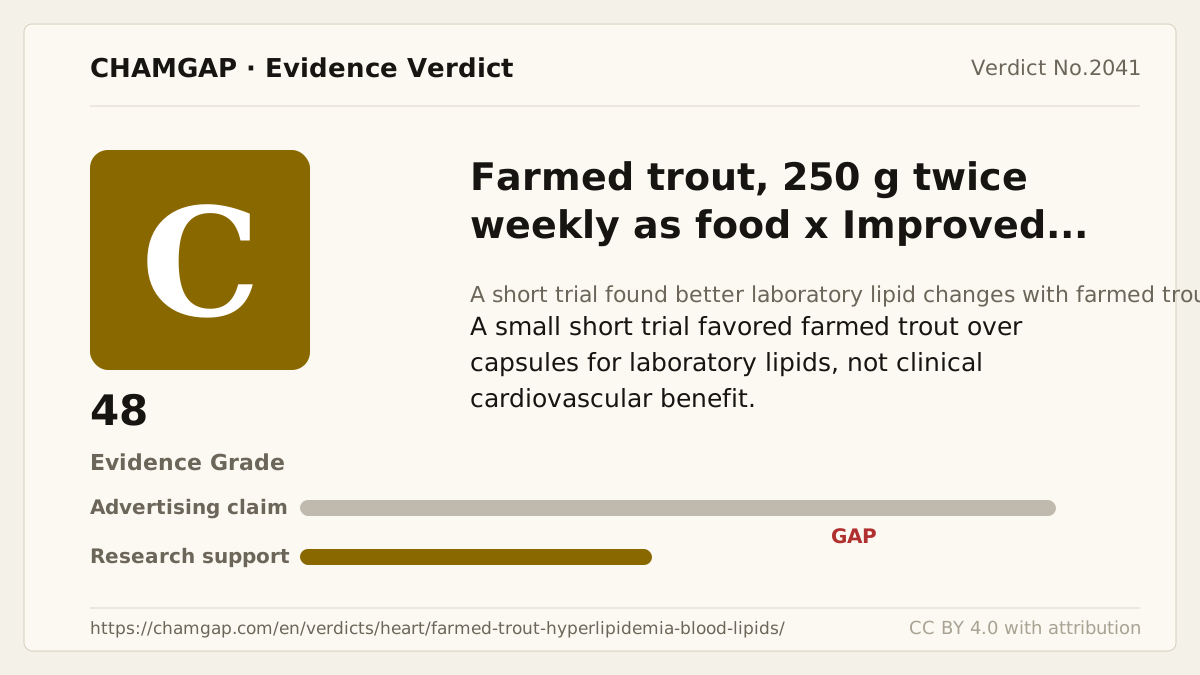
research showsThe grade is C with 54 points. An eight-week open trial randomized 106 people with hyperlipidemia to farmed trout or omega-3 capsules, with 47 and 48 analyzed. Total cholesterol and triglycerides fell more with trout, but cardiovascular events were not measured and there was no untreated control.
ads claimMeasured fatty-acid content is factual, but it does not establish cardiovascular prevention. Verdict 010 is C with no recorded score and concerns capsules, so capsule and whole-fish interventions were not merged.
Useful facts when choosing a product
- The intervention was 250 g farmed trout at lunch or dinner twice weekly, 500 g/week for eight weeks. Fresh or frozen state, cooking method, and feed were not adequately reported.
- The paper reports 1.4 g omega-3 per 100 g trout. That yields 7 g per 500 g week, while the paper states 14 g/week, an internal arithmetic inconsistency.
- The FDA monitoring-table mean for total mercury in freshwater trout is 0.071 ppm; it is not a direct methylmercury measurement of the trial fish.
- Trial-product methylmercury, sodium, calcium, and zinc were not reported as measured.
Chamgap Semantic Classification Code
Candidate index · review held
F.farmed-trout.oral.blood-lipids-with-hyperlipidemia.improve.activeFoods and beverages > Farmed trout > Oral > blood lipids with hyperlipidemia > Improvement claim > Active comparator
An automated migration candidate, not an issued permanent code; exact claim scope remains under review. This machine-generated migration candidate helps retrieval but is not a permanent assignment. The original verdict ID and URL remain authoritative.
What the research actually shows
The trial randomized 106 participants, 53 per arm, and analyzed 47 trout and 48 capsule recipients. Trout was 250 g twice weekly for eight weeks; the active comparator supplied 2 g omega-3 daily. The article cites IRCT201411141525N5, but the original registry record could not be opened, so prospective registration and registered primary outcomes were not treated as confirmed. Funding was Shiraz University of Medical Sciences grant 7391, with no seafood-industry funding reported.
Why this is classified as C (54)
Lipid effect sizes exceeded the conventional moderate threshold, but one small eight-week active-comparator trial of surrogate outcomes gives C with 54 points.
Counterpoint. C does not deny the lipid differences; long-term cardiovascular benefit remains untested.
Rejudgment record. Cross-check applied — The original table, analysis counts, registry, funding, and trout-dose arithmetic were checked while laboratory lipids were separated from clinical events
| Endpoint | S | Surrogate marker - laboratory or imaging measures |
| Replication | R1 | Single confirmatory trial |
| Independence | I2 | Decisive evidence is publicly or non-profit funded |
| Effect size | E+ | Meets the clinically important threshold |
Stored derived and displayed grades match; this is not a current recalculation or validity check (C).
Sub-claim grades by effect
This ingredient is marketed for several effects. A single overall grade blends strong and weak claims together, so each effect is graded separately here. The overall grade reflects the strongest disconfirming or core claim.
| Effect (sub-claim) | Grade | Basis |
|---|---|---|
| Farmed trout improves laboratory lipids more than omega-3 capsules | C | Several eight-week lipid changes favored trout. |
| Farmed trout prevents cardiovascular events | ? | The trial did not measure cardiovascular events. |
Cross-check — AI research and Codex final gate
Evidence Table
| Study | Design | Sample | Funding | Endpoint | Result | Weight |
|---|---|---|---|---|---|---|
| Zibaeenezhad MJ et al. 2017 | Open-label randomized active-comparator parallel trial | 106 randomized, 53 per arm; 95 analyzed, 47 trout and 48 capsules | Shiraz University of Medical Sciences grant 7391 | Eight-week changes in total cholesterol, triglycerides, HDL, LDL, and total-cholesterol/HDL ratio | Active comparator: omega-3 capsules 2 g/day. Hedges g was -0.655 for total cholesterol, -1.607 for triglycerides, and -1.573 for LDL; LDL changed -22.75 with trout versus +18.70 mg/dL with capsules, a -41.45 mg/dL between-group change difference | Direct comparison limited to surrogate laboratory outcomes in a small short trial |
Receipt — 2 References
All 2 cited sources were verified for existence at the original page (as of 2026-08-03).
Final verification and publication gate: Codex · Evidence date: 2026-08-03 · Corrections: none
Cite this verdict
[Chamgap] Farmed trout x improved blood lipids in hyperlipidemia — Evidence Grade C·54. 2 cited sources checked. Source: https://chamgap.com/en/verdicts/heart/farmed-trout-hyperlipidemia-blood-lipids/ · CC BY 4.0CC BY 4.0 — free to use with attribution; do not distort grades, numbers, or verdict meaning.
What this document does and does not do
Chamgap is an information source. It reports what research has and has not confirmed; it does not tell readers what to take or buy. That decision belongs to readers and, when needed, medical or legal professionals. This verdict reflects literature available up to the search date and may change as new research appears. Nothing here is medical advice.