
Nicotinic acid — prescription NIASPAN extended-release, added to LDL-targeted statin therapy,
does it really help with Ischemic-stroke incidence; other prevention settings, subtypes and formulations separated?
research showsIn adults with established cardiovascular disease receiving statin-based therapy, adding high-dose extended-release nicotinic acid has not demonstrated a reduction in ischemic stroke. The final AIM-HIGH analysis found 32/1718 versus 18/1696 participants with ischemic stroke, a borderline signal in the direction of increased risk rather than proof of harm or equivalence. This result is not automatically transferable to first-stroke prevention in the general population, recurrence prevention in all stroke survivors, hemorrhagic stroke, other release formulations or dietary niacin intake. [S01–S03, S13]
ads claimThe evidence does not support assuming that raising HDL prevents stroke, that all vitamin B3 molecular forms or foods share this result, or that a niacin-containing combination isolates the effect of niacin. These are illustrative overinterpretations, not quotations from an identified advertisement.
Four separate assessment dimensions
| Effect direction and size | AIM-HIGH reported an ischemic-stroke HR of 1.78 (95% CI 1.00–3.17), p=.050, and an adjusted HR of 1.74 (0.97–3.11), p=.063. Both are retained. With only 50 events, precision is limited; stroke was a component of the original cardiovascular composite, not the sole primary endpoint. Lipid improvement or the parent composite verdict is not substituted for this endpoint. [S01, S02] |
|---|---|
| Evidence certainty | No demonstrated benefit in the representative comparison is separated from uncertainty about increased harm; this is not an official GRADE assessment. |
| Applicability | A cardiovascular secondary-prevention trial does not imply that every participant previously had a stroke. Separate treatment effects for lifetime first stroke and recurrent stroke were not confirmed in the accessed sources. Direct results for post-onset recovery study NCT00796887 also remain inaccessible; functional recovery is not substituted for recurrent events. [S01, S02, S04, S12] |
| Safety | Safety is Caution. AIM-HIGH study-drug discontinuation of 25.4% versus 20.1% is not loss to follow-up and followed selection for tolerability. In HPS2-THRIVE, serious bleeding occurred in 326/12838 versus 238/12835 and serious infection in 1031/12838 versus 853/12835; overall bleeding is not the same as hemorrhagic stroke. Hepatic, glucose/uric-acid, statin-associated muscle and assay-interference warnings are reused from the dated2020 FDA source. Safety is not established here for pregnancy, children or severe hepatic/renal disease. This report does not instruct an individual to start, stop or change treatment. [S04, S09, S13] |
Efficacy D/34 and document quality A are different assessments. The score is a Chamgap rule-based evidence indicator, not a treatment-success probability, official GRADE rating or external certification. This is a dated current-value assessment with disclosed full-text and subtype limitations; no publication ID has been assigned. Unassigned-ID/nondeployment statements in the immutable report describe its research handoff. Technical integration assigned 3130 and its URLs, preserving D/34, Caution and all disclosed uncertainty. Actual deployment is recorded in a separate technical receipt.
Useful facts when choosing a product
- The representative molecule is nicotinic acid, not nicotinamide, NR/NMN or inositol hexanicotinate.
- The representative formulation is prescription NIASPAN extended-release tablets, classified M rather than provisional S. Manufacturing origin is unverified; botanical part is not applicable.
- 1500–2000 mg/day describes study exposure, not a nutritional recommendation or personal dose.
- The4–8-week tolerability run-in precedes the mean 36-month randomized follow-up. Mean total 4.1 years in the 2018 report is not continuous assigned-niacin treatment.
- Baseline niacin deficiency/sufficiency, total dietary intake and concurrent vitamins were not established in the accessed material. Low HDL is not a diagnosis of niacin deficiency. [S01–S03, S13]
Chamgap Semantic Classification Code
Permanent code issued
M.nicotinic-acid.oral-niaspan-extended-release.ascvd-statin-add-on-ischemic-stroke.reduce.ldl-targeted-statin-low-dose-ir-niacin-controlMedicines > Nicotinic acid > Oral NIASPAN ER > ASCVD statin-add-on ischemic stroke > Reduce > LDL-targeted/low-dose IR niacin control
Unassigned-ID/nondeployment statements in the immutable report describe its research handoff. Technical integration assigned 3130 and its URLs, preserving D/34, Caution and all disclosed uncertainty. Actual deployment is recorded in a separate technical receipt. The code identifies the intervention and claim; it never contains the evidence grade, score, or safety result.
Exact Claim Classification
These independent facets prevent evidence from different forms, routes, populations, effects, and comparators from being mixed.
| Intervention class | M · Medicine |
|---|---|
| Canonical ingredient or intervention | Nicotinic acid — prescription NIASPAN extended-release, added to LDL-targeted statin therapy |
| Source or part used | Nicotinic-acid chemical entity; botanical part not applicable; manufacturing origin unverified |
| Formulation or processing | Prescription NIASPAN extended-release tablets; combinations, immediate/other sustained-release forms and other B3 molecules are separate |
| Route | Oral |
| Dose | Niacin1500–2000 mg/day; control contains immediate-release niacin 100–150 mg/day |
| Duration | 4–8-week prerandomization run-in; mean 36-month randomized follow-up, not a separately verified on-drug-only estimate |
| Population | Adults aged 45+ with established ASCVD, low HDL/high triglycerides and run-in tolerability; separate first/recurrent-stroke effects unverified |
| Effect or condition | Does this strategy reduce ischemic-stroke incidence? |
| Primary endpoint | Page endpoint: fatal/nonfatal ischemic stroke. Original trial primary endpoint: cardiovascular composite. |
| Comparator | Both groups target LDL 40–80 mg/dL with simvastatin 40–80 mg/day±ezetimibe 10 mg/day. Control tablets contain immediate-release niacin 50 mg/tablet (100–150 mg/day). Background doses are titrated. |
| Duplicate-detection key | nicotinic-acid|NIASPAN-ER|oral|ASCVD-low-HDL-high-TG-runin-tolerant|LDL-targeted-statin-strategy|ischemic-stroke-incidence|mean 36 months|IR-niacin 100-150 mg-control |
What the research actually shows
30-second answer — In adults with established cardiovascular disease receiving statin-based therapy, adding high-dose extended-release nicotinic acid has not demonstrated a reduction in ischemic stroke. The final AIM-HIGH analysis found 32/1718 versus 18/1696 participants with ischemic stroke, a borderline signal in the direction of increased risk rather than proof of harm or equivalence. This result is not automatically transferable to first-stroke prevention in the general population, recurrence prevention in all stroke survivors, hemorrhagic stroke, other release formulations or dietary niacin intake. [S01–S03, S13]
The actual comparison — The score applies only to the mean 36-month ischemic-stroke comparison of adding NIASPAN 1500–2000 mg/day. The control also contained immediate-release niacin 100–150 mg/day; both groups received LDL-targeted simvastatin with optional ezetimibe. This was neither a niacin-free comparator nor necessarily identical fixed statin doses. [S02, S13]
Decisive direct evidence — AIM-HIGH reported an ischemic-stroke HR of 1.78 (95% CI 1.00–3.17), p=.050, and an adjusted HR of 1.74 (0.97–3.11), p=.063. Both are retained. With only 50 events, precision is limited; stroke was a component of the original cardiovascular composite, not the sole primary endpoint. Lipid improvement or the parent composite verdict is not substituted for this endpoint. [S01, S02]
Favorable counter-evidence — Favorable evidence is also retained. The2019 review reported stroke RR 0.74 (0.59–0.94) in trials without statins, reflecting historical CDP and combination regimens such as niacin plus clofibrate. The2026 WHI observational analysis reported HR 0.80 (0.72–0.88) for highest versus lowest long-term niacin-intake quintile. The former does not establish a clean modern single-agent comparison and original stroke tables remain inaccessible; the latter is not a randomized prescription-niacin trial. [S05–S08, S10]
Other formulation and subtype findings — HPS2-THRIVE separately compared extended-release niacin 2 g plus laropiprant40 mg/day with placebo. Over median 3.9 years, any stroke occurred in 498/12838 versus 499/12835, rate ratio 1.00 (0.88–1.13); nonhemorrhagic/presumed ischemic stroke in 389 versus 415,0.94 (0.82–1.08); hemorrhagic stroke in 114 versus 89,1.28 (0.97–1.69). These are not isolated-nicotinic-acid effects, and subtype counts must not simply be added. [S04]
Limits on interpretation — The evidence does not support assuming that raising HDL prevents stroke, that all vitamin B3 molecular forms or foods share this result, or that a niacin-containing combination isolates the effect of niacin. These are illustrative overinterpretations, not quotations from an identified advertisement.
Formulation, exposure and applicability — - The representative molecule is nicotinic acid, not nicotinamide, NR/NMN or inositol hexanicotinate. - The representative formulation is prescription NIASPAN extended-release tablets, classified M rather than provisional S. Manufacturing origin is unverified; botanical part is not applicable. - 1500–2000 mg/day describes study exposure, not a nutritional recommendation or personal dose. - The4–8-week tolerability run-in precedes the mean 36-month randomized follow-up. Mean total 4.1 years in the 2018 report is not continuous assigned-niacin treatment. - Baseline niacin deficiency/sufficiency, total dietary intake and concurrent vitamins were not established in the accessed material. Low HDL is not a diagnosis of niacin deficiency. [S01–S03, S13]
Grade rationale — Applying H / R1 / I1 / E0 / B1 / C0 and big_hard_rct=true to the supplied calculator yields D. The two strengths, H and a large hard-event RCT, select the fixed 34-point anchor. E0 codes the absence of demonstrated preventive benefit in this comparison, not universal absence of effect or equivalence. Only50 events and wide intervals do not justify C1 or a claim of repeated disproof (RX).
Prevention boundaries — A cardiovascular secondary-prevention trial does not imply that every participant previously had a stroke. Separate treatment effects for lifetime first stroke and recurrent stroke were not confirmed in the accessed sources. Direct results for post-onset recovery study NCT00796887 also remain inaccessible; functional recovery is not substituted for recurrent events. [S01, S02, S04, S12]
Meaning of the assessment — Efficacy D/34 and document quality A are different assessments. The score is a Chamgap rule-based evidence indicator, not a treatment-success probability, official GRADE rating or external certification. This is a dated current-value assessment with disclosed full-text and subtype limitations; no publication ID has been assigned.
Safety details — Safety is Caution. AIM-HIGH study-drug discontinuation of 25.4% versus 20.1% is not loss to follow-up and followed selection for tolerability. In HPS2-THRIVE, serious bleeding occurred in 326/12838 versus 238/12835 and serious infection in 1031/12838 versus 853/12835; overall bleeding is not the same as hemorrhagic stroke. Hepatic, glucose/uric-acid, statin-associated muscle and assay-interference warnings are reused from the dated2020 FDA source. Safety is not established here for pregnancy, children or severe hepatic/renal disease. This report does not instruct an individual to start, stop or change treatment. [S04, S09, S13]
Why this is classified as D (34)
Applying H / R1 / I1 / E0 / B1 / C0 and big_hard_rct=true to the supplied calculator yields D. The two strengths, H and a large hard-event RCT, select the fixed 34-point anchor. E0 codes the absence of demonstrated preventive benefit in this comparison, not universal absence of effect or equivalence. Only50 events and wide intervals do not justify C1 or a claim of repeated disproof (RX).
Counterpoint. A cardiovascular secondary-prevention trial does not imply that every participant previously had a stroke. Separate treatment effects for lifetime first stroke and recurrent stroke were not confirmed in the accessed sources. Direct results for post-onset recovery study NCT00796887 also remain inaccessible; functional recovery is not substituted for recurrent events. [S01, S02, S04, S12]
Rejudgment record. Supplied calculator and fixed score anchor agree; applies only to the representative comparison — Supplied E0 grade rule, cases34/42, and the D34 anchor for two strengths
| Endpoint | H | Hard endpoint - actual events such as death Case application: Ischemic stroke is a hard clinical event, not a lipid or FMD surrogate. |
| Replication | R1 | Single confirmatory trial Case application: R1 for the single directly relevant AIM-HIGH trial family. Its stroke analysis and later follow-up are not independent replications; the combination and historical regimens are different comparisons. |
| Independence | I1 | Mixed funding sources |
| Effect size | E0 | Null |
| Precision | C0 | The confidence interval leaves room for benefit Case application: C0: only 50 ischemic events, wide intervals, borderline testing and a small benefit still compatible with the adjusted interval. No verified prespecified clinical-exclusion threshold supports C1 (supplied rules 34 and 42). |
Stored derived and displayed grades match; this is not a current recalculation or validity check (D).
Sub-claim grades by effect
This ingredient is marketed for several effects. A single overall grade blends strong and weak claims together, so each effect is graded separately here. The overall grade reflects the strongest disconfirming or core claim.
| Effect (sub-claim) | Grade | Basis |
|---|---|---|
| Statin add-on in established ASCVD: ischemic stroke | D · 34 |
Review performed and remaining limitations
Disclosed limits include inaccessible full methods/original tables/earliest registry versions, first/recurrent-stroke and baseline nutritional data, HPS statistical alignment and incomplete image verification.
Preliminary RoB 2-informed review — not a complete formal assessment
| Randomization | AIM-HIGH central allocation and double masking are supported by the supplied extraction (S13) and official design (S02); the niacin-containing comparator is explicit. |
|---|---|
| Deviations from assigned interventions | Early stopping is flagged B1; drug discontinuation is not attrition. Exposure during the extension differs from assigned treatment. |
| Missing outcome data | Final event ascertainment in the 2013 abstract does not resolve every unavailable missing-data detail. In2018, only 2613 of 3236 survivors had extended follow-up. |
| Outcome measurement | Retain the ischemic endpoint and HPS subtype distinctions; recovery scales and lipid changes do not replace new stroke events. |
| Selection of the reported result | The original primary endpoint was composite. The stroke-focused analysis and both adjusted/unadjusted estimates are shown without claiming access to every initial registry version or supplement. |
Reasons for the certainty judgment — not formal GRADE
| Risk of bias | B1 flags early stopping. Incomplete access to detailed stroke methods and the original registry version does not support a clean B0 rating. Tolerability run-in is also an applicability constraint. |
|---|---|
| Inconsistency | R1 for the single directly relevant AIM-HIGH trial family. Its stroke analysis and later follow-up are not independent replications; the combination and historical regimens are different comparisons. |
| Indirectness | HPS combination, historical CDP, intake observations and recovery studies are separated from the representative comparison. |
| Imprecision | C0: only 50 ischemic events, wide intervals, borderline testing and a small benefit still compatible with the adjusted interval. No verified prespecified clinical-exclusion threshold supports C1 (supplied rules 34 and 42). |
| Publication bias | Complete detection of small studies and unpublished registry results was not achieved; publication bias is not labelled absent. |
Search scope and limitations. 2026-09-16:36 general-web queries plus direct source access, covering Korean/English terms, unfavorable/favorable evidence, formulation, prevention and post-trial timing. See search_log.json.
Evidence Table
| Study | Design | Sample | Funding | Endpoint | Result | Weight |
|---|---|---|---|---|---|---|
| AIM-HIGH final ischemic-stroke analysis | Event analysis within randomized trial; original primary endpoint composite | 1718 versus 1696 randomized | Reused NHLBI plus Abbott support extraction; mixed | ischemic | 32/1718 versus 18/1696; HR 1.78 (95% CI 1.00–3.17); mean 36 months | Direct representative comparison; analysis/extension not counted independently |
| HPS2-THRIVE: any | Event analysis within randomized trial; original primary endpoint composite | 12838 versus 12835 randomized | Mixed Merck and public/charitable support; niacin–laropiprant combination | any | 498/12838 versus 499/12835; rate ratio 1.00 (95% CI 0.88–1.13); median 3.9 years | Separate combination context; not pooled into single-agent grade |
| HPS2-THRIVE: nonhemorrhagic / presumed ischemic | Event analysis within randomized trial; original primary endpoint composite | 12838 versus 12835 randomized | Mixed Merck and public/charitable support; niacin–laropiprant combination | nonhemorrhagic / presumed ischemic | 389/12838 versus 415/12835; rate ratio 0.94 (95% CI 0.82–1.08); median 3.9 years | Separate combination context; not pooled into single-agent grade |
| HPS2-THRIVE: hemorrhagic | Event analysis within randomized trial; original primary endpoint composite | 12838 versus 12835 randomized | Mixed Merck and public/charitable support; niacin–laropiprant combination | hemorrhagic | 114/12838 versus 89/12835; rate ratio 1.28 (95% CI 0.97–1.69); median 3.9 years | Separate combination context; not pooled into single-agent grade |
| Off-assigned-treatment follow-up of the same cohort | same mixed-history ASCVD cohort; selected survivors followed | See source-specific denominators; cohorts/times are not pooled | See source-specific verification | Stroke-incidence context | 2.2% versus 1.5%, p=.13; not independent replication or4.1 years of continuous assigned therapy. | Context, separate from the representative grade |
| Historical regimens without statins | post-MI cardiovascular_secondary, not dedicated recurrent-stroke population | See source-specific denominators; cohorts/times are not pooled | See source-specific verification | Stroke-incidence context | Favorable review signal retained, but inaccessible primary stroke tables and combination exposure prevent a clean single-agent prevention claim. | Context, separate from the representative grade |
| Observational long-term niacin intake | Incident-stroke cohort; exact prior-history exclusion not confirmed in accessed abstract | See source-specific denominators; cohorts/times are not pooled | See source-specific verification | Stroke-incidence context | Favorable WHI association HR 0.80(0.72–0.88), not a randomized causal effect of prescription nicotinic acid. | Context, separate from the representative grade |
Receipt — 13 References
Evidence access cutoff: 2026-09-16. Each citation states its actual access level (full-text transcription, abstract, index, or other) and remaining limitations. Bibliographic checking does not certify the study results or treatment efficacy.
Technical integration by: Codex · Evidence date: 2026-09-16 · Corrections: 7
Correction log — 7
Corrections applied to this verdict, in chronological order. Changes are logged, not erased.
- 2026-09-16 · —
- 2026-09-16 · —
- 2026-09-16 · —
- 2026-09-16 · —
- 2026-09-16 · —
- 2026-09-16 · —
- 2026-09-16 · —
Cite this verdict
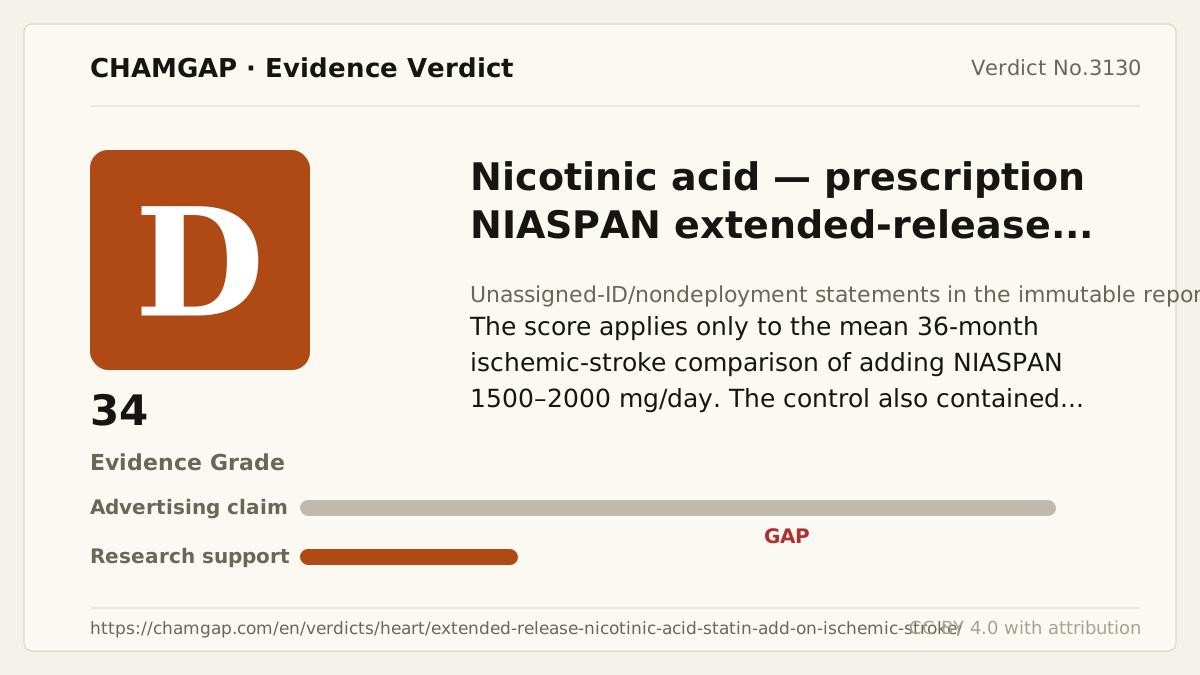
[Chamgap] Nicotinic acid × stroke incidence: extended-release niacin added to statin-based therapy — Evidence Grade D·34. 13 cited sources checked. Source: https://chamgap.com/en/verdicts/heart/extended-release-nicotinic-acid-statin-add-on-ischemic-stroke/ · CC BY 4.0CC BY 4.0 — free to use with attribution; do not distort grades, numbers, or verdict meaning.
What this document does and does not do
Chamgap is an information source. It reports what research has and has not confirmed; it does not tell readers what to take or buy. That decision belongs to readers and, when needed, medical or legal professionals. This verdict reflects literature available up to the search date and may change as new research appears. Nothing here is medical advice.