
Oral extended-release nicotinic acid added to atorvastatin,
does it really help with Improvement in brachial FMD in adults with coronary artery disease?
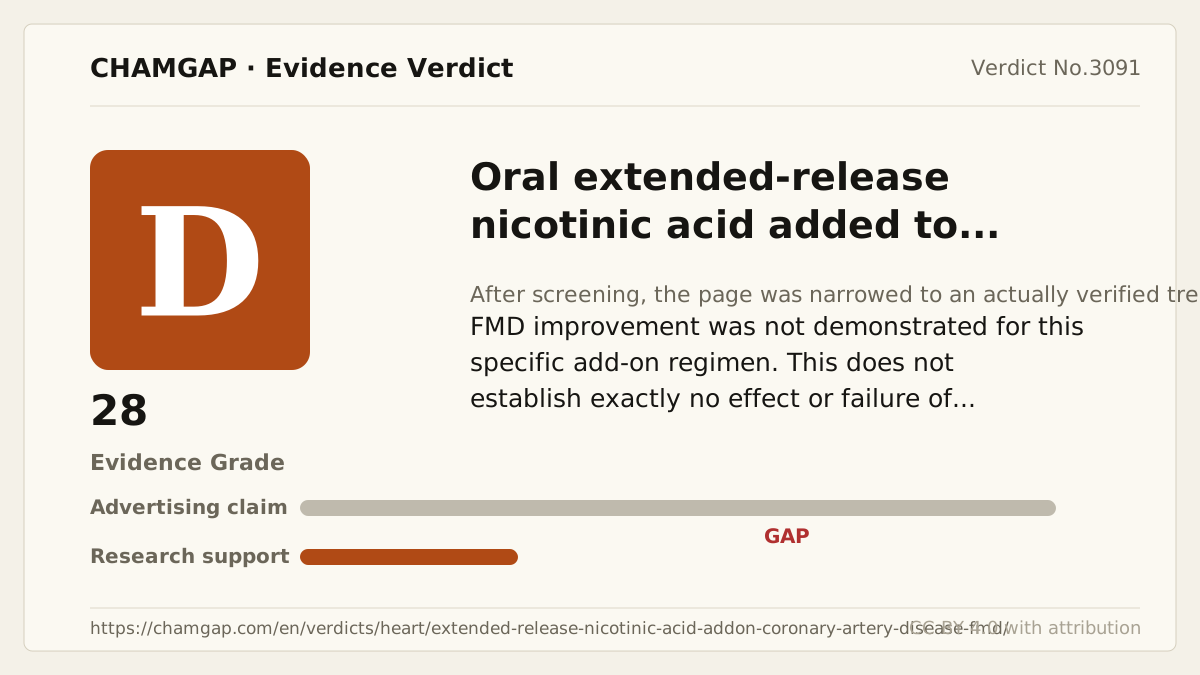
research showsIn adults with coronary artery disease receiving atorvastatin 80 mg/day, the direct trial of extended-release nicotinic acid 1500 mg/day for each 3-month treatment period did not demonstrate improved FMD versus placebo. The current grade is D, 28 points. [S01]
ads claimA claim that vascular measurements or lipids improved is not enough to conclude that this add-on regimen improves FMD or prevents myocardial infarction or stroke. [S01]
Four separate assessment dimensions
| Effect direction and size | In adults with coronary artery disease receiving atorvastatin 80 mg/day, the direct trial of extended-release nicotinic acid 1500 mg/day for each 3-month treatment period did not demonstrate improved FMD versus placebo. The current grade is D, 28 points. [S01] |
|---|---|
| Evidence certainty | The supplied rubric axes are B / S / R1 / I1 / E0 / B1 / CX. The small direct trial failed to demonstrate improvement; repeated refutation and exclusion of a meaningful benefit were not established. The calculator’s D floor and the anchor for 0 strengths give 28 points. E0 here means failure to demonstrate improvement, not an effect of exactly 0. F criteria are not met, and direct human evidence exists, so ? is not substituted. |
| Applicability | Adults with coronary artery disease, common atorvastatin 80 mg/day |
| Safety | Caution. The FDA’s 2020 NIASPAN information describes flushing, liver injury, increases in glucose or uric acid, and myopathy or rhabdomyolysis risk with statins. This drug has contraindications including active liver disease and requires clinical oversight and monitoring; self-medication for FMD or arbitrary substitution between release formulations is not advised. This is a historical product label, and the decisive trial’s brand is unconfirmed. Its adverse-event and withdrawal counts and long-term safety were not verified; unreported information is not treated as absence of events. [S12][S01] |
D, 28 points is a current Chamgap rule-based evidence indicator, not proof of exactly zero effect, a treatment-success probability or a manuscript-quality grade.
Useful facts when choosing a product
- The molecular identity is restricted to clinical nicotinic acid (niacin), distinct from nicotinamide.
- ER release, oral administration and the 1500 mg/day study target dose are confirmed; the exact salt, manufacturing origin, brand, excipients and titration remain unconfirmed.
- The endothelial-dysfunction threshold, FMD protocol, washout, placebo ingredients and other common treatments are also unconfirmed. This does not mean the study itself lacked those details. [S01][S13]
Chamgap Semantic Classification Code
Permanent code issued
M.extended-release-nicotinic-acid.oral-addon.flow-mediated-dilation.improve.addonMedicines > Brand-unconfirmed extended-release nicotinic acid > Oral add-on > Brachial FMD in coronary artery disease > Improvement claim > Placebo period on common atorvastatin
Technically bound to the ChatGPT-fixed current-value boundary of ER nicotinic acid 1500 mg/day on common atorvastatin 80 mg/day, each three-month crossover period, and FMD. The unconfirmed brand, salt and clinical details remain in multidimensional fields and revision history. The code identifies the intervention and claim; it never contains the evidence grade, score, or safety result.
Exact Claim Classification
These independent facets prevent evidence from different forms, routes, populations, effects, and comparators from being mixed.
| Intervention class | M · Medicine |
|---|---|
| Canonical ingredient or intervention | Nicotinic acid (niacin), not nicotinamide |
| Source or part used | Manufacturing origin unconfirmed; botanical part not applicable |
| Formulation or processing | Extended-release (ER); exact salt, brand and manufacturer unconfirmed |
| Route | Oral |
| Dose | 1500 mg/day |
| Duration | Each treatment period 3 months; titration/washout unconfirmed |
| Population | Adults with coronary artery disease, common atorvastatin 80 mg/day |
| Effect or condition | Improvement in brachial FMD |
| Primary endpoint | Page priority endpoint: between-treatment period-end brachial FMD; registered primary status unconfirmed |
| Comparator | Placebo period on the same atorvastatin; placebo composition unconfirmed |
| Duplicate-detection key | extended-release-nicotinic-acid|oral-addon|1500mg-day|3months-per-period|coronary-artery-disease-on-atorvastatin-80mg-day|brachial-fmd-period-end|placebo-crossover-period |
What the research actually shows
The original abstract describes a randomized crossover trial of 66 participants. Period-end FMD was 6.6 ± 4.8% with nicotinic acid and 6.1 ± 4.9% with placebo, P=0.48. The type of ± statistic and the FMD analysis denominator were not verified in the accessed abstract. Simple subtraction gives +0.5 percentage points, but this is not a verified crossover-model treatment coefficient or a difference in changes from baseline. The paired between-treatment confidence interval is unconfirmed. [S01]
Why this is classified as D (28)
The supplied rubric axes are B / S / R1 / I1 / E0 / B1 / CX. The small direct trial failed to demonstrate improvement; repeated refutation and exclusion of a meaningful benefit were not established. The calculator’s D floor and the anchor for 0 strengths give 28 points. E0 here means failure to demonstrate improvement, not an effect of exactly 0. F criteria are not met, and direct human evidence exists, so ? is not substituted.
Counterpoint. Some studies under other conditions reported positive findings. INEF did not demonstrate an overall FMD benefit but reported a positive post-hoc low-HDL subgroup. The positive statement in metabolic syndrome was a within-niacin-group change; an HIV trial differed between unadjusted changes and adjusted end-of-period comparisons. These findings are retained, but different doses, periods, populations and controls are not combined as repeated confirmation of this fixed contrast. [S02][S03][S05]
Rejudgment record. In adults with coronary artery disease receiving atorvastatin 80 mg/day, the direct trial of extended-release nicotinic acid 1500 mg/day for each 3-month treatment period did not demonstrate improved FMD versus placebo. The current grade is D, 28 points. [S01] — The supplied rubric axes are B / S / R1 / I1 / E0 / B1 / CX. The small direct trial failed to demonstrate improvement; repeated refutation and exclusion of a meaningful benefit were not established. The calculator’s D floor and the anchor for 0 strengths give 28 points. E0 here means failure to demonstrate improvement, not an effect of exactly 0. F criteria are not met, and direct human evidence exists, so ? is not substituted.
| Endpoint | S | Surrogate marker - laboratory or imaging measures Case application: Brachial FMD is a surrogate, not a cardiovascular-event endpoint. |
| Replication | R1 | Single confirmatory trial Case application: One direct trial for the fixed 1500 mg plus atorvastatin 80 mg, 3-month-period contrast. Different regimens/populations/combinations do not establish R2 or RX. R1 does not assert verified confirmatory preregistration. |
| Independence | I1 | Mixed funding sources Case application: Funding, product supply and author conflicts of the decisive trial were not verified. I1 follows precedent 29 for unknown funding, not a factual claim that mixed funding was established. |
| Effect size | E0 | Null Case application: The original abstract reports FMD P=0.48 and failure to demonstrate improvement. E0 is not evidence of exactly zero effect or exclusion of a clinically worthwhile benefit. |
| Precision | CX | No pooled confidence interval could be confirmed Case application: The crossover contrast CI, paired dispersion, analysis denominator and applicable between-group MCID were not verified. Nonsignificance is not C1. This is an access/verification limitation, not a claim of permanent mathematical impossibility. |
Review performed and remaining limitations
The main full text and registry record, paired treatment CI, FMD analysis denominator, dispersion type, measurement protocol, funding and conflicts, and trial-specific adverse-event and withdrawal counts remain unconfirmed.
Search scope and limitations. search_log.json and verification_report.md in the R01-011 verified package
Evidence Table
| Study | Design | Sample | Funding | Endpoint | Result | Weight |
|---|---|---|---|---|---|---|
| Philpott 2013 / NCT00150722 direct trial | Randomized crossover trial; ER nicotinic acid versus placebo by treatment period | 66 participants in the study; FMD analysis denominator unconfirmed | Funding, product supply and author conflicts unconfirmed | Brachial FMD at the end of each three-month treatment period | ER nicotinic acid 6.6 ± 4.8% versus placebo 6.1 ± 4.9%, P=0.48. The dispersion type and paired contrast CI are unconfirmed. The simple +0.5-point subtraction is not a verified crossover-model effect. | Decisive direct trial for the fixed question |
| INEF randomized trial | Randomized double-blind placebo-controlled trial, 12 weeks | 107 randomized; arm denominators for the post-hoc subgroup unconfirmed | Funding and conflicts relevant to this page were unconfirmed in the accessed material | FMD, separating the whole cohort from a post-hoc low-HDL subgroup | No whole-cohort FMD benefit was reported. The post-hoc low-HDL subgroup changed by 3.25 versus 1.03 points, P=0.047, but was not counted as replication of the fixed contrast. | Contextual evidence with a different dose, population and estimand |
| Thoenes/Vaccari metabolic-syndrome trial family | Randomized study, 52 weeks; potentially overlapping reports treated as one trial family | 50 randomized participants | Funding and conflicts relevant to this page were unconfirmed from the accessed abstract | Endothelial function; within-niacin-group change | A 22% within-niacin-group improvement was reported, P<0.001. The between-group FMD contrast and CI are unconfirmed. | Not used for the direct effect judgment because it is a within-group result in a different population and dose |
| Chow 2010 / NCT00986986 HIV trial | Randomized placebo-controlled trial, 12 weeks; maximum dose 1500 mg/day | 10 participants receiving niacin and 9 receiving placebo | The manuscript acknowledgements were inspected, but this trial was not used as independent replication of the direct contrast | FMD change and end-of-period FMD adjusted for baseline FMD and HDL-C | The unadjusted change comparison gave P=0.67, whereas the adjusted end-of-period comparison gave P=0.048. The adjusted treatment-contrast CI is unconfirmed. | Retained only as contrasting context because the population and analysis differ |
| Dubé / NCT01426438 HIV comparative trial | ER niacin plus aspirin versus fenofibrate, 24 weeks | 99 randomized; 74 complete scans (35/39) | Funding and conflicts relevant to this page were unconfirmed from the accessed abstract | Within-arm FMD change | Median change was 0.6 points with niacin, P=0.28, and 0.5 points with fenofibrate, P=0.19. The between-group contrast and CI are unconfirmed. | Not used for the direct judgment because the population, co-intervention and comparator differ |
| FDA NIASPAN 2020 prescribing information | Regulatory safety document and pooled clinical-trial information | 402 pooled participants; median treatment duration 16 weeks | Product prescribing information, separate from the decisive FMD trial | Contraindications, warnings, adverse reactions and discontinuation due to adverse events | The label identifies flushing, liver injury, glucose or urate increases and myopathy risk with statins. Pooled discontinuation was 16% with niacin versus 4% with placebo, not an event rate from the decisive FMD trial. | Safety context; not used in the efficacy score |
| NCT01052311 terminated combination trial | Registered study of a niacin/laropiprant combination | Actual enrollment of 8 participants | Registry context for sponsor discontinuation, separate from the decisive trial | Planned FMD outcome | No results were posted and no FMD value was imputed. The study stopped after the sponsor decided to withdraw the study drug from the market. | Used to document the combination boundary and unreported evidence |
Receipt — 15 References
Evidence access cutoff: 2026-09-15. Each citation states its actual access level (full-text transcription, abstract, index, or other) and remaining limitations. Bibliographic checking does not certify the study results or treatment efficacy.
Technical integration by: Codex · Evidence date: 2026-09-15 · Corrections: none
Cite this verdict
[Chamgap] Does adding extended-release nicotinic acid to high-dose statin therapy improve endothelial function? — Evidence Grade D·28. 15 cited sources checked. Source: https://chamgap.com/en/verdicts/heart/extended-release-nicotinic-acid-addon-coronary-artery-disease-fmd/ · CC BY 4.0CC BY 4.0 — free to use with attribution; do not distort grades, numbers, or verdict meaning.
What this document does and does not do
Chamgap is an information source. It reports what research has and has not confirmed; it does not tell readers what to take or buy. That decision belongs to readers and, when needed, medical or legal professionals. This verdict reflects literature available up to the search date and may change as new research appears. Nothing here is medical advice.