
Extended-release niacin added to statins,
does it really help with Reduction in major cardiovascular events?
research showsThe grade is D. AIM-HIGH found a primary event rate of 16.4% versus 16.2%, HR 1.02 (95% CI 0.87 to 1.21), and HPS2-THRIVE found 13.2% versus 13.7%, rate ratio 0.96 (0.90 to 1.03). Two large trials with nonoverlapping author teams failed to demonstrate a reduction in clinical cardiovascular events, although their intervals did not exclude a meaningful benefit.
ads claimA rise in HDL and a further fall in LDL are laboratory findings, not proof that heart attacks or strokes decline. Verdict 128 is C with 50 points for cholesterol and lipid measures; this verdict addresses clinical cardiovascular events.
Useful facts when choosing a product
- The published AIM-HIGH and HPS2-THRIVE author lists have no overlapping name.
- Serious disturbance of diabetes control was 11.1% versus 7.5%, new diabetes was 5.7% versus 4.3%, and serious musculoskeletal events were 3.7% versus 3.0% in HPS2-THRIVE.
- Treatment discontinuation in HPS2-THRIVE was 25.4% versus 16.6%; skin-related medical reasons were 5.4% versus 1.2%, and flushing was recorded as a stopping reason in 106 versus 14 participants.
Chamgap Semantic Classification Code
Candidate index · review held
UNK.extended-release-niacin-added-to-statin-therapy.UNK.major-cardiovascular-events.reduce.MULTIUnknown > extended-release niacin added to statin therapy > Unknown > major cardiovascular events > Reduction claim > Multiple: primary unresolved
An automated migration candidate, not an issued permanent code; exact claim scope remains under review. This machine-generated migration candidate helps retrieval but is not a permanent assignment. The original verdict ID and URL remain authoritative.
What the research actually shows
AIM-HIGH randomized 3,414 patients and stopped early for futility after a mean of three years. Its composite primary outcome occurred in 282/1,718 versus 274/1,696, HR 1.02 (0.87 to 1.21). HPS2-THRIVE randomized 25,673 patients and followed them for a median of four years; major vascular events occurred in 1,696/12,838 versus 1,758/12,835, rate ratio 0.96 (0.90 to 1.03). Comparing the published author lists found no overlapping name. AIM-HIGH was funded by the National Heart, Lung, and Blood Institute and Abbott Laboratories. HPS2-THRIVE was funded by Merck, the UK Medical Research Council, the British Heart Foundation, Cancer Research UK, and the BHF Centre of Research Excellence–Oxford; Merck also provided study treatments.
Why this is classified as D (34)
Two large trials with nonoverlapping author teams failed to demonstrate fewer cardiovascular events, but their intervals did not exclude meaningful benefit. Infection and bleeding were unadjusted exploratory signals, and AIM-HIGH stopped early for futility, giving D with 34 points.
Counterpoint. D does not deny changes in lipid measurements; it applies to adding high-dose extended-release niacin to statins to reduce major cardiovascular events.
Rejudgment record. Cross-check applied — Repeated null efficacy in two nonoverlapping large trials, confidence intervals that retain benefit, exploratory infection and bleeding signals, and AIM-HIGH early stopping
| Endpoint | H | Hard endpoint - actual events such as death |
| Replication | RX | Repeatedly refuted in the same indication |
| Independence | I1 | Mixed funding sources |
| Effect size | E0 | Null |
| Precision | C0 | The confidence interval leaves room for benefit |
Stored derived and displayed grades match; this is not a current recalculation or validity check (D).
Sub-claim grades by effect
This ingredient is marketed for several effects. A single overall grade blends strong and weak claims together, so each effect is graded separately here. The overall grade reflects the strongest disconfirming or core claim.
| Effect (sub-claim) | Grade | Basis |
|---|---|---|
| Reduction in major cardiovascular events | D | Two large trials failed to demonstrate event reduction, but their intervals retained the possibility of meaningful benefit. |
| Improvement in cholesterol and lipid measures | C | The separate lipid-measure verdict 128 is C with 50 points. |
Cross-check — AI research and Codex final gate
Evidence Table
| Study | Design | Sample | Funding | Endpoint | Result | Weight |
|---|---|---|---|---|---|---|
| AIM-HIGH Investigators, 2011 | Multicenter double-blind randomized placebo-controlled trial stopped early | 3,414 randomized, 1,718 versus 1,696 | Funded by the National Heart, Lung, and Blood Institute and Abbott Laboratories | Primary composite of major cardiovascular events | 282/1,718 (16.4%) versus 274/1,696 (16.2%), HR 1.02 (95% CI 0.87 to 1.21). | First large null trial |
| HPS2-THRIVE Collaborative Group, 2014 | Multinational double-blind randomized placebo-controlled trial | 25,673 randomized, 12,838 versus 12,835 | Merck, UK Medical Research Council, British Heart Foundation, Cancer Research UK, BHF Centre of Research Excellence–Oxford; Merck provided study treatments | Primary composite of major vascular events | 1,696/12,838 (13.2%) versus 1,758/12,835 (13.7%), rate ratio 0.96 (95% CI 0.90 to 1.03). Infection, 8.0% versus 6.6%, RR 1.22 (1.12 to 1.34), and bleeding, 2.5% versus 1.9%, RR 1.38 (1.17 to 1.62), were unadjusted exploratory signals rather than prespecified safety outcomes. | Second large null trial with exploratory safety signals |
Receipt — 2 References
All 2 cited sources were verified for existence at the original page (as of 2026-08-07).
Final verification and publication gate: Codex · Evidence date: 2026-08-07 · Corrections: none
Cite this verdict
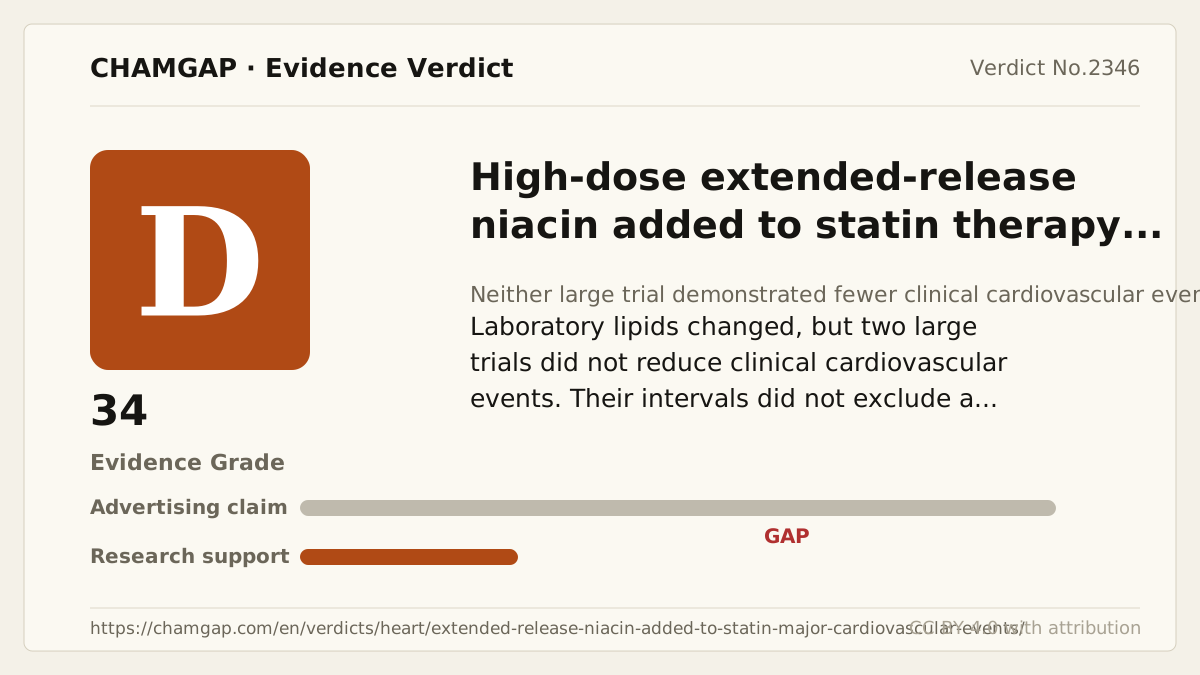
[Chamgap] Extended-release niacin added to statins x major cardiovascular events — Evidence Grade D·34. 2 cited sources checked. Source: https://chamgap.com/en/verdicts/heart/extended-release-niacin-added-to-statin-major-cardiovascular-events/ · CC BY 4.0CC BY 4.0 — free to use with attribution; do not distort grades, numbers, or verdict meaning.
What this document does and does not do
Chamgap is an information source. It reports what research has and has not confirmed; it does not tell readers what to take or buy. That decision belongs to readers and, when needed, medical or legal professionals. This verdict reflects literature available up to the search date and may change as new research appears. Nothing here is medical advice.