
Exercise-based cardiac rehabilitation,
does it really help with Reduced recurrent myocardial infarction and hospitalisation in people with coronary heart disease?
research showsExercise-based cardiac rehabilitation is rated A because direct hard-endpoint evidence for reducing recurrent myocardial infarction in coronary heart disease is of high certainty. The 2021 Cochrane review included 85 randomized trials; fatal or nonfatal myocardial infarction at 6 to 12 months had an RR of 0.72 (95% CI 0.55 to 0.93; 22 trials, 7,423 participants) with high certainty. All-cause hospital admission at the same time point had an RR of 0.58 (95% CI 0.43 to 0.77; 14 trials, 2,030 participants) with moderate certainty, whereas all-cause mortality had an RR of 0.87 (95% CI 0.73 to 1.04) with moderate certainty and included no effect.
ads claimPromotional language can recast the intervention as simple fitness training or a cure for heart disease. The studied intervention was a structured healthcare program combining risk assessment, prescribed exercise, education, and behavioral support; it is distinct from medicines, automated external defibrillators, and acute myocardial-infarction treatment.
Useful facts when choosing a product
- Exercise-based cardiac rehabilitation is not a single exercise product; it is a structured healthcare program that includes assessment, prescribed aerobic or resistance exercise, risk-factor education, and behavioral support.
- Programs in the Cochrane review were delivered in hospital, community, and home settings and used exercise alone or exercise combined with education or psychological support.
- Exercise intensity and supervision are adjusted after assessment of ischemia, arrhythmia, heart failure, postoperative status, and functional capacity.
- Serious events during exercise are uncommon, but people with chest pain, syncope, severe dyspnea, or arrhythmia risk require clinical assessment and appropriate supervision.
Chamgap Semantic Classification Code
Candidate index · review held
X.exercise-based-cardiac-rehabilitation.behavioral.recurrent-myocardial-infarction-and-hospitalisation-with-coronary-heart-disease.reduce.UNKBehaviors, exposures and policies > Exercise-based cardiac rehabilitation > Behavioral delivery > recurrent myocardial infarction and hospitalisation with coronary heart disease > Reduction claim > Unknown
An automated migration candidate, not an issued permanent code; exact claim scope remains under review. This machine-generated migration candidate helps retrieval but is not a permanent assignment. The original verdict ID and URL remain authoritative.
What the research actually shows
The 2021 Dibben Cochrane review included 85 randomized trials comparing exercise alone or exercise combined with educational or psychological components against a no-exercise control in adults with coronary heart disease. At 6 to 12 months, myocardial infarction was reduced across 22 trials and 7,423 participants, RR 0.72, with an NNTB of 75 (95% CI 47 to 298) and high GRADE certainty. All-cause admission was reduced across 14 trials and 2,030 participants, RR 0.58, NNTB 12 (95% CI 9 to 21), with moderate certainty after downgrading for suspected publication bias. All-cause mortality across 25 trials and 8,823 participants had an RR of 0.87 (95% CI 0.73 to 1.04) with moderate certainty. A 2023 European Heart Journal meta-analysis of the same 85-trial evidence base reported pooled RRs of 0.82 for myocardial infarction, 0.77 for hospitalisation, and 0.96 for all-cause mortality across follow-up.
Why this is classified as A (88)
The core adjudicated endpoint, fatal or nonfatal myocardial infarction at 6 to 12 months, was reduced with RR 0.72 (95% CI 0.55 to 0.93) across 22 trials and 7,423 participants with high GRADE certainty, while all-cause admission was also reduced with moderate certainty, giving A with 88 points.
Counterpoint. Effect sizes and statistical certainty differed for all-cause mortality and longer follow-up, so the high certainty for short-term myocardial infarction was not transferred to every mortality or long-term endpoint.
Rejudgment record. New verdict — The myocardial-infarction endpoint specified in the claim has high GRADE certainty across multiple randomized trials and the all-cause admission endpoint has moderate certainty, meeting the direct hard-endpoint rule for grade A
Sub-claim grades by effect
This ingredient is marketed for several effects. A single overall grade blends strong and weak claims together, so each effect is graded separately here. The overall grade reflects the strongest disconfirming or core claim.
| Effect (sub-claim) | Grade | Basis |
|---|---|---|
| Reduced recurrent myocardial infarction | A | At 6 to 12 months, RR was 0.72 (95% CI 0.55 to 0.93) across 22 trials and 7,423 participants, with high GRADE certainty. |
| Reduced all-cause hospital admission | B | At 6 to 12 months, RR was 0.58 (95% CI 0.43 to 0.77) across 14 trials and 2,030 participants, with moderate certainty after downgrading for suspected publication bias. |
| Reduced all-cause mortality | B | At 6 to 12 months, RR was 0.87 (95% CI 0.73 to 1.04) with moderate certainty, but the confidence interval included no effect, so a reduction was not established. |
Cross-check — AI research and Codex final gate
Evidence Table
| Study | Design | Sample | Funding | Endpoint | Result | Weight |
|---|---|---|---|---|---|---|
| Dibben G et al. 2021 | Cochrane systematic review and meta-analysis of randomized trials | 85 randomized trials and 23,430 participants; 22 trials and 7,423 participants for 6-to-12-month myocardial infarction; 14 trials and 2,030 participants for all-cause admission | Public and academic support including the UK Medical Research Council and Scottish Chief Scientist Office | Fatal or nonfatal myocardial infarction, all-cause admission, and all-cause mortality | At 6 to 12 months, myocardial infarction RR was 0.72 (95% CI 0.55 to 0.93), high certainty; all-cause admission RR was 0.58 (0.43 to 0.77), moderate certainty; all-cause mortality RR was 0.87 (0.73 to 1.04), moderate certainty. | Key endpoint-specific GRADE evidence |
| Dibben GO et al. 2023 | Contemporary meta-analysis of randomized trials in coronary heart disease | 85 randomized trials and 23,430 participants; median follow-up 12 months | Public support from the UK Medical Research Council and Scottish Chief Scientist Office | Myocardial infarction, hospitalisation, cardiovascular mortality, and all-cause mortality | Across follow-up, myocardial infarction RR was 0.82 (95% CI 0.70 to 0.96), hospitalisation RR was 0.77 (0.67 to 0.89), and all-cause mortality RR was 0.96 (0.89 to 1.04). | Cross-check of outcome direction |
Receipt — 2 References
All 2 cited sources were verified for existence at the original page (as of 2026-07-23).
Final verification and publication gate: Codex · Evidence date: 2026-07-23 · Corrections: none
Cite this verdict
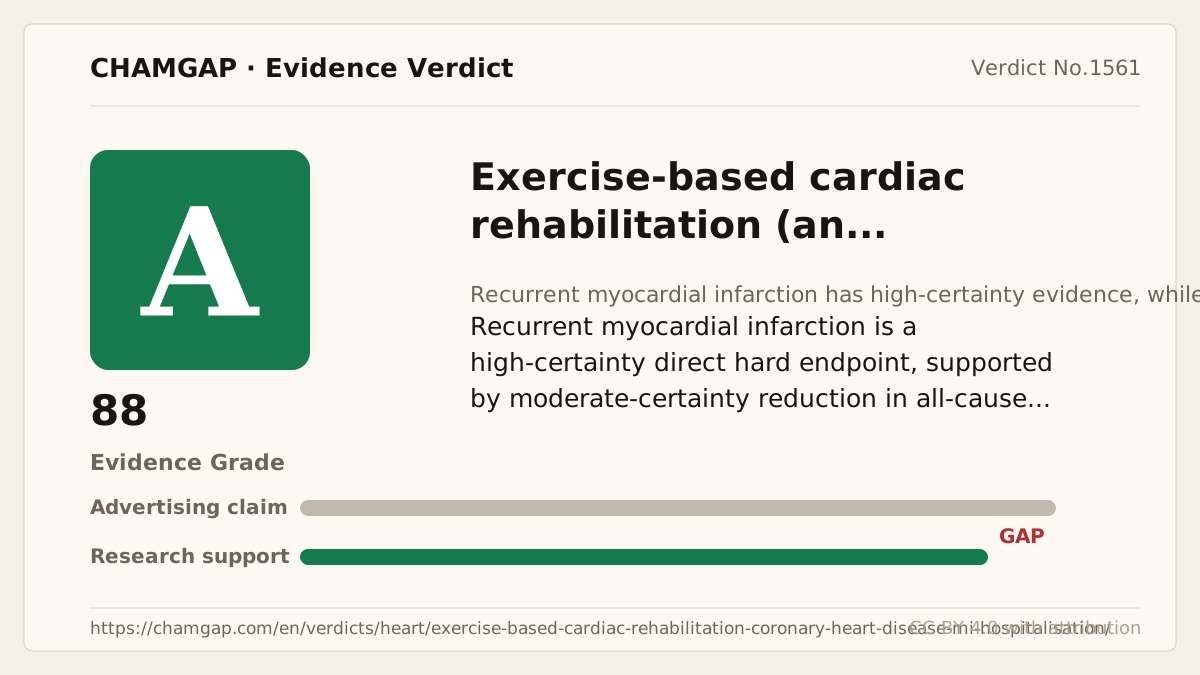
[Chamgap] Exercise-based cardiac rehabilitation x reduced recurrent myocardial infarction and hospitalisation in coronary heart disease — Evidence Grade A·88. 2 cited sources checked. Source: https://chamgap.com/en/verdicts/heart/exercise-based-cardiac-rehabilitation-coronary-heart-disease-mi-hospitalisation/ · CC BY 4.0CC BY 4.0 — free to use with attribution; do not distort grades, numbers, or verdict meaning.
What this document does and does not do
Chamgap is an information source. It reports what research has and has not confirmed; it does not tell readers what to take or buy. That decision belongs to readers and, when needed, medical or legal professionals. This verdict reflects literature available up to the search date and may change as new research appears. Nothing here is medical advice.