
Nicotinic acid,
does it really help with Two-year triglyceride percentage change?
research showsAt two years in AIM-HIGH, reported triglyceride changes were −28.6% with the ER-niacin strategy and −8.1% with control, an arithmetic contrast of −20.5 percentage points. This is not cardiovascular-event prevention or evidence for every formulation and dose in all hypertriglyceridaemia. [S15; S17]
ads claimThis is not individual dosing advice. It does not establish the same effect for generic vitamin B3, no-flush niacin, nicotinamide or another formulation. [S15:form]
Four separate assessment dimensions
| Effect direction and size | At two years in AIM-HIGH, reported triglyceride changes were −28.6% with the ER-niacin strategy and −8.1% with control, an arithmetic contrast of −20.5 percentage points. This is not cardiovascular-event prevention or evidence for every formulation and dose in all hypertriglyceridaemia. [S15; S17] |
|---|---|
| Evidence certainty | The current rubric caps surrogate endpoint S and EX(a) at C. Zero counted strengths gives the fixed 46-point anchor. This does not deny the lipid decrease; it avoids claiming established clinical importance, independent replication or verified precision. |
| Applicability | Adults ≥45 with established ASCVD and low-HDL/residual dyslipidaemia tolerating niacin run-in. Entry TG >150 and <400 mg/dL off statins or >100 and <400 on statins. Not a nutrient-deficiency treatment cohort. |
| Safety | This pharmacological regimen has flushing, liver-enzyme, glucose/urate and specific laboratory-interference risks. Study-drug discontinuation of 25.4% versus 20.1% is not loss to follow-up. The 4–8-week tolerability run-in limits safety generalization to all starters. Safety details are from the fixed 2020 FDA source, not new current prescribing guidance. Research doses are not personal dosing instructions. [S15:safety; S15:interference; S17:discontinuation; S18:runin] |
C/46 is a Chamgap rule-based evidence indicator, not a treatment-success probability. Document quality A is separate, and precision/applicability limits remain explicit.
Useful facts when choosing a product
- 3414 (1718 versus 1696) is the randomized sample, not a verified two-year TG analysis denominator. [S15:aim_tg]
- The −20.5 percentage-point contrast subtracts reported arm-level percentage changes; it is not an adjusted mean difference, mg/dL difference or NNT. [S15:aim_tg; S17:tg]
- The estimator for percentage change and between-arm lipid CI/change-score SD were not confirmed in the accessed sources. [S15 limitations; S17 limitations]
Chamgap Semantic Classification Code
Permanent code issued
M.niaspan-er-nicotinic-acid.oral-addon.triglycerides.reduce.low-doseMedicines > NIASPAN extended-release nicotinic acid > Oral add-on > Two-year triglyceride percentage change > Reduction claim > Low-dose immediate-release niacin control
Technically bound to the ChatGPT-verified AIM-HIGH boundary of NIASPAN 1500–2000 mg/day as an add-on and the two-year triglyceride percentage change. Dose, population, background statin±ezetimibe, and the low-dose immediate-release niacin control remain in the exact facets. The code identifies the intervention and claim; it never contains the evidence grade, score, or safety result.
Exact Claim Classification
These independent facets prevent evidence from different forms, routes, populations, effects, and comparators from being mixed.
| Intervention class | M · Medicine |
|---|---|
| Canonical ingredient or intervention | Nicotinic acid (prescription NIASPAN ER tablets added to LDL-targeted statin therapy) |
| Source or part used | Nicotinic acid chemical entity; botanical part not applicable, manufacturing origin unconfirmed |
| Formulation or processing | NIASPAN nicotinic-acid extended-release tablets; not nicotinamide or inositol hexanicotinate |
| Route | Oral |
| Dose | 1500–2000 mg/day; control includes IR niacin 100–150 mg/day |
| Duration | Two-year lipid assessment; trial stopped early after approximately three years; 4–8-week run-in before randomization |
| Population | Adults ≥45 with established ASCVD and low-HDL/residual dyslipidaemia tolerating niacin run-in. Entry TG >150 and <400 mg/dL off statins or >100 and <400 on statins. Not a nutrient-deficiency treatment cohort. |
| Effect or condition | Two-year triglyceride percentage change |
| Primary endpoint | Reported baseline-to-two-year TG percentage change: page endpoint. Trial primary: cardiovascular composite; lipids were a protocol tertiary objective. |
| Comparator | Both groups used simvastatin 40–80 mg/day±ezetimibe 10 mg/day for LDL-C 40–80 mg/dL. Control contained IR niacin 50 mg/tablet (100–150 mg/day). Actual background doses were titrated, so this is a treatment-strategy contrast, not identical fixed background dosing. |
| Duplicate-detection key | nicotinic-acid|NIASPAN-ER|oral|1500-2000mg-day|ASCVD-low-HDL-runin-tolerant|LDL-targeted-statin-ezetimibe-strategy|TG-percent-change|2years|control-IR-niacin-100-150mg-day |
What the research actually shows
At two years in AIM-HIGH, reported triglyceride changes were −28.6% with the ER-niacin strategy and −8.1% with control, an arithmetic contrast of −20.5 percentage points. This is not cardiovascular-event prevention or evidence for every formulation and dose in all hypertriglyceridaemia. Background medication was titrated to the same LDL target. Tolerability run-in and a low-dose-niacin control mean this is not niacin alone versus no treatment in all patients. [S15:aim_regimen; S17:comparison; S18:runin]
Why this is classified as C (46)
The current rubric caps surrogate endpoint S and EX(a) at C. Zero counted strengths gives the fixed 46-point anchor. This does not deny the lipid decrease; it avoids claiming established clinical importance, independent replication or verified precision.
Counterpoint. The cardiovascular primary endpoint failed and the trial stopped early; lipids were a tertiary protocol objective. This does not negate the TG reduction, but lipid lowering alone does not establish clinical-event prevention. [S17:primary; S19:hierarchy]
Rejudgment record. Retains both the consistent lipid decrease and its interpretation limits — Provided rubric precedents 28, 29 and 40, surrogate cap, actual grade calculator, and C46 fixed anchor for zero strengths
| Endpoint | S | Surrogate marker - laboratory or imaging measures Case application: S: blood surrogate. |
| Replication | R1 | Single confirmatory trial Case application: R1: the identified trial family is not double-counted. Multiple label trials are not R2 without verified independent authors/funding. |
| Independence | I1 | Mixed funding sources |
| Effect size | EX | The clinical size of the effect could not be judged |
| Precision | CX | No pooled confidence interval could be confirmed Case application: CX: lipid contrast CI unconfirmed; no substitution of a cardiovascular HR CI. |
Stored derived and displayed grades match; this is not a current recalculation or validity check (C).
Review performed and remaining limitations
Two-year lipid denominators, missing-data detail and a between-arm CI were not confirmed. ITT wording for event outcomes is not taken as proof of complete lipid-data analysis. Mixed NHLBI/Abbott support and product supply: I1. Reported sponsor non-involvement in analysis does not convert mixed funding to I2.
Preliminary RoB 2-informed review — not a complete formal assessment
| Randomization | The body text describes secure Internet randomization and double blinding, with a low-dose-niacin control used for masking. |
|---|---|
| Deviations from assigned interventions | Background treatment was target-titrated; medication discontinuation is distinct from missing follow-up. |
| Missing outcome data | Two-year lipid denominators, missing-data detail and a between-arm CI were not confirmed. ITT wording for event outcomes is not taken as proof of complete lipid-data analysis. |
| Outcome measurement | Objective blood-lipid marker. Sample/time/%p distinctions are retained without turning it into event prevention. |
| Selection of the reported result | The archived protocol is Amendment 6 dated 2011-06-01; lipids are tertiary objectives and the event primary has an amendment history. Complete reconciliation with initial registration is not claimed. |
Reasons for the certainty judgment — not formal GRADE
| Risk of bias | B1: early stopping. |
|---|---|
| Inconsistency | Primary and regulatory figures crosschecked; discrepancies at other endpoints/times are neither hidden nor pooled. |
| Indirectness | No generalization to other formulations, populations, co-treatments or clinical events. |
| Imprecision | Lipid contrast CI/SD unconfirmed. The observed decrease is retained with EX(a), not relabelled null or below MCID. |
| Publication bias | Exhaustive database/unpublished-trial searching was not achieved; publication bias is not declared absent. |
Search scope and limitations. 2026-09-14 web-index discovery, the provided 3081-record index and relevant originals, and direct publisher/FDA/NHLBI sources. See verification report and sources.json for queries/access failures; not an exhaustive PubMed systematic search.
Evidence Table
| Study | Design | Sample | Funding | Endpoint | Result | Weight |
|---|---|---|---|---|---|---|
| AIM-HIGH | Multicentre randomized double-blind treatment-strategy trial; stopped early | 3414 randomized: 1718/1696; two-year TG analysis n unconfirmed | Mixed NHLBI/Abbott support and product supply: I1. Reported sponsor non-involvement in analysis does not convert mixed funding to I2. | Reported baseline-to-two-year TG percentage change: page endpoint. Trial primary: cardiovascular composite; lipids were a protocol tertiary objective. | At two years in AIM-HIGH, reported triglyceride changes were −28.6% with the ER-niacin strategy and −8.1% with control, an arithmetic contrast of −20.5 percentage points. This is not cardiovascular-event prevention or evidence for every formulation and dose in all hypertriglyceridaemia. | Pivotal trial within the bounded question; crosschecked against S15 official clinical data |
Receipt — 4 References
Evidence access cutoff: 2026-09-14. Each citation states its actual access level (full-text transcription, abstract, index, or other) and remaining limitations. Bibliographic checking does not certify the study results or treatment efficacy.
Technical integration by: Codex · Evidence date: 2026-09-14 · Corrections: 8
Correction log — 8
Corrections applied to this verdict, in chronological order. Changes are logged, not erased.
- 2026-09-14 · Pre-submission self-check correction / prevented misreading — See shared/corrections.json; source IDs: S15,S17,S19 (grade not_published→C)
- 2026-09-14 · Pre-submission self-check correction / prevented misreading — See shared/corrections.json; source IDs: S18,S19 (grade not_published→C)
- 2026-09-14 · Pre-submission self-check correction / prevented misreading — See shared/corrections.json; source IDs: S15,S17 (grade not_published→C)
- 2026-09-14 · Pre-submission self-check correction / prevented misreading — See shared/corrections.json; source IDs: S15 (grade not_published→C)
- 2026-09-14 · Pre-submission self-check correction / prevented misreading — See shared/corrections.json; source IDs: S17,S19 (grade not_published→C)
- 2026-09-14 · Pre-submission self-check correction / prevented misreading — See shared/corrections.json; source IDs: L128,S15 (grade not_published→C)
- 2026-09-14 · Pre-submission self-check correction / prevented misreading — See shared/corrections.json; source IDs: S15,S16 (grade not_published→C)
- 2026-09-14 · Pre-submission self-check correction / prevented misreading — See shared/corrections.json; source IDs: S17 (grade not_published→C)
Cite this verdict
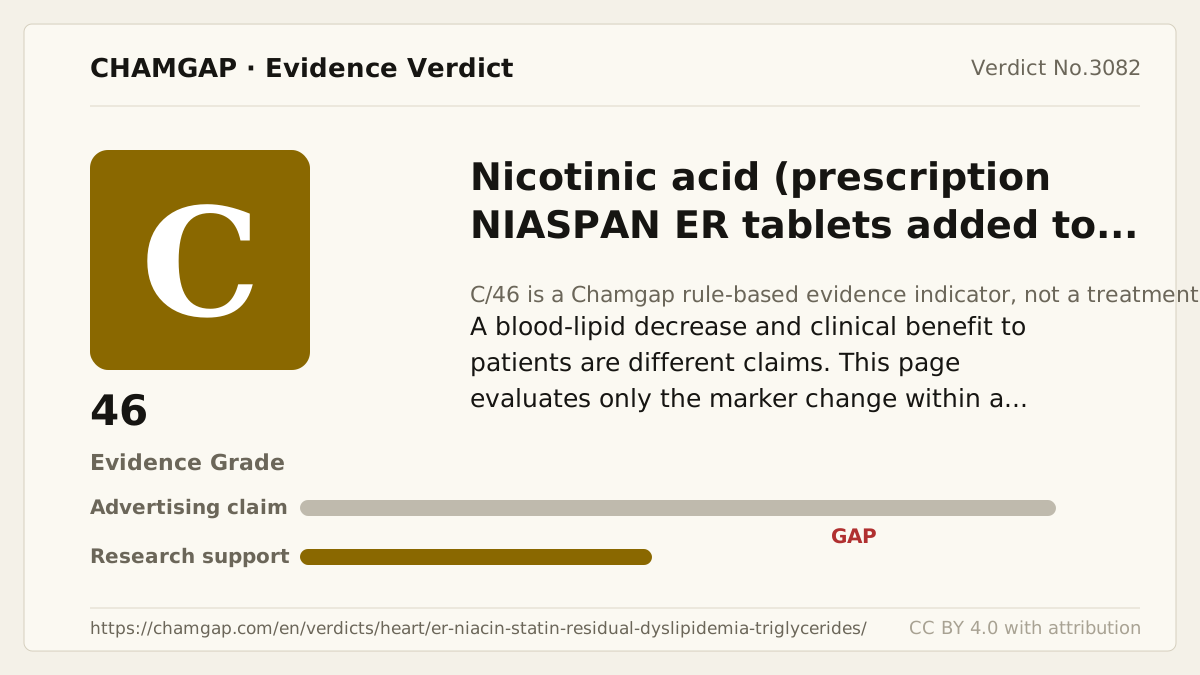
[Chamgap] Added ER nicotinic acid × triglycerides in statin-treated residual dyslipidaemia — Evidence Grade C·46. 4 cited sources checked. Source: https://chamgap.com/en/verdicts/heart/er-niacin-statin-residual-dyslipidemia-triglycerides/ · CC BY 4.0CC BY 4.0 — free to use with attribution; do not distort grades, numbers, or verdict meaning.
What this document does and does not do
Chamgap is an information source. It reports what research has and has not confirmed; it does not tell readers what to take or buy. That decision belongs to readers and, when needed, medical or legal professionals. This verdict reflects literature available up to the search date and may change as new research appears. Nothing here is medical advice.