
Enoxaparin,
does it really help with Reduced composite risk of death or nonfatal recurrent myocardial infarction versus unfractionated heparin in fibrinolysis-treated STEMI?
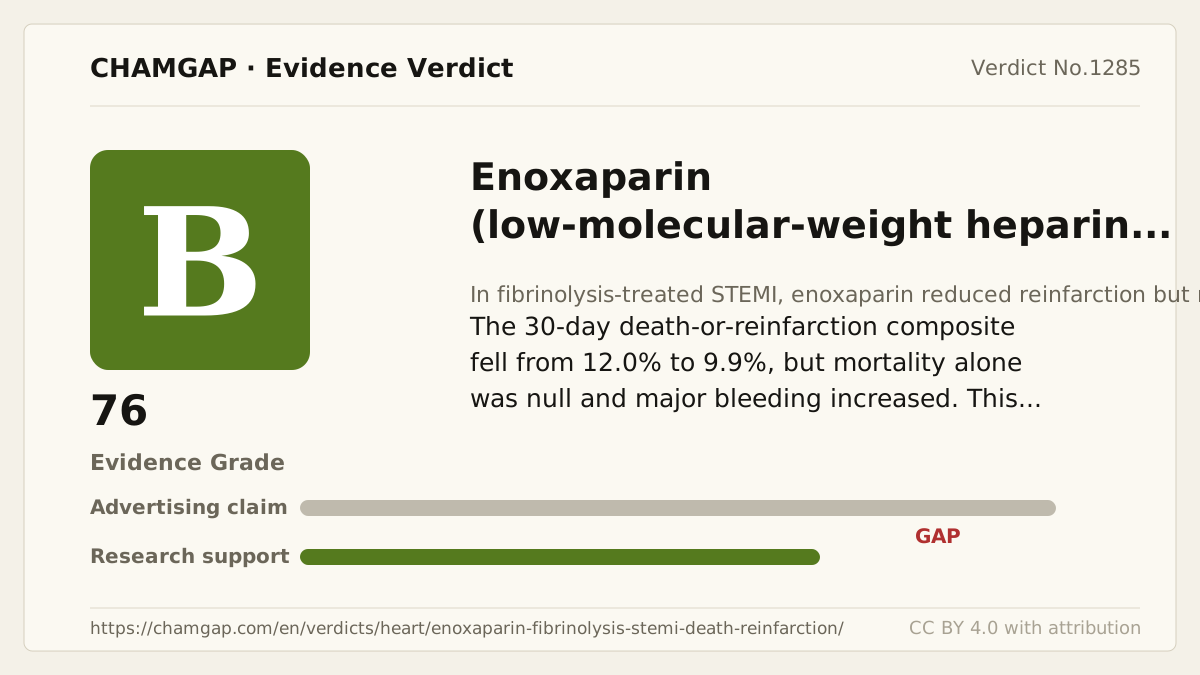
research showsThe enoxaparin strategy for fibrinolysis-treated ST-elevation myocardial infarction is rated B. In the randomized double-blind ExTRACT-TIMI 25 trial of about 20,500 patients, 30-day death or nonfatal recurrent myocardial infarction occurred in 9.9% with enoxaparin and 12.0% with unfractionated heparin (P<0.001). The benefit was clear for nonfatal reinfarction, 3.0% versus 4.5%, while mortality alone was not significantly different, 6.9% versus 7.5% (P=0.11). TIMI major bleeding increased from 1.4% to 2.1%, and the comparison bundled enoxaparin for up to eight days against unfractionated heparin for about 48 hours. These features support B with 76 points rather than A.
ads claimCalling enoxaparin an injection that lowers mortality is inaccurate. The statistically secure 30-day benefit was the composite of death and nonfatal reinfarction, while mortality alone was nonsignificant. Bleeding risk and age- and renal-adjusted dosing must accompany efficacy claims.
Useful facts when choosing a product
- Enoxaparin is an anticoagulant low-molecular-weight heparin. This verdict is restricted to adjunctive anticoagulation in acute STEMI treated with fibrinolysis and is separate from primary percutaneous coronary intervention strategies.
- The ExTRACT regimen used an intravenous loading dose followed by subcutaneous dosing every 12 hours in patients younger than 75 years, and a reduced regimen without the intravenous bolus in older patients. Severe renal impairment requires further dose or interval adjustment.
- Bleeding is the principal harm. Active major bleeding and recent immune-mediated heparin-induced thrombocytopenia or relevant antibodies are contraindications, and platelets, hemoglobin, and renal function require monitoring.
- Neuraxial procedures create a spinal or epidural hematoma risk, and antiplatelet drugs, other anticoagulants, and nonsteroidal anti-inflammatory drugs can increase bleeding. Emergency myocardial-infarction treatment follows hospital protocols and specialist judgment.
Chamgap Semantic Classification Code
Candidate index · review held
M.enoxaparin.UNK.composite-risk-of-death-or-nonfatal-recurrent-myocardial-infarction.reduce.MULTIMedicinal interventions > Enoxaparin > Unknown > composite risk of death or nonfatal recurrent myocardial infarction > Reduction claim > Multiple: primary unresolved
An automated migration candidate, not an issued permanent code; exact claim scope remains under review. This machine-generated migration candidate helps retrieval but is not a permanent assignment. The original verdict ID and URL remain authoritative.
What the research actually shows
ExTRACT-TIMI 25 double-masked and double-dummied 20,506 patients with STEMI presenting within six hours and scheduled for fibrinolysis to enoxaparin or unfractionated heparin. Enoxaparin continued through hospitalization for up to eight days, whereas unfractionated heparin lasted about 48 hours, so this was a combined drug-and-duration strategy rather than a same-duration comparison of the molecules alone. At 30 days, death or nonfatal reinfarction was 9.9% versus 12.0%, nonfatal reinfarction 3.0% versus 4.5%, and urgent revascularization 2.1% versus 2.8%. Mortality was not significantly different at 6.9% versus 7.5%, while TIMI major bleeding increased to 2.1% from 1.4%. Among 20,275 patients followed to one year, death or nonfatal myocardial infarction remained lower at 15.8% versus 17.0%, but mortality alone was 10.5% versus 10.6%, indicating that sustained benefit mainly reflected early prevention of reinfarction.
Why this is classified as B (76)
ExTRACT-TIMI 25 was a double-blind active-controlled trial of about 20,500 patients that reduced 30-day death or nonfatal reinfarction from 12.0% to 9.9%, with the reinfarction benefit persisting to one year. Mortality alone was null at both 30 days and one year, major bleeding increased, and the strategy compared up to eight days of enoxaparin with about 48 hours of unfractionated heparin, bundling molecule and duration. This supports B with 76 points.
Counterpoint. In a fibrinolysis setting, prevention of reocclusion and reinfarction is clinically important. Net benefit can differ in patients at high bleeding risk, older patients, and renal impairment, and anticoagulant choice for primary percutaneous coronary intervention follows separate evidence.
Rejudgment record. Cross-check applied — Applied B because the large double-blind active-controlled ExTRACT-TIMI 25 trial reduced the hard composite of death or nonfatal reinfarction and recurrent infarction, but mortality alone was null, major bleeding increased, and the comparison bundled up to eight days of enoxaparin against about 48 hours of unfractionated heparin, invoking the composite-endpoint and active-comparator rules
Sub-claim grades by effect
This ingredient is marketed for several effects. A single overall grade blends strong and weak claims together, so each effect is graded separately here. The overall grade reflects the strongest disconfirming or core claim.
| Effect (sub-claim) | Grade | Basis |
|---|---|---|
| Reduced 30-day composite risk of death or nonfatal recurrent myocardial infarction | B | The difference, 9.9% versus 12.0%, was significant, but mortality alone was null and TIMI major bleeding increased to 2.1% from 1.4%. The trial compared an in-hospital enoxaparin strategy with about 48 hours of unfractionated heparin, not the molecules over the same duration. |
| Reduced nonfatal recurrent myocardial infarction | B | Rates were 3.0% versus 4.5% at 30 days and remained different at one year, 5.7% versus 6.8%. |
| Reduction in all-cause mortality alone | D | There was no significant reduction: 6.9% versus 7.5% at 30 days (P=0.11) and 10.5% versus 10.6% at one year. |
Cross-check — AI research and Codex final gate
Evidence Table
| Study | Design | Sample | Funding | Endpoint | Result | Weight |
|---|---|---|---|---|---|---|
| Antman EM et al.; ExTRACT-TIMI 25 Investigators. 2006 | Multinational randomized double-blind double-dummy active-controlled trial | 20,506 randomized; 20,479 in the 30-day efficacy analysis | Research grant from Sanofi-Aventis | All-cause death or nonfatal recurrent myocardial infarction at 30 days; TIMI major bleeding | Composite 9.9% versus 12.0% (P<0.001), reinfarction 3.0% versus 4.5%, mortality 6.9% versus 7.5% (P=0.11), and major bleeding 2.1% versus 1.4%. | Core large randomized hard-composite trial |
| Morrow DA et al.; ExTRACT-TIMI 25 Investigators. 2010 | One-year follow-up analysis by original randomized assignment | 20,275 participants followed for one year | Sanofi-Aventis-sponsored ExTRACT-TIMI 25 | Death, nonfatal myocardial infarction, and disabling stroke at one year | Death or nonfatal myocardial infarction was 15.8% versus 17.0% (HR 0.92), nonfatal myocardial infarction 5.7% versus 6.8%, and mortality was null at 10.5% versus 10.6%. | Durability confirmation and cross-check of null mortality |
Receipt — 2 References
All 2 cited sources were verified for existence at the original page (as of 2026-07-24).
Final verification and publication gate: Codex · Evidence date: 2026-07-24 · Corrections: none
Cite this verdict
[Chamgap] Enoxaparin x reduced death or nonfatal reinfarction in fibrinolysis-treated STEMI — Evidence Grade B·76. 2 cited sources checked. Source: https://chamgap.com/en/verdicts/heart/enoxaparin-fibrinolysis-stemi-death-reinfarction/ · CC BY 4.0CC BY 4.0 — free to use with attribution; do not distort grades, numbers, or verdict meaning.
What this document does and does not do
Chamgap is an information source. It reports what research has and has not confirmed; it does not tell readers what to take or buy. That decision belongs to readers and, when needed, medical or legal professionals. This verdict reflects literature available up to the search date and may change as new research appears. Nothing here is medical advice.