
Empagliflozin,
does it really help with Reduced cardiovascular events and mortality in type 2 diabetes with established cardiovascular disease?
research showsEmpagliflozin reduced cardiovascular events and mortality in people with type 2 diabetes and established cardiovascular disease, and the verdict is B with 72 points. The Boehringer Ingelheim- and Eli Lilly-led EMPA-REG OUTCOME trial analyzed 7,020 participants. Three-point MACE was 10.5% versus 12.1%, HR 0.86 (95.02% CI 0.74 to 0.99), and cardiovascular death had HR 0.62. CANVAS succeeded for MACE in 10,142 participants, HR 0.86 (0.75 to 0.97). DECLARE-TIMI 58 failed its MACE primary endpoint in 17,160 participants, HR 0.93 (0.84 to 1.03), while its co-primary cardiovascular-death-or-heart-failure-hospitalization endpoint succeeded, HR 0.83 (0.73 to 0.95). Class trials, however, tested different drugs and do not replicate this intervention; the only trial of empagliflozin itself is EMPA-REG, and the second citation, the Zelniker 2019 meta-analysis, rests on EMPA-REG for its empagliflozin evidence — a repeat report of the same trial. With no confirmed replication by different investigators and funders, the axis 2 R1 cap of B applies: B with 72 points.
ads claimMarketing may broaden heart protection into a universal effect for everyone with diabetes. The most direct evidence applies to people with type 2 diabetes who already have cardiovascular disease and are receiving standard care. Starting or stopping this prescription requires clinical assessment of kidney function, volume status, and concomitant medicines.
Useful facts when choosing a product
- Empagliflozin is a prescription SGLT2 inhibitor used for selected indications in type 2 diabetes, heart failure, and chronic kidney disease; eligible populations and dosing differ by indication.
- EMPA-REG OUTCOME added 10 mg or 25 mg to standard care and pooled the two doses for the primary efficacy comparison with placebo.
- Fasting, acute illness, and the perioperative period can precipitate ketoacidosis even with normal or only mildly elevated glucose, so temporary interruption should be discussed with a clinician.
- Genital fungal infection, volume depletion, hypotension, and rare ketoacidosis can occur; insulin or sulfonylurea doses may need adjustment to limit hypoglycemia.
Chamgap Semantic Classification Code
Candidate index · review held
M.empagliflozin.UNK.cardiovascular-events-and-mortality-in-type-2-diabetes-with-established-cardiovascular-disease.reduce.placeboMedicinal interventions > Empagliflozin > Unknown > cardiovascular events and mortality in type 2 diabetes with established cardiovascular disease > Reduction claim > Placebo
An automated migration candidate, not an issued permanent code; exact claim scope remains under review. This machine-generated migration candidate helps retrieval but is not a permanent assignment. The original verdict ID and URL remain authoritative.
What the research actually shows
The Boehringer Ingelheim- and Eli Lilly-led EMPA-REG OUTCOME trial by Zinman et al. 2015 randomized, treated, and analyzed 7,020 participants. Three-point MACE was 10.5% versus 12.1%, HR 0.86 (95.02% CI 0.74 to 0.99), and cardiovascular death had HR 0.62. CANVAS succeeded for MACE in 10,142 participants, HR 0.86 (0.75 to 0.97). DECLARE-TIMI 58 failed its MACE primary endpoint in 17,160 participants, HR 0.93 (0.84 to 1.03), while its co-primary cardiovascular-death-or-heart-failure-hospitalization endpoint succeeded, HR 0.83 (0.73 to 0.95). All were manufacturer led, and no nonmanufacturer independent trial replicated EMPA-REG under the same conditions. EMPEROR trials studied heart failure, a different indication, so they are not direct replications of this claim.
Why this is classified as B (72)
EMPA-REG showed successful three-point MACE and cardiovascular death benefit in 7,020 participants. CANVAS MACE succeeded, whereas DECLARE MACE failed and its cardiovascular-death-or-heart-failure-hospitalization co-primary endpoint succeeded. Class trials tested different drugs and do not replicate this intervention: the only trial of empagliflozin itself is EMPA-REG (the Zelniker 2019 meta-analysis repeats the same trial), and no replication by different investigators and funders has been confirmed, so the axis 2 R1 cap of B applies. Manufacturer funding adds no axis 3 cap under the large hard-endpoint prescription-drug RCT exception, and heart-failure EMPEROR trials address another indication: B with 72 points.
Counterpoint. This verdict concerns cardiovascular events and mortality, not merely glucose lowering. Absolute benefit varies with baseline cardiovascular and kidney risk and concomitant therapy.
Rejudgment record. Cross-check applied — Rated EMPA-REG MACE and cardiovascular death as direct hard outcomes, incorporated CANVAS success and DECLARE MACE failure plus cardiovascular-death-or-heart-failure-hospitalization success, and applied the axis 2 R1 cap of B because the only trial of this intervention is EMPA-REG (the Zelniker 2019 meta-analysis repeats the same trial) and no replication by different investigators and funders is confirmed; manufacturer funding adds no axis 3 cap under the large hard-endpoint prescription-drug RCT exception, and heart-failure EMPEROR trials were not direct replications
| Endpoint | H | Hard endpoint - actual events such as death |
| Replication | R1 | Single confirmatory trial |
| Independence | I0 | Evidence comes only from manufacturer studies |
| Effect size | E+ | Meets the clinically important threshold |
Stored derived and displayed grades match; this is not a current recalculation or validity check (B).
Sub-claim grades by effect
This ingredient is marketed for several effects. A single overall grade blends strong and weak claims together, so each effect is graded separately here. The overall grade reflects the strongest disconfirming or core claim.
| Effect (sub-claim) | Grade | Basis |
|---|---|---|
| Reduction in three-point major adverse cardiovascular events | A | The primary endpoint succeeded with HR 0.86 and superiority P=.04. |
| Reduction in cardiovascular death | A | Cardiovascular death was 3.7% versus 5.9%, HR 0.62. |
| Reduction in all-cause mortality | B | All-cause mortality decreased with HR 0.68 but was not the prespecified primary endpoint. |
Cross-check — AI research and Codex final gate
Evidence Table
| Study | Design | Sample | Funding | Endpoint | Result | Weight |
|---|---|---|---|---|---|---|
| Zinman B et al. 2015 | Multinational randomized double-blind placebo-controlled cardiovascular outcome trial | 7,020 randomized, treated, and included in the primary analysis; 4,687 pooled empagliflozin and 2,333 placebo | Sponsored by Boehringer Ingelheim and Eli Lilly; manufacturer employees were coauthors | Primary: three-point MACE of cardiovascular death, nonfatal myocardial infarction, or nonfatal stroke | Primary endpoint succeeded: 10.5% versus 12.1%, HR 0.86 (95.02% CI 0.74 to 0.99), superiority P=.04; cardiovascular death HR 0.62. | Pivotal large direct hard-outcome evidence |
| Zelniker TA et al. 2019 | Systematic review and meta-analysis of SGLT2 cardiovascular outcome trials | Three randomized trials and 34,322 participants | No external funding for the meta-analysis; the included trials were individually manufacturer sponsored | MACE, cardiovascular death or heart-failure hospitalization, and kidney-disease progression | CANVAS succeeded for MACE in 10,142 participants, HR 0.86 (0.75 to 0.97). DECLARE-TIMI 58 failed MACE in 17,160 participants, HR 0.93 (0.84 to 1.03), but succeeded for the co-primary cardiovascular-death-or-heart-failure-hospitalization endpoint, HR 0.83 (0.73 to 0.95). | Class convergence and scope support |
Receipt — 2 References
All 2 cited sources were verified for existence at the original page (as of 2026-08-11).
Final verification and publication gate: Codex · Evidence date: 2026-08-11 · Corrections: 1
Correction log — 1
Corrections applied to this verdict, in chronological order. Changes are logged, not erased.
- 2026-08-11 · Grade correction for unmet independent-replication requirement — Of the two cited references, only one is an actual trial, EMPA-REG OUTCOME (NCT01131676); the second citation, the Zelniker 2019 meta-analysis, rests on EMPA-REG itself for its empagliflozin evidence, making it a repeat report of the same trial. Chamgap's A requires axis 2 R2 (multiple RCTs by different investigators and funders), but EMPA-REG is the only empagliflozin CVOT directly testing MACE and mortality in type 2 diabetes, and searches found no nonmanufacturer separately recruited replication RCT (EMPEROR and EMPA-KIDNEY are BI/Lilly funded and address other indications). Axis 2 is R1 and the cap is B. Axes were recorded as B·H·R1·I0·E+·B1 with 72 points; manufacturer funding adds no axis 3 cap under the large hard-endpoint prescription-drug RCT exception. The effect itself (three-point MACE 10.5% versus 12.1%, HR 0.86, 95.02% CI 0.74 to 0.99; cardiovascular death HR 0.62) is not denied. Confirmed in the 2026-08-11 internal audit (workflow verification plus concordant Codex cross-check). (grade A→B)
Cite this verdict
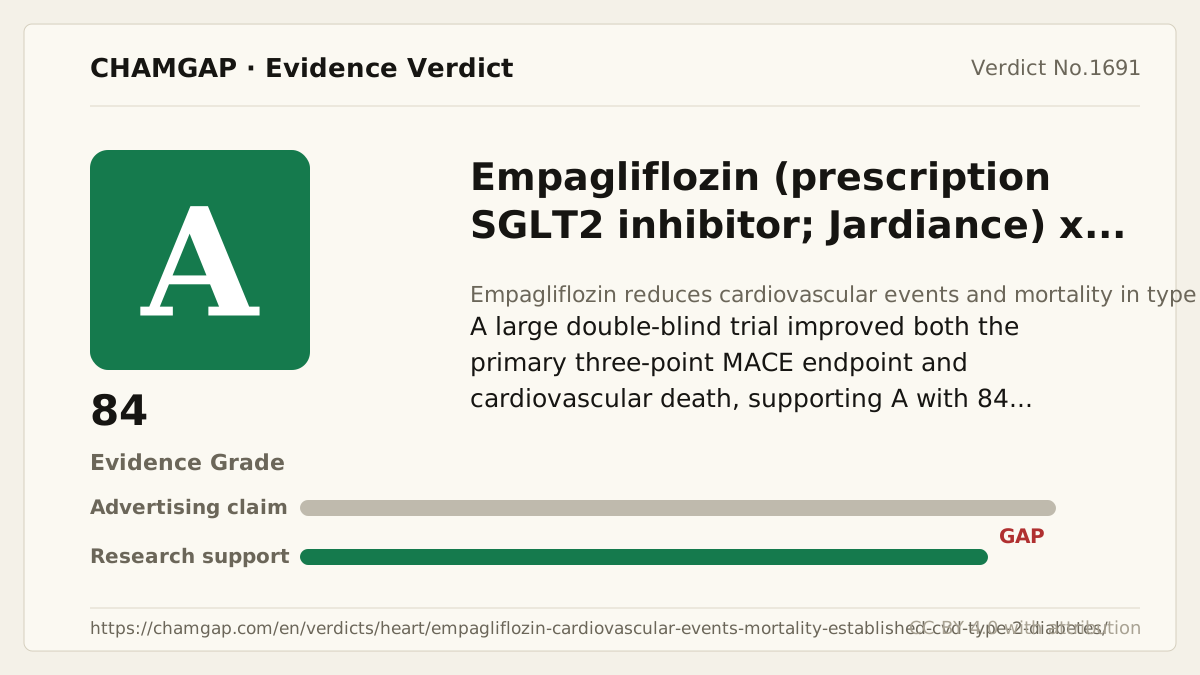
[Chamgap] Empagliflozin x reduced cardiovascular events and mortality in type 2 diabetes — Evidence Grade B·72. 2 cited sources checked. Source: https://chamgap.com/en/verdicts/heart/empagliflozin-cardiovascular-events-mortality-established-cvd-type-2-diabetes/ · CC BY 4.0CC BY 4.0 — free to use with attribution; do not distort grades, numbers, or verdict meaning.
What this document does and does not do
Chamgap is an information source. It reports what research has and has not confirmed; it does not tell readers what to take or buy. That decision belongs to readers and, when needed, medical or legal professionals. This verdict reflects literature available up to the search date and may change as new research appears. Nothing here is medical advice.