
Domestic water hardness 121-180 mg/L,
does it really help with Lower incidence of atrial fibrillation, heart failure, coronary heart disease, and stroke?
research showsThe grade is C. In a prospective UK Biobank cohort, 121-180 mg/L as CaCO3 was associated with lower hazards of cardiovascular events, but the dose response was nonmonotonic. Exposure was not measured from personal water samples; 2005 utility hardness values were assigned to postcode locations, leaving exposure misclassification and area-level confounding when linked to individual outcomes.
ads claimHardness is a composition measure, chiefly calcium and magnesium expressed as mg/L CaCO3. Assigning area water exposure to individual medical-record outcomes introduces exposure misclassification and area-level confounding; it does not justify a person-level drinking benefit. Atrial-fibrillation HR was 1.04 at 61-120 mg/L and 1.04 (95% CI 1.01-1.07) above 180 mg/L, so higher hardness was not monotonically better.
Useful facts when choosing a product
- The study measured hardness as CaCO3 concentration and classified it as 60 mg/L or less, 61-120, 121-180, and above 180 mg/L.
- Only 6.41% were in the 121-180 mg/L category; above 180 mg/L, atrial-fibrillation hazard was instead 1.04.
- Individual volume, water-source choice, and filter use were not measured; utility data were assigned by address.
Chamgap Semantic Classification Code
Candidate index · review held
UNK.domestic-water-hardness-of-l.UNK.incidence-of-atrial-fibrillation-heart-failure-coronary-heart-disease-and-stroke.reduce.UNKUnknown > Domestic water hardness of /L > Unknown > incidence of atrial fibrillation, heart failure, coronary heart disease, and stroke > Reduction claim > Unknown
An automated migration candidate, not an issued permanent code; exact claim scope remains under review. This machine-generated migration candidate helps retrieval but is not a permanent assignment. The original verdict ID and URL remain authoritative.
What the research actually shows
The atrial-fibrillation analysis included 447,950 people free of AF at baseline, and the heart-failure, coronary-disease, and stroke analyses included 423,946. Investigators linked 2005 utility CaCO3 data to approximate postcode locations at participant visits. Actual consumed water, volume, urine output, and osmolality were unavailable. Baseline disease was excluded and broad adjustment was performed, but a three-year early-event exclusion analysis was not identified in the article. A separate 324,136-person UK Biobank analysis reported HR 0.991 (0.974-1.009) for a calcium-magnesium mixture and overall cardiovascular disease, but different exposure construction, categories, endpoints, and estimands prevent a direct conflict test. Verdict 989 is D with 33 points for exercise outcomes; this verdict concerns long-term cardiovascular events.
Why this is classified as C (56)
The large publicly funded prospective cohort showed clear hard-event associations, but individual intake was unmeasured and multiplicity was uncorrected, producing two observational-design defects and C with 56 points.
Counterpoint. This should not be reduced to a study of regional average mortality. Outcomes were individual-level records, while exposure assignment remained area-level; that mixed-level limitation is the precise concern.
Rejudgment record. Cross-check applied — A large publicly funded cohort found cardiovascular-event associations, but address-based exposure did not verify individual intake and many comparisons were tested
| Endpoint | H | Hard endpoint - actual events such as death |
| Replication | R1 | Single confirmatory trial |
| Independence | I2 | Decisive evidence is publicly or non-profit funded |
| Effect size | E+ | Meets the clinically important threshold |
Stored derived and displayed grades match; this is not a current recalculation or validity check (C).
Sub-claim grades by effect
This ingredient is marketed for several effects. A single overall grade blends strong and weak claims together, so each effect is graded separately here. The overall grade reflects the strongest disconfirming or core claim.
| Effect (sub-claim) | Grade | Basis |
|---|---|---|
| Cardiovascular-event association in areas with 121-180 mg/L hardness | C | Confidence intervals excluded one for four events, but exposure was observational. |
| Drinking hard water prevents cardiovascular disease | ? | Personal intake, source, and filter use were unmeasured, so this direct claim was not tested. |
| Consistent cardiovascular protection above 180 mg/L | D | A monotonic protective association did not persist in the highest-hardness category. |
Cross-check — AI research and Codex final gate
Evidence Table
| Study | Design | Sample | Funding | Endpoint | Result | Weight |
|---|---|---|---|---|---|---|
| Tian F et al. 2025 | Prospective UK Biobank cohort | 447,950 for atrial fibrillation; 423,946 for the other three events | Public institutional funding from the Guangdong education authority and Shunde Hospital | Incident atrial fibrillation, heart failure, coronary heart disease, and stroke over median 13.74 years | For 121-180 versus 60 mg/L or less, HRs were 0.83, 0.82, 0.80, and 0.88, all with confidence intervals excluding one. | Large individual-event dataset with address-based exposure |
| Li S et al. 2025 | Separate prospective UK Biobank cohort | 324,136 participants | Xiamen Science and Technology Program for High-Quality Development in Healthcare | Fifteen cardiovascular events and overall cardiovascular disease | For the calcium-magnesium mixture and overall cardiovascular disease, HR was 0.991 (95% CI 0.974-1.009); the estimand differed from the first study, precluding direct replication or conflict classification. | Indirectly discordant evidence |
Receipt — 2 References
All 2 cited sources were verified for existence at the original page (as of 2026-08-04).
Final verification and publication gate: Codex · Evidence date: 2026-08-04 · Corrections: none
Cite this verdict
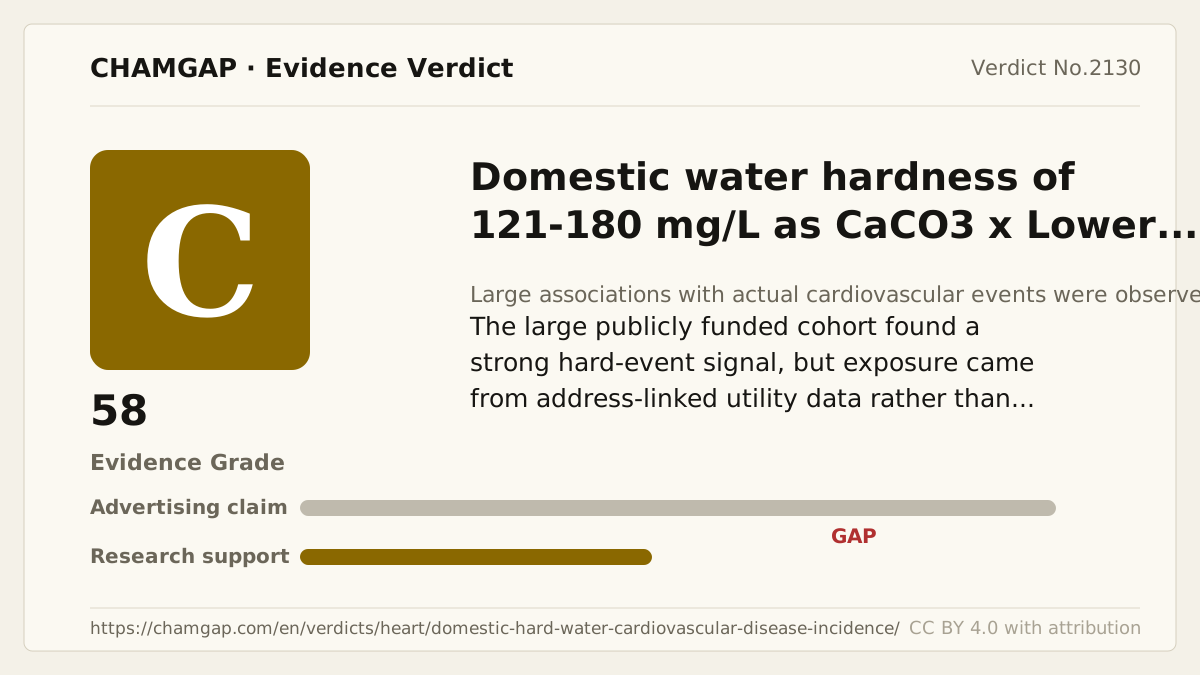
[Chamgap] Domestic water hardness 121-180 mg/L x lower cardiovascular-disease incidence — Evidence Grade C·56. 2 cited sources checked. Source: https://chamgap.com/en/verdicts/heart/domestic-hard-water-cardiovascular-disease-incidence/ · CC BY 4.0CC BY 4.0 — free to use with attribution; do not distort grades, numbers, or verdict meaning.
What this document does and does not do
Chamgap is an information source. It reports what research has and has not confirmed; it does not tell readers what to take or buy. That decision belongs to readers and, when needed, medical or legal professionals. This verdict reflects literature available up to the search date and may change as new research appears. Nothing here is medical advice.