
Daily stair climbing,
does it really help with Lower first atherosclerotic cardiovascular disease events?
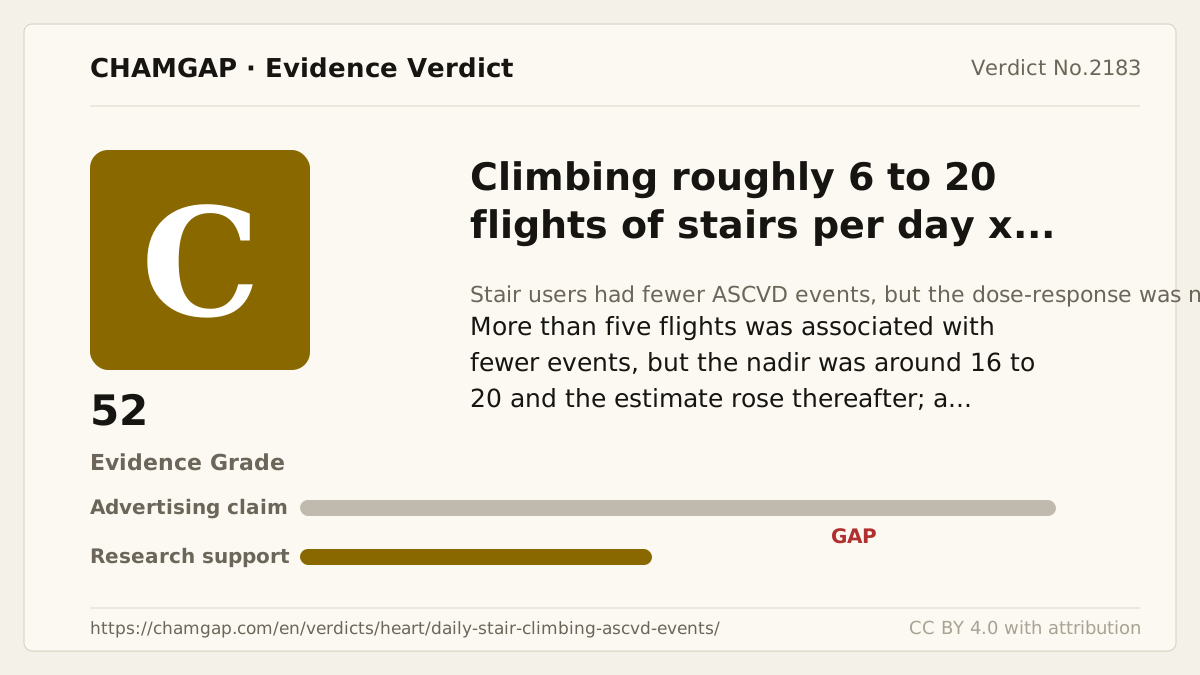
research showsThe grade is C. In 458,860 UK Biobank participants, hazard ratios versus reporting no stair climbing were 0.84 (95% CI 0.82 to 0.87), 0.78 (0.75 to 0.81), and 0.77 (0.73 to 0.80) for 6 to 10, 11 to 15, and 16 to 20 times per day. At 21 or more, the estimate rose to 0.81 (0.77 to 0.85), so the dose-response was not monotonic. Stair use was self-reported, and the reference could include people avoiding stairs because of illness or poor access.
ads claimFifty stairs per day is a description of a category, not a validated prevention threshold. The lowest category above zero was null and risk did not keep falling at the highest category.
Useful facts when choosing a product
- The study converted one flight to about ten steps, so 6 to 10 flights means roughly 60 to 100 steps.
- Exposure came from baseline and five-year self-report, not a stair sensor.
- HR rose from 0.77 at 16 to 20 times per day to 0.81 at 21 or more.
- Verdict 1561 is A with 88 points and concerns exercise-based cardiac rehabilitation after coronary disease, while this verdict concerns everyday stair use and first ASCVD in a general cohort.
Chamgap Semantic Classification Code
Candidate index · review held
UNK.climbing-roughly-6-to-20-flights-of-stairs.UNK.first-atherosclerotic-cardiovascular-disease-events.reduce.UNKUnknown > Climbing roughly 6 to 20 flights of stairs > Unknown > first atherosclerotic cardiovascular disease events > Reduction claim > Unknown
An automated migration candidate, not an issued permanent code; exact claim scope remains under review. This machine-generated migration candidate helps retrieval but is not a permanent assignment. The original verdict ID and URL remain authoritative.
What the research actually shows
The analysis included 458,860 of 502,530 UK Biobank participants after exclusions. Participants reported daily stair flights in categories of 0, 1 to 5, 6 to 10, 11 to 15, 16 to 20, and at least 21; investigators described one flight as about ten steps. Thus 6 to 10 corresponds to roughly 60 to 100 steps and 16 to 20 to roughly 160 to 200. Over median 12.5 years, there were 39,043 ASCVD, 30,718 coronary disease, and 10,521 ischemic stroke events. The National Key Research and Development Program of China funded the study under grant 2020YFC2003401, and authors declared no known financial conflicts.
Why this is classified as C (56)
A large event signal, independent analysis, and public funding are limited by self-reported exposure, health and access differences in the reference, unconfirmed lag analysis, and a nonmonotonic dose-response, giving C with 56 points.
Counterpoint. C does not deny the exercise value of stairs; it grades the narrower claim of preventing first ASCVD events.
Rejudgment record. Cross-check applied — The large event cohort, independent analysis, and National Key Research and Development Program of China support were weighed against self-report, reference-group health and access, reverse causation, and a nonmonotonic dose-response
| Endpoint | H | Hard endpoint - actual events such as death |
| Replication | R1 | Single confirmatory trial |
| Independence | I2 | Decisive evidence is publicly or non-profit funded |
| Effect size | E+ | Meets the clinically important threshold |
Stored derived and displayed grades match; this is not a current recalculation or validity check (C).
Sub-claim grades by effect
This ingredient is marketed for several effects. A single overall grade blends strong and weak claims together, so each effect is graded separately here. The overall grade reflects the strongest disconfirming or core claim.
| Effect (sub-claim) | Grade | Basis |
|---|---|---|
| Association of 6 to 20 daily stair flights with lower ASCVD incidence | C | Confidence intervals excluded 1 in a large event cohort. |
| Fifty daily steps as a causal prevention threshold | D | One to five flights was null, and a self-reported category did not establish a causal threshold. |
Cross-check — AI research and Codex final gate
Evidence Table
| Study | Design | Sample | Funding | Endpoint | Result | Weight |
|---|---|---|---|---|---|---|
| Song Z et al. 2023 UK Biobank | Prospective cohort study | 458,860 participants, median 12.5 years, 39,043 ASCVD events | National Key Research and Development Program of China grant 2020YFC2003401; no known financial conflicts declared | First ASCVD, coronary disease, and ischemic stroke | Versus zero, HR was 0.84 at 6 to 10, 0.78 at 11 to 15, 0.77 at 16 to 20, and 0.81 at 21 or more. | Principal large hard-outcome cohort with self-reported exposure |
Receipt — 1 References
All 1 cited sources were verified for existence at the original page (as of 2026-08-04).
Final verification and publication gate: Codex · Evidence date: 2026-08-04 · Corrections: none
Cite this verdict
[Chamgap] Daily stair climbing x lower ASCVD events — Evidence Grade C·56. 1 cited sources checked. Source: https://chamgap.com/en/verdicts/heart/daily-stair-climbing-ascvd-events/ · CC BY 4.0CC BY 4.0 — free to use with attribution; do not distort grades, numbers, or verdict meaning.
What this document does and does not do
Chamgap is an information source. It reports what research has and has not confirmed; it does not tell readers what to take or buy. That decision belongs to readers and, when needed, medical or legal professionals. This verdict reflects literature available up to the search date and may change as new research appears. Nothing here is medical advice.