
Dabigatran etexilate,
does it really help with Prevention of stroke and systemic embolism in nonvalvular atrial fibrillation?
research showsDabigatran is rated high B because direct clinical-event evidence supports prevention of stroke and systemic embolism in nonvalvular atrial fibrillation. RE-LY followed 18,113 at-risk patients for a median of two years: 110 mg twice daily was noninferior to warfarin, while 150 mg twice daily was superior with annual primary-event rates of 1.11% versus 1.69%. The pivotal randomized evidence is nevertheless concentrated in essentially one manufacturer-funded megatrial, and warfarin treatment was open label, supporting B rather than A with 78 points. Bleeding, dyspepsia and gastrointestinal bleeding, renal dosing and contraindications, thrombotic risk after interruption, avoidance with mechanical valves, and the reversal agent idarucizumab remain separate safety issues.
ads claimMarketing can turn no routine INR testing into no bleeding concern, no monitoring, or suitability for every form of valvular heart disease. Routine INR testing is unnecessary, but renal function, adherence, interactions, and bleeding still require assessment, and mechanical heart valves are a contraindicated setting.
Useful facts when choosing a product
- Dabigatran etexilate is an oral prodrug converted to the direct thrombin inhibitor dabigatran. Authorized doses and renal or age criteria differ by country, so the prescribed regimen must be followed exactly.
- Renal elimination is substantial, making kidney-function assessment necessary before and during treatment; acute kidney injury, advanced age, low body weight, and interacting drugs can increase exposure.
- Opening or chewing capsules can alter absorption, and abrupt interruption can increase thrombotic risk. Discontinuation and preoperative withholding should therefore be planned with a clinician.
- The specific reversal agent idarucizumab can be used for life-threatening or uncontrolled bleeding or urgent procedures, but availability of reversal does not remove the underlying bleeding risk.
Chamgap Semantic Classification Code
Candidate index · review held
M.dabigatran-etexilate.UNK.stroke-and-systemic-embolism-in-nonvalvular-atrial-fibrillation.prevent.UNKMedicinal interventions > Dabigatran etexilate > Unknown > stroke and systemic embolism in nonvalvular atrial fibrillation > Occurrence-prevention claim > Unknown
An automated migration candidate, not an issued permanent code; exact claim scope remains under review. This machine-generated migration candidate helps retrieval but is not a permanent assignment. The original verdict ID and URL remain authoritative.
What the research actually shows
Connolly and colleagues randomized 18,113 patients with atrial fibrillation and stroke risk in RE-LY to dabigatran 110 mg or 150 mg twice daily or adjusted-dose warfarin and followed them for a median of two years. Stroke or systemic embolism occurred at 1.69% per year with warfarin, 1.53% with 110 mg, meeting noninferiority, and 1.11% with 150 mg, meeting superiority. Hemorrhagic stroke was less frequent with both dabigatran doses, but major-bleeding patterns varied by age and dose and the higher dose raises gastrointestinal-bleeding concern. Romanelli and colleagues' real-world meta-analysis of seven retrospective cohorts with 348,750 participants found no significant stroke advantage for dabigatran 150 mg versus warfarin (HR 0.92, 95% CI 0.84–1.01), less intracranial hemorrhage (HR 0.44), and more gastrointestinal bleeding (HR 1.23). In contrast, RE-ALIGN in 252 people with mechanical heart valves was stopped early because dabigatran caused excess thromboembolism and bleeding, precluding extrapolation to that indication.
Why this is classified as B (78)
RE-LY assessed the direct clinical event of stroke or systemic embolism in 18,113 participants over a median of two years, showing noninferiority with 110 mg and superiority with 150 mg. Real-world synthesis replicated lower intracranial hemorrhage and higher gastrointestinal bleeding but not the 150-mg stroke superiority. Pivotal randomized efficacy is still concentrated in one manufacturer-funded megatrial with open-label warfarin and dose- and patient-selection dependence, supporting B with 78 points. Bleeding, gastrointestinal effects, renal elimination, the mechanical-valve contraindication, and reversal remain separate safety matters.
Counterpoint. Choice of anticoagulant must jointly consider stroke risk, renal function, age, bleeding history, interactions, cost, and reliable adherence. Well-managed warfarin, another DOAC, or dabigatran may be preferable in different patients, making unsupervised switching or stopping dangerous.
Rejudgment record. New verdict — Applied high B because 18,113-participant RE-LY established noninferiority with 110 mg and superiority with 150 mg on direct stroke or systemic-embolism events, while randomized efficacy remains concentrated in essentially one manufacturer-funded megatrial with open-label warfarin
Sub-claim grades by effect
This ingredient is marketed for several effects. A single overall grade blends strong and weak claims together, so each effect is graded separately here. The overall grade reflects the strongest disconfirming or core claim.
| Effect (sub-claim) | Grade | Basis |
|---|---|---|
| Prevention of stroke and systemic embolism in nonvalvular atrial fibrillation | B | RE-LY established noninferiority with 110 mg and superiority with 150 mg on direct clinical events, but pivotal evidence is concentrated in one sponsored trial. |
| Prevention of thromboembolism in patients with mechanical heart valves | F | RE-ALIGN was stopped early for excess thromboembolism and bleeding, so dabigatran should not be used in this population. |
Cross-check — AI research and Codex final gate
Evidence Table
| Study | Design | Sample | Funding | Endpoint | Result | Weight |
|---|---|---|---|---|---|---|
| Connolly SJ et al. 2009 RE-LY | Multinational randomized noninferiority trial with blinded dabigatran doses and open-label warfarin | 18,113 patients with atrial fibrillation and stroke risk; median follow-up 2.0 years | Sponsored by Boehringer Ingelheim | Stroke or systemic embolism and major bleeding | Primary-event rates were 1.69% per year with warfarin, 1.53% with 110 mg meeting noninferiority, and 1.11% with 150 mg meeting superiority. | Pivotal large randomized trial with direct clinical events |
| Romanelli RJ et al. 2016 | Systematic review and meta-analysis of real-world observational studies | Seven retrospective cohort studies with 348,750 participants | Funding source not stated in the PubMed abstract | Ischemic and hemorrhagic stroke, major and gastrointestinal bleeding, and death | Dabigatran 150 mg did not significantly reduce stroke versus warfarin (HR 0.92, 95% CI 0.84–1.01), while intracranial hemorrhage was lower (HR 0.44) and gastrointestinal bleeding higher (HR 1.23). | Supportive external-validity evidence |
| Eikelboom JW et al. 2013 RE-ALIGN | Randomized open-label dose-validation trial in patients with mechanical heart valves | 252 patients with mechanical aortic or mitral valves | Sponsored by Boehringer Ingelheim | Clinical thromboembolic and bleeding events | The trial was terminated early because thromboembolic and bleeding events were excessive with dabigatran. | Direct safety boundary against extrapolation beyond nonvalvular disease |
Receipt — 4 References
All 4 cited sources were verified for existence at the original page (as of 2026-07-20).
Final verification and publication gate: Codex · Evidence date: 2026-07-20 · Corrections: none
Cite this verdict
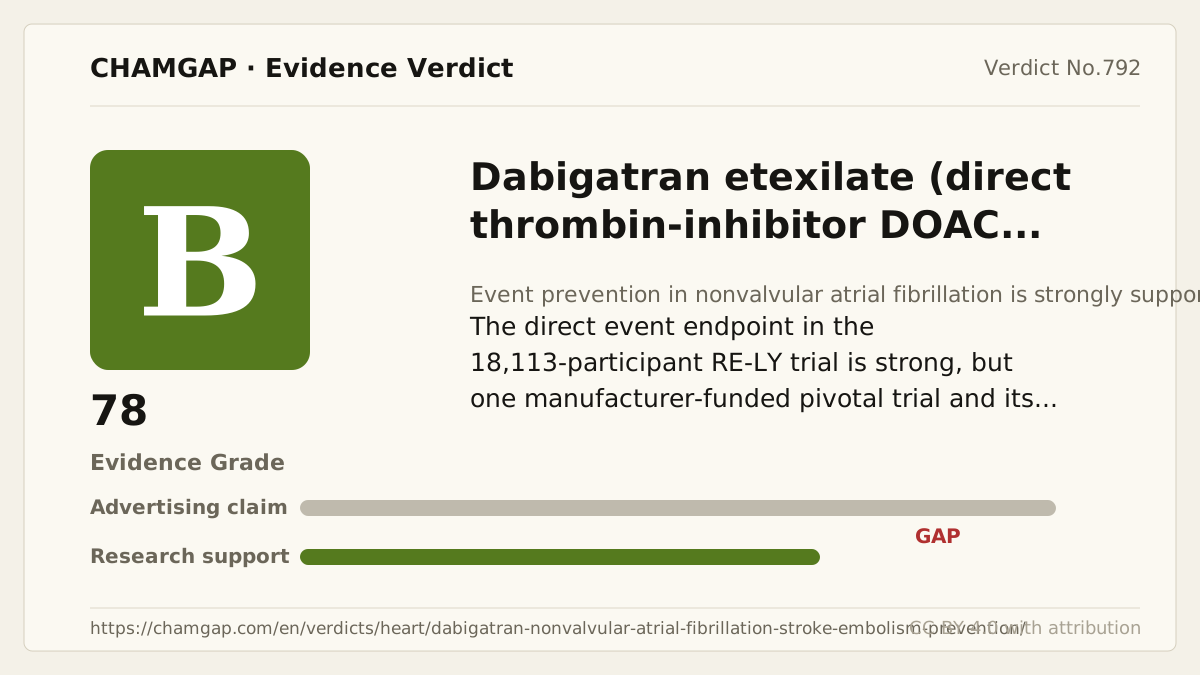
[Chamgap] Dabigatran etexilate x stroke and systemic-embolism prevention in nonvalvular atrial fibrillation — Evidence Grade B·78. 4 cited sources checked. Source: https://chamgap.com/en/verdicts/heart/dabigatran-nonvalvular-atrial-fibrillation-stroke-embolism-prevention/ · CC BY 4.0CC BY 4.0 — free to use with attribution; do not distort grades, numbers, or verdict meaning.
What this document does and does not do
Chamgap is an information source. It reports what research has and has not confirmed; it does not tell readers what to take or buy. That decision belongs to readers and, when needed, medical or legal professionals. This verdict reflects literature available up to the search date and may change as new research appears. Nothing here is medical advice.