
Continuous positive airway pressure,
does it really help with Reduced 24-hour blood pressure in resistant hypertension with obstructive sleep apnea?
research showsCPAP is rated C because it modestly lowers 24-hour mean blood pressure in resistant hypertension with obstructive sleep apnea, but blood pressure is a surrogate for long-term clinical benefit. HIPARCO randomized 194 participants and included all 194 in the intention-to-treat primary analysis. The between-group change in 24-hour mean blood pressure was -3.1 mm Hg at 12 weeks, P=0.02, so the primary endpoint succeeded. A meta-analysis of 10 randomized trials and 606 participants also reported reductions of 5.06 mm Hg systolic and 4.21 mm Hg diastolic. Direct reductions in myocardial infarction, stroke, or death were not established, so rule ①-ⓐ caps the grade at C with 56 points.
ads claimMarketing can turn a reduction of a few millimeters of mercury into a claim of proven myocardial-infarction or stroke prevention. CPAP may treat sleep apnea, but it does not replace medication review, adherence assessment, or investigation of secondary causes of resistant hypertension.
Useful facts when choosing a product
- Resistant hypertension usually means blood pressure remains above target despite at least three appropriately dosed agents, typically including a diuretic.
- HIPARCO found an approximately 3-mm Hg reduction in mean 24-hour pressure, with a correlation between longer CPAP use and greater reduction.
- Mask discomfort, nasal congestion or dryness, skin irritation, air leak, and abdominal bloating can impair adherence and may require mask or pressure adjustment.
Chamgap Semantic Classification Code
Candidate index · review held
P.continuous-positive-airway-pressure.device.blood-pressure-in-resistant-hypertension-with-obstructive-sleep-apnea.reduce.UNKProcedures, devices and tests > Continuous positive airway pressure > Device delivered > blood pressure in resistant hypertension with obstructive sleep apnea > Reduction claim > Unknown
An automated migration candidate, not an issued permanent code; exact claim scope remains under review. This machine-generated migration candidate helps retrieval but is not a permanent assignment. The original verdict ID and URL remain authoritative.
What the research actually shows
Martínez-García and colleagues randomized 194 patients with obstructive sleep apnea and resistant hypertension to CPAP or continued blood-pressure care in HIPARCO. Both the randomized population and the actual intention-to-treat primary analysis included 194 patients, and the mean-blood-pressure primary endpoint succeeded. The 2021 Labarca meta-analysis confirmed 24-hour and nighttime blood-pressure reductions across 10 randomized trials and 606 participants but did not establish long-term clinical events. This verdict concerns the blood-pressure surrogate. Evidence was not borrowed from verdict 1179, which is F with 9 points and concerns recurrent cardiovascular-event prevention, or verdict 1212, which is B with 72 points and concerns sleepiness and quality of life.
Why this is classified as C (56)
The primary 24-hour mean-blood-pressure endpoint succeeded in the intention-to-treat analysis of all 194 HIPARCO participants, and 10 randomized trials with 606 participants supported lower blood pressure. These are surrogate outcomes without direct long-term cardiovascular-event benefit, so rule ①-ⓐ gives C with 56 points.
Counterpoint. CPAP can be an adjunct to blood-pressure management when sleep apnea itself warrants treatment. It is not evidence for reducing or stopping antihypertensive medication without medical supervision.
Rejudgment record. Cross-check applied — Accepted 24-hour blood-pressure reductions in HIPARCO and across 10 randomized trials, but applied the rule ①-ⓐ ceiling of C because only the blood-pressure surrogate improved
Sub-claim grades by effect
This ingredient is marketed for several effects. A single overall grade blends strong and weak claims together, so each effect is graded separately here. The overall grade reflects the strongest disconfirming or core claim.
| Effect (sub-claim) | Grade | Basis |
|---|---|---|
| Reduced 24-hour mean blood pressure | C | The HIPARCO primary endpoint succeeded, but blood pressure is a surrogate and remains capped at C. |
| Reduced 24-hour diastolic blood pressure | C | The pivotal trial and meta-analysis were positive, but this remains a surrogate. |
| Reduced 24-hour systolic blood pressure | C | The HIPARCO systolic result failed, whereas the 10-trial synthesis was positive with heterogeneity. |
Cross-check — AI research and Codex final gate
Evidence Table
| Study | Design | Sample | Funding | Endpoint | Result | Weight |
|---|---|---|---|---|---|---|
| Martínez-García MA et al. 2013 HIPARCO | Randomized multicenter open-label trial with blinded endpoint assessment | 194 randomized (98 versus 96); 194 in the actual intention-to-treat primary analysis | Grants from Philips-Respironics, the Spanish Society of Pulmonology, Instituto de Salud Carlos III, and the Valencian Society of Pulmonology; sponsors reportedly had no role in design, conduct, analysis, or reporting | Primary endpoint: change in 24-hour mean blood pressure at 12 weeks | The between-group difference was -3.1 mm Hg (95% CI -5.6 to -0.6), P=0.02, so the primary endpoint succeeded; systolic blood pressure failed at P=0.10. | Pivotal surrogate-endpoint trial |
| Labarca G et al. 2021 | Systematic review and meta-analysis of randomized trials | 10 randomized trials and 606 participants | No manufacturer-led review funding reported; institutions of some authors disclosed separate research grants from ResMed and Philips | 24-hour, daytime, and nighttime systolic and diastolic blood pressure | CPAP favored 24-hour systolic pressure by -5.06 mm Hg and diastolic pressure by -4.21 mm Hg. | Replicated surrogate synthesis |
Receipt — 2 References
All 2 cited sources were verified for existence at the original page (as of 2026-07-24).
Final verification and publication gate: Codex · Evidence date: 2026-07-24 · Corrections: none
Cite this verdict
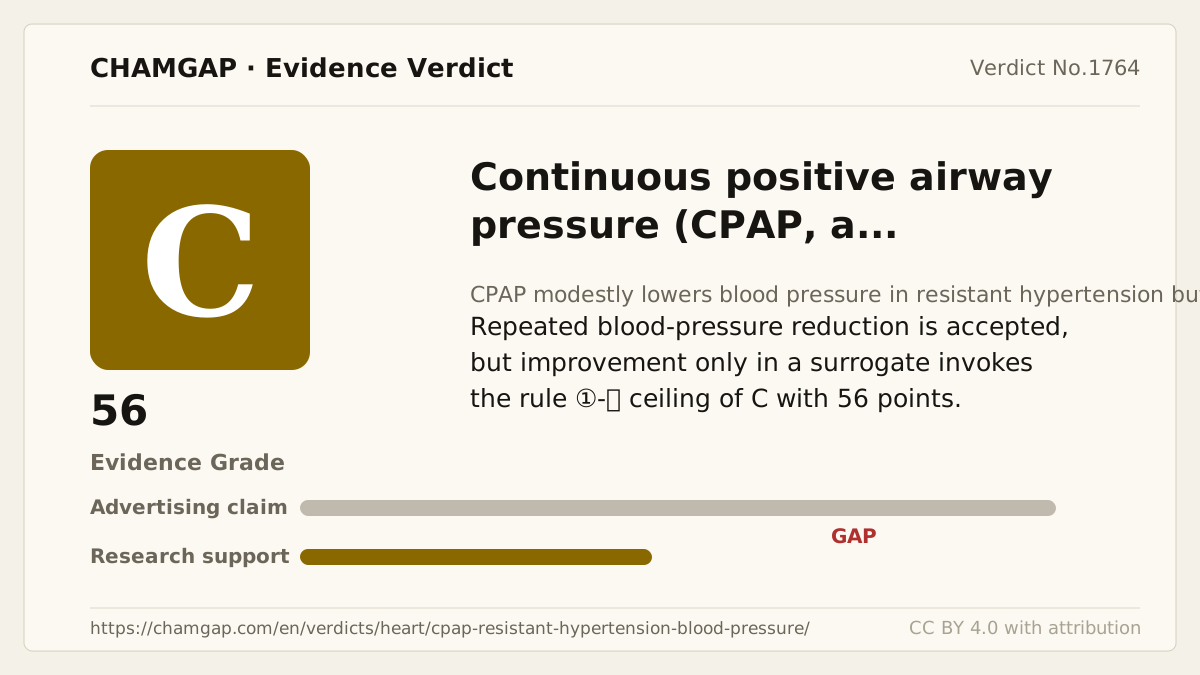
[Chamgap] Continuous positive airway pressure x reduced blood pressure in resistant hypertension — Evidence Grade C·56. 2 cited sources checked. Source: https://chamgap.com/en/verdicts/heart/cpap-resistant-hypertension-blood-pressure/ · CC BY 4.0CC BY 4.0 — free to use with attribution; do not distort grades, numbers, or verdict meaning.
What this document does and does not do
Chamgap is an information source. It reports what research has and has not confirmed; it does not tell readers what to take or buy. That decision belongs to readers and, when needed, medical or legal professionals. This verdict reflects literature available up to the search date and may change as new research appears. Nothing here is medical advice.