
Coronary CT angiography,
does it really help with Prevention of coronary death or nonfatal myocardial infarction in stable chest pain?
research showsThe grade is B. In SCOT-HEART, the prespecified five-year primary endpoint of coronary heart disease death or nonfatal myocardial infarction occurred in 48/2,073 (2.3%) with added CT versus 81/2,073 (3.9%) with standard care, HR 0.59 (95% CI 0.41-0.84). Imaging was not the treatment; it changed diagnosis and downstream preventive prescribing.
ads claimThe supported claim is a CT-guided care strategy in stable chest pain, not that a scan directly prevents infarction.
Useful facts when choosing a product
- The control was standard care without CT.
- The five-year primary outcome was 2.3% versus 3.9%.
- Preventive therapy initiation was 19.4% versus 14.7%.
Chamgap Semantic Classification Code
Candidate index · review held
P.coronary-ct-angiography-added-to-standard-care.UNK.coronary-death-or-nonfatal-myocardial-infarction-in-stable-chest-pain.prevent.MULTIProcedures, devices and tests > Coronary CT angiography added to standard care > Unknown > coronary death or nonfatal myocardial infarction in stable chest pain > Occurrence-prevention claim > Multiple: primary unresolved
An automated migration candidate, not an issued permanent code; exact claim scope remains under review. This machine-generated migration candidate helps retrieval but is not a permanent assignment. The original verdict ID and URL remain authoritative.
What the research actually shows
This was an open-label multicenter randomized trial using linked national administrative and clinical records for events. The methods section does not state that an independent blinded event-adjudication committee was used. There were 129 primary events. CT reclassified coronary disease and changed preventive and antianginal prescribing as well as early tests and procedures; imaging itself should not be described as therapy.
Why this is classified as B (76)
A large publicly funded hard-outcome randomized trial supports benefit, but independent confirmation is lacking and the open-label trial's methods do not state that an independent blinded adjudication committee was used, giving B with 76 points.
Counterpoint. Results from acute emergency presentations cannot be directly substituted for the stable outpatient population.
Rejudgment record. Cross-check applied — Direct cross-check of SCOT-HEART primary outcome, events, follow-up, treatment changes, and comparability with RAPID-CTCA
| Endpoint | H | Hard endpoint - actual events such as death |
| Replication | R1 | Single confirmatory trial |
| Independence | I2 | Decisive evidence is publicly or non-profit funded |
| Effect size | E+ | Meets the clinically important threshold |
Stored derived and displayed grades match; this is not a current recalculation or validity check (B).
Sub-claim grades by effect
This ingredient is marketed for several effects. A single overall grade blends strong and weak claims together, so each effect is graded separately here. The overall grade reflects the strongest disconfirming or core claim.
| Effect (sub-claim) | Grade | Basis |
|---|---|---|
| Reduced five-year coronary death or nonfatal infarction in stable chest pain | B | The SCOT-HEART primary endpoint was significantly reduced. |
| Reduced one-year death or infarction in acute chest pain | D | RAPID-CTCA found no significant difference. |
| Increased initiation of preventive medication after adding coronary CT | B | In SCOT-HEART, preventive therapy was newly initiated in 19.4% versus 14.7%. |
Cross-check — AI research and Codex final gate
Evidence Table
| Study | Design | Sample | Funding | Endpoint | Result | Weight |
|---|---|---|---|---|---|---|
| SCOT-HEART five-year follow-up | Open-label multicenter randomized parallel-group trial | 4,146 randomized, 2,073 per arm; median follow-up 4.8 years | Scottish Government Chief Scientist Office, British Heart Foundation, and other nonprofit support | Coronary heart disease death or nonfatal myocardial infarction at five years | 48/2,073 (2.3%) versus 81/2,073 (3.9%), HR 0.59 (95% CI 0.41-0.84), P=0.004 | Pivotal large hard-outcome randomized trial |
| RAPID-CTCA | Open randomized trial with blinded endpoint adjudication | 1,748 acute-chest-pain patients, 877/871, one year | UK NIHR Health Technology Assessment programme | All-cause death or nonfatal type 1 or 4b myocardial infarction | 51/877 (5.8%) versus 53/871 (6.1%), adjusted HR 0.91 (0.62-1.35) | Not directly comparable because of acute population and one-year endpoint |
Receipt — 2 References
All 2 cited sources were verified for existence at the original page (as of 2026-08-06).
Final verification and publication gate: Codex · Evidence date: 2026-08-06 · Corrections: none
Cite this verdict
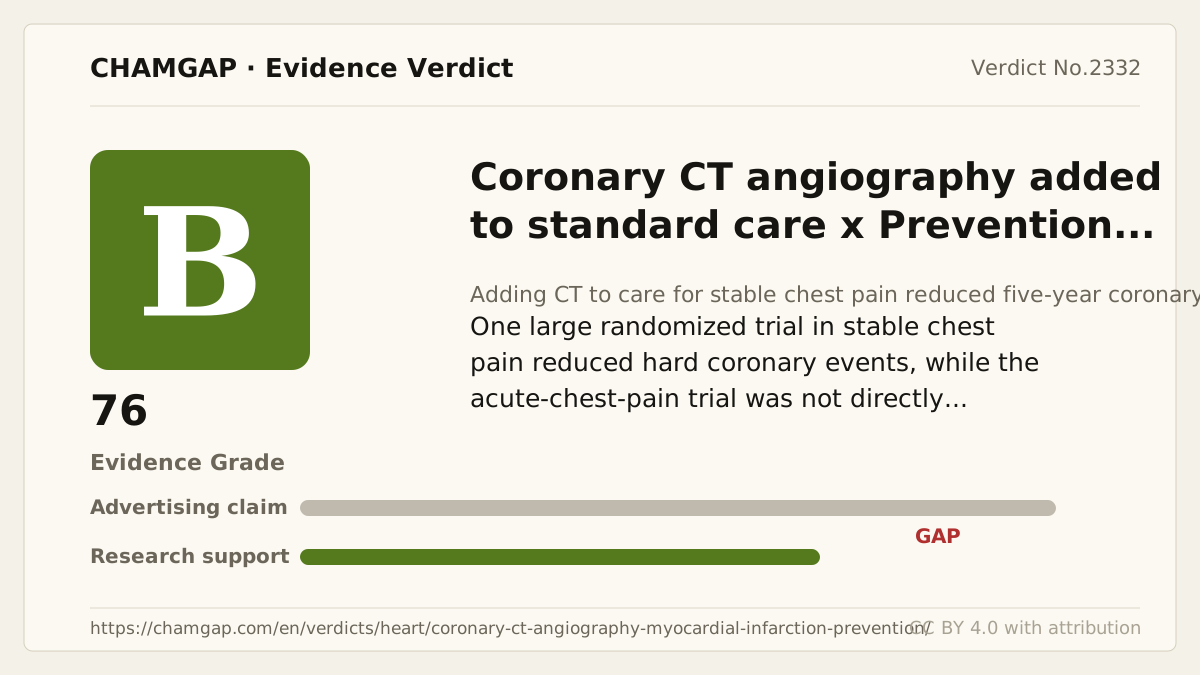
[Chamgap] Coronary CT angiography x myocardial infarction prevention — Evidence Grade B·76. 2 cited sources checked. Source: https://chamgap.com/en/verdicts/heart/coronary-ct-angiography-myocardial-infarction-prevention/ · CC BY 4.0CC BY 4.0 — free to use with attribution; do not distort grades, numbers, or verdict meaning.
What this document does and does not do
Chamgap is an information source. It reports what research has and has not confirmed; it does not tell readers what to take or buy. That decision belongs to readers and, when needed, medical or legal professionals. This verdict reflects literature available up to the search date and may change as new research appears. Nothing here is medical advice.