
Coenzyme Q10,
does it really help with Relief of statin-associated muscle symptoms and improved continuation of statin therapy?
research showsCoenzyme Q10 is rated at the lower end of C for statin-associated muscle symptoms. Positive and null small trials and meta-analyses coexist, but a synthesis of seven trials and 321 participants found no benefit for pain, WMD -0.42 (95% CI -1.47 to 0.62), or remaining on statins, RR 0.99. A rigorous randomized trial in 41 patients with confirmed statin myalgia was also null for pain, strength, and performance, and the 2026 ACC/AHA multisociety guideline recommends against routine use. A subjective pain surrogate can reach no higher than C, while null adherence and objective outcomes plus guideline opposition support 43 points.
ads claimClaims that it removes statin adverse effects and keeps everyone on treatment extend conflicting pain scores into adherence and cardiovascular outcomes. Statins should not be stopped without clinical review.
Useful facts when choosing a product
- Ubiquinone and ubiquinol products vary in dose and absorption, so one formulation's result cannot be generalized to all supplements.
- Suspected statin muscle symptoms require assessment of thyroid disease, exercise, interactions, and other muscle disorders rather than unsupervised statin discontinuation.
- Trial doses vary, and no standard therapeutic dose for symptom relief or adherence has been established.
- Mild gastrointestinal effects are most common, and possible interactions such as with warfarin should be disclosed.
Chamgap Semantic Classification Code
Candidate index · review held
S.coenzyme-q10.UNK.statin-associated-muscle-symptoms-and-improved-continuation-of-statin-therapy.relieve.placeboSupplements and nutraceuticals > Coenzyme Q10 > Unknown > statin-associated muscle symptoms and improved continuation of statin therapy > Symptom-relief claim > Placebo
An automated migration candidate, not an issued permanent code; exact claim scope remains under review. This machine-generated migration candidate helps retrieval but is not a permanent assignment. The original verdict ID and URL remain authoritative.
What the research actually shows
Qu 2018 pooled 12 trials and 575 participants and reported subjective symptom improvement without CK reduction. Kennedy 2020 found pain WMD -0.42 (95% CI -1.47 to 0.62) and continuation RR 0.99 across seven trials and 321 participants. Taylor 2015 rigorously confirmed statin myalgia by rechallenge before randomizing 41 patients and found no benefit for pain, strength, or performance at 600 mg daily. The 2026 ACC/AHA multisociety guideline states that the preponderance of evidence does not support routine CoQ10 use for patients taking statins or for treating statin-attributed muscle symptoms.
Why this is classified as C (43)
Positive and null syntheses coexist, but the rigorous 41-person trial and the seven-trial, 321-person meta-analysis were null, with pain WMD -0.42 and continuation RR 0.99. Objective strength and CK benefits are also unproved, and 2026 ACC/AHA guidance recommends against routine use. The subjective pain surrogate is capped at C, and guideline opposition supports the lower-end score of 43. Safety and product variation remain separate.
Counterpoint. An individual trial after standard statin rechallenge and dose management may be considered, but it does not replace cardiovascular risk-reduction therapy.
Rejudgment record. New verdict — Applied a C ceiling for subjective muscle-pain surrogates, then placed the claim at the lower end because the rigorous 41-person confirmed-myalgia trial and seven-trial, 321-person synthesis were null for pain, strength, CK, or continuation and the 2026 ACC/AHA guideline recommends against routine use
Sub-claim grades by effect
This ingredient is marketed for several effects. A single overall grade blends strong and weak claims together, so each effect is graded separately here. The overall grade reflects the strongest disconfirming or core claim.
| Effect (sub-claim) | Grade | Basis |
|---|---|---|
| Relief of statin-associated muscle symptoms | C | Positive and null small trials coexist, but the seven-trial synthesis and rigorous 41-person trial were null and guidance recommends against routine use. |
| Improved continuation of statin therapy | D | Direct meta-analysis found no benefit, RR 0.99. |
| Improvement of objective muscle outcomes such as strength and CK | D | Strength did not improve in the confirmed-myalgia trial, and CK was unchanged even in the positive meta-analysis. |
Cross-check — AI research and Codex final gate
Evidence Table
| Study | Design | Sample | Funding | Endpoint | Result | Weight |
|---|---|---|---|---|---|---|
| Qu H et al. 2018 | Meta-analysis of randomized trials | 12 trials and 575 participants | Academic study | Pain, weakness, cramps, fatigue, and CK | Subjective symptoms improved but CK did not. | Positive synthesis |
| Kennedy C et al. 2020 | Systematic review and meta-analysis | Seven trials and 321 participants | No relevant conflicts reported | Myalgia and statin continuation | Pain WMD was -0.42 and continuation RR was 0.99, both null. | Key null synthesis |
| Taylor BA et al. 2015 | Double-blind trial in confirmed cases | 41 confirmed cases randomized | Academic support including NIH | Pain, strength, and performance | 600 mg daily did not improve outcomes versus placebo. | Rigorous direct null evidence |
| 2026 ACC/AHA multisociety dyslipidemia guideline | Evidence-based clinical practice guideline | Multisociety guideline evidence synthesis | American College of Cardiology and American Heart Association | Prevention and treatment of statin-attributed muscle symptoms | Did not recommend routine CoQ10 use because the preponderance of evidence did not support efficacy. | Current guidance against routine use |
Receipt — 4 References
All 4 cited sources were verified for existence at the original page (as of 2026-07-20).
Final verification and publication gate: Codex · Evidence date: 2026-07-20 · Corrections: none
Cite this verdict
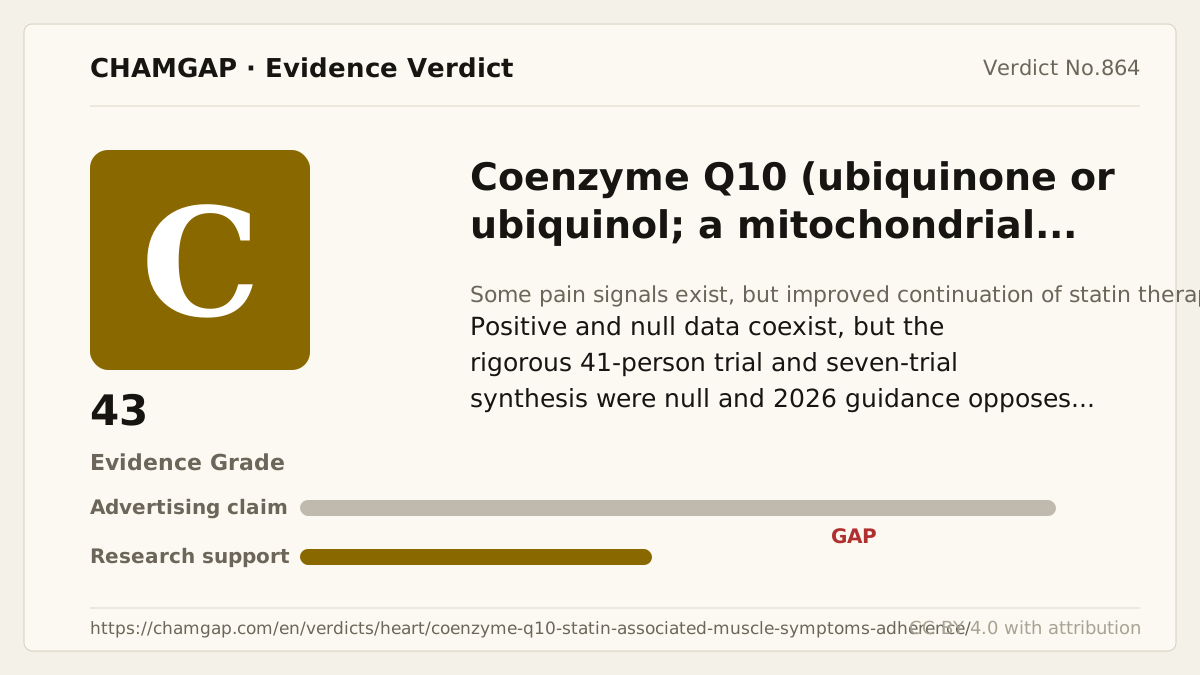
[Chamgap] Coenzyme Q10 x statin-associated muscle symptoms and adherence — Evidence Grade C·43. 4 cited sources checked. Source: https://chamgap.com/en/verdicts/heart/coenzyme-q10-statin-associated-muscle-symptoms-adherence/ · CC BY 4.0CC BY 4.0 — free to use with attribution; do not distort grades, numbers, or verdict meaning.
What this document does and does not do
Chamgap is an information source. It reports what research has and has not confirmed; it does not tell readers what to take or buy. That decision belongs to readers and, when needed, medical or legal professionals. This verdict reflects literature available up to the search date and may change as new research appears. Nothing here is medical advice.