
Clopidogrel,
does it really help with Reduced recurrence of myocardial infarction, ischemic stroke, and vascular death in patients with atherosclerotic disease?
research showsClopidogrel is rated A because large randomized trials repeatedly reduced recurrent ischemic events in atherosclerotic disease. In 19,185 CAPRIE participants, the annual risk of myocardial infarction, ischemic stroke, or vascular death was 5.32% with clopidogrel and 5.83% with aspirin; in 12,562 CURE participants with non-ST-elevation acute coronary syndromes, adding clopidogrel to aspirin reduced cardiovascular death, myocardial infarction, or stroke from 11.4% to 9.3%. The 8.7% relative advantage over aspirin in CAPRIE was modest, and treatment combinations and durations differ by indication. Bleeding, rare thrombotic thrombocytopenic purpura, CYP2C19 loss of function, and interactions are separate safety issues.
ads claimPromotion or simplified summaries may imply that clopidogrel is universally and substantially stronger than aspirin. Actual selection depends on recent stroke, myocardial infarction, peripheral arterial disease, acute coronary syndrome or PCI status, treatment duration, and bleeding risk.
Useful facts when choosing a product
- Clopidogrel is a prescription antiplatelet drug that irreversibly inhibits platelet P2Y12 receptors, and a common maintenance dose is 75 mg once daily.
- For acute coronary syndromes or PCI it may follow a loading dose and be combined with aspirin for an indication-specific period, while chronic secondary prevention may use monotherapy.
- Stopping it without medical direction can raise the risk of stent thrombosis or recurrent ischemia, so interruption before surgery or dental procedures requires prescriber guidance.
- Formation of its active metabolite depends on CYP2C19; genetic poor metabolism and inhibitors such as omeprazole or esomeprazole can reduce its effect.
Chamgap Semantic Classification Code
Candidate index · review held
M.clopidogrel.UNK.recurrence-of-myocardial-infarction-ischemic-stroke-and-vascular-death-with-atherosclerotic-disease.reduce.MULTIMedicinal interventions > Clopidogrel > Unknown > recurrence of myocardial infarction, ischemic stroke, and vascular death with atherosclerotic disease > Reduction claim > Multiple: primary unresolved
An automated migration candidate, not an issued permanent code; exact claim scope remains under review. This machine-generated migration candidate helps retrieval but is not a permanent assignment. The original verdict ID and URL remain authoritative.
What the research actually shows
CAPRIE compared clopidogrel 75 mg with aspirin 325 mg for one to three years and reported annual composite-event rates of 5.32% and 5.83%, respectively. CURE added clopidogrel or placebo to aspirin for three to twelve months in non-ST-elevation acute coronary syndromes; the primary composite fell from 11.4% to 9.3%, while major bleeding rose from 2.7% to 3.7%. Both provide direct event evidence but address different indications and treatment strategies.
Why this is classified as A (82)
The 19,185-participant CAPRIE trial and 12,562-participant CURE trial reduced direct events such as myocardial infarction, stroke, and vascular death, supporting A with 82 points. CAPRIE's annual rates of 5.32% versus 5.83%, 8.7% relative reduction, 0.51-percentage-point absolute difference, and heterogeneity across indication subgroups temper the score. Bleeding and CYP2C19 variation remain separate safety issues.
Counterpoint. Despite established efficacy, individual net benefit depends on bleeding risk, aspirin tolerance, PCI or acute-coronary-syndrome status, and CYP2C19 function. Prescribed combination duration or monotherapy should not be changed without medical direction.
Rejudgment record. New verdict — Assigned A because CAPRIE and CURE repeatedly reduced direct clinical endpoints including myocardial infarction, ischemic stroke, and vascular death in large randomized trials, with deductions for CAPRIE's 0.51-percentage-point annual absolute difference and heterogeneity across indication subgroups
Sub-claim grades by effect
This ingredient is marketed for several effects. A single overall grade blends strong and weak claims together, so each effect is graded separately here. The overall grade reflects the strongest disconfirming or core claim.
| Effect (sub-claim) | Grade | Basis |
|---|---|---|
| Reduction of recurrent myocardial infarction, ischemic stroke, and vascular death in atherosclerotic disease | A | Large CAPRIE and CURE randomized trials repeatedly confirmed reductions in direct clinical events. |
| Superiority over aspirin monotherapy | B | The 8.7% relative reduction in CAPRIE was modest and statistically borderline. |
| Added benefit with aspirin in acute coronary syndromes | A | CURE reduced direct clinical events; increased bleeding is a separate safety outcome. |
Cross-check — AI research and Codex final gate
Evidence Table
| Study | Design | Sample | Funding | Endpoint | Result | Weight |
|---|---|---|---|---|---|---|
| CAPRIE Steering Committee 1996 | Randomized blinded active-controlled multicenter trial | 19,185 patients with atherosclerotic vascular disease | Sponsored by Sanofi and Bristol-Myers Squibb | Composite of ischemic stroke, myocardial infarction, or vascular death | Annual risk was 5.32% versus 5.83% with aspirin, an 8.7% relative reduction (95% CI 0.3 to 16.5). | Key large direct-event evidence |
| Yusuf S et al. CURE 2001 | Randomized double-blind placebo-controlled multicenter trial | 12,562 patients with non-ST-elevation acute coronary syndromes | Sponsored by Sanofi-Synthelabo and Bristol-Myers Squibb | Cardiovascular death, nonfatal myocardial infarction, or stroke | With background aspirin, rates were 9.3% versus 11.4%, RR 0.80 (95% CI 0.72 to 0.90); major bleeding increased. | Replicated direct-event evidence in a distinct clinical setting |
| Koo BK et al. HOST-EXAM 2021 | Investigator-initiated randomized open-label multicenter trial | 5,438 event-free patients in the chronic maintenance period after percutaneous coronary intervention with drug-eluting stents | Funded by ChongKunDang, SamJin, HanMi, DaeWoong, and the South Korea Ministry of Health and Welfare (independent of Sanofi and Bristol-Myers Squibb) | Composite of all-cause death, nonfatal myocardial infarction, stroke, readmission due to acute coronary syndrome, or BARC type 3 or greater bleeding | Over 24 months, rates were 5.7% with clopidogrel monotherapy versus 7.7% with aspirin monotherapy, HR 0.73 (95% CI 0.59 to 0.90, p=0.0035). | Independent replication of the CAPRIE-type monotherapy comparison by different investigators with different funding |
| Wang Y et al. CHANCE 2013 | Randomized double-blind placebo-controlled multicenter trial | 5,170 patients with minor ischemic stroke or high-risk transient ischemic attack | Funded by the Ministry of Science and Technology of the People's Republic of China (public funding) | Stroke (ischemic or hemorrhagic) within 90 days | With clopidogrel added to aspirin, stroke occurred in 8.2% versus 11.7% with aspirin alone, HR 0.68 (95% CI 0.57 to 0.81, P<0.001); moderate or severe hemorrhage was 0.3% in each group. | Publicly funded independent replication of the CURE-type addition-to-aspirin strategy in a cerebrovascular indication |
Receipt — 4 References
All 4 cited sources were verified for existence at the original page (as of 2026-08-11).
Final verification and publication gate: Codex · Evidence date: 2026-08-11 · Corrections: none
Cite this verdict
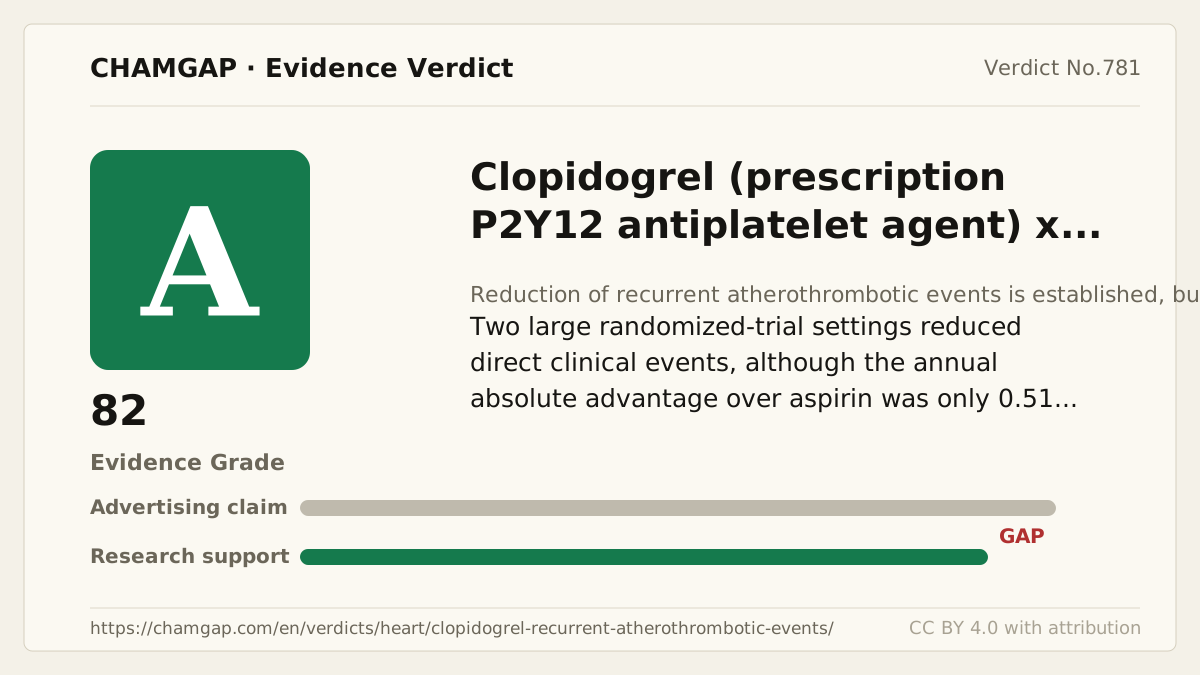
[Chamgap] Clopidogrel x reduced recurrent atherothrombotic events — Evidence Grade A·82. 4 cited sources checked. Source: https://chamgap.com/en/verdicts/heart/clopidogrel-recurrent-atherothrombotic-events/ · CC BY 4.0CC BY 4.0 — free to use with attribution; do not distort grades, numbers, or verdict meaning.
What this document does and does not do
Chamgap is an information source. It reports what research has and has not confirmed; it does not tell readers what to take or buy. That decision belongs to readers and, when needed, medical or legal professionals. This verdict reflects literature available up to the search date and may change as new research appears. Nothing here is medical advice.