
Cardiovascular polypill,
does it really help with Reduction of recurrent major cardiovascular events after recent myocardial infarction?
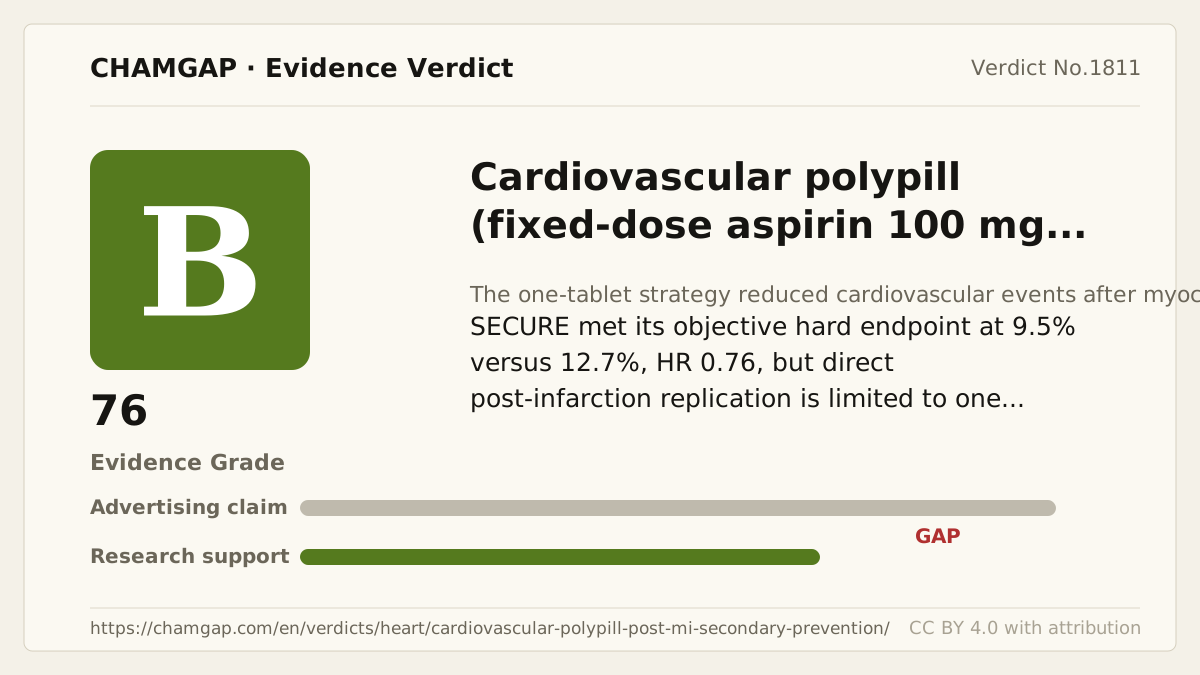
research showsThe cardiovascular polypill strategy is rated B. SECURE randomized 2,499 patients and included 2,466 with follow-up data in the primary intention-to-treat analysis. Compared with active usual care rather than placebo, the MACE endpoint fell from 12.7% to 9.5% (HR 0.76, 95% CI 0.60 to 0.96; superiority P=0.02), and adherence also improved. However, about 89% of PolyIran participants had no established cardiovascular disease, making it predominantly primary prevention rather than direct replication of post-infarction secondary prevention. Pharmacologic and adherence effects cannot be separated.
ads claimMarketing can turn the convenience of combining established medicines into the supposed unique potency of a new ingredient. Fewer pills is a real formulation fact, and fewer events is clinically demonstrated, but SECURE cannot isolate formulation convenience from the effects of its components.
Useful facts when choosing a product
- The SECURE polypill combined aspirin 100 mg, atorvastatin 20 or 40 mg, and ramipril 2.5, 5, or 10 mg in one tablet.
- Component evidence is distinct from verdict 1441, which is A with 94 points for low-dose aspirin, verdict 681, which is A with 92 points for simvastatin, and verdict 1181, which is B with 72 points for ramipril. A polypill is a treatment strategy, not a single ingredient.
- SECURE used guideline-based active usual care rather than placebo, so differences in components, doses, and adherence may all have contributed.
Chamgap Semantic Classification Code
Candidate index · review held
UNK.cardiovascular-polypill.UNK.recurrent-major-cardiovascular-events-after-recent-myocardial-infarction.reduce.MULTIUnknown > Cardiovascular polypill > Unknown > recurrent major cardiovascular events after recent myocardial infarction > Reduction claim > Multiple: primary unresolved
An automated migration candidate, not an issued permanent code; exact claim scope remains under review. This machine-generated migration candidate helps retrieval but is not a permanent assignment. The original verdict ID and URL remain authoritative.
What the research actually shows
Castellano and colleagues randomized 2,499 recent myocardial infarction patients in SECURE to polypill, 1,258, or usual care, 1,241. The primary intention-to-treat analysis included 2,466 with follow-up, 1,237 and 1,229. Over a median 36 months, primary MACE occurred in 118 patients, 9.5%, versus 156, 12.7%, HR 0.76 (95% CI 0.60 to 0.96), with P<0.001 for noninferiority and P=0.02 for superiority. High adherence improved from 62.7% to 70.6% at six months and from 63.2% to 74.1% at 24 months. PolyIran randomized 6,838 participants and found 5.9% versus 8.8%, adjusted HR 0.66 (0.55 to 0.80), but about 89% lacked established cardiovascular disease, so it is not direct replication of post-infarction secondary prevention.
Why this is classified as B (76)
H, R1, I2, E+, and B1 formally derive C. The editor assigned B with 76 points because SECURE is a large publicly funded hard-outcome superiority trial and PolyIran provides independent indirect directional support.
Counterpoint. Adherence actually improved in SECURE. The trial therefore cannot separate pharmacologic component or dose effects from the adherence effect of the one-tablet strategy.
Rejudgment record. Cross-check applied — Rated SECURE's successful large objective hard endpoint while treating PolyIran as non-direct post-infarction replication and active-usual-care-only control as H, R1, I2, E+, and B1
| Endpoint | H | Hard endpoint - actual events such as death |
| Replication | R1 | Single confirmatory trial |
| Independence | I2 | Decisive evidence is publicly or non-profit funded |
| Effect size | E+ | Meets the clinically important threshold |
Stored derived and displayed grades match; this is not a current recalculation or validity check (B).
Sub-claim grades by effect
This ingredient is marketed for several effects. A single overall grade blends strong and weak claims together, so each effect is graded separately here. The overall grade reflects the strongest disconfirming or core claim.
| Effect (sub-claim) | Grade | Basis |
|---|---|---|
| Reduction of recurrent MACE after myocardial infarction | B | SECURE met its large hard endpoint versus active usual care. |
| Reduction of cardiovascular death | B | The SECURE component was 3.9% versus 5.8%, HR 0.67, but it remains a component from one trial. |
| Reduction of cardiovascular events through treatment simplification | B | Event reduction was demonstrated, but adherence and component or dose contributions were not isolated. |
Cross-check — AI research and Codex final gate
Evidence Table
| Study | Design | Sample | Funding | Endpoint | Result | Weight |
|---|---|---|---|---|---|---|
| Castellano JM et al. 2022 SECURE | Multinational phase 3 open-label randomized active usual-care-controlled trial | 2,499 randomized (1,258/1,241); actual primary intention-to-treat analysis 2,466 (1,237/1,229) | Public European Union Horizon 2020 funding; Ferrer International supplied the polypill and had no other trial role | Composite cardiovascular death, nonfatal type 1 myocardial infarction, ischemic stroke, or urgent revascularization | 9.5% versus 12.7%, HR 0.76 (95% CI 0.60 to 0.96), superiority P=0.02; the primary endpoint succeeded. | Pivotal large hard-outcome evidence |
| Roshandel G et al. 2019 PolyIran | Pragmatic cluster-randomized minimal-care-controlled trial | 6,838 randomized; cluster-assignment intention-to-treat analysis of 6,838 | Tehran University of Medical Sciences, Barakat Foundation, and Alborz Darou Pharmaceutical Company | Composite major cardiovascular events | 5.9% versus 8.8%, adjusted HR 0.66 (95% CI 0.55 to 0.80), a positive result. | Indirect directional support in a predominantly primary-prevention population, not direct post-infarction replication |
Receipt — 2 References
All 2 cited sources were verified for existence at the original page (as of 2026-07-24).
Final verification and publication gate: Codex · Evidence date: 2026-07-24 · Corrections: none
Cite this verdict
[Chamgap] Cardiovascular polypill x reduction of recurrent major cardiovascular events after myocardial infarction — Evidence Grade B·76. 2 cited sources checked. Source: https://chamgap.com/en/verdicts/heart/cardiovascular-polypill-post-mi-secondary-prevention/ · CC BY 4.0CC BY 4.0 — free to use with attribution; do not distort grades, numbers, or verdict meaning.
What this document does and does not do
Chamgap is an information source. It reports what research has and has not confirmed; it does not tell readers what to take or buy. That decision belongs to readers and, when needed, medical or legal professionals. This verdict reflects literature available up to the search date and may change as new research appears. Nothing here is medical advice.