
Cardiac resynchronization therapy,
does it really help with Reduced mortality and heart-failure hospitalization in eligible patients with heart failure and reduced ejection fraction?
research showsCardiac resynchronization therapy is rated A because it reduces death and heart-failure hospitalization in selected patients with systolic dysfunction and electrical dyssynchrony. Medtronic-supported CARE-HF (Cleland 2005, N Engl J Med 352(15):1539-1549) enrolled 813 participants; death or cardiovascular hospitalization was 39% versus 55%, HR 0.63 (95% CI 0.51 to 0.77). Solely Guidant-sponsored COMPANION (Bristow 2004, N Engl J Med) enrolled 1,520 participants; primary-composite HRs were 0.81 for CRT-P and 0.80 for CRT-D. Both pivotal trials had industry sponsorship, benefit is strongest with QRS at least 150 ms and left bundle-branch block, and implantation has complications, giving 88 points.
ads claimMarketing may present CRT as a life-extending device for every person with heart failure, regardless of ejection fraction or QRS morphology. The evidence concerns selected patients meeting dyssynchrony and medical-therapy criteria, and an expert heart team must assess procedural suitability and complications.
Useful facts when choosing a product
- CRT paces the right and left ventricles to coordinate ventricular contraction. CRT-D adds defibrillation, whereas CRT-P primarily provides pacing.
- Benefit varies with ejection fraction, QRS duration and morphology, symptoms, rhythm, and use of optimal medical therapy.
- Implantation carries risks including infection, bleeding, pneumothorax, lead displacement or malfunction, and inappropriate shocks, requiring specialist follow-up.
Chamgap Semantic Classification Code
Candidate index · review held
P.cardiac-resynchronization-therapy.device.mortality-and-heart-failure-hospitalization-in-eligible-patients-with-heart-failure-and-reduced-ejection-fraction.reduce.UNKProcedures, devices and tests > Cardiac resynchronization therapy > Device delivered > mortality and heart-failure hospitalization in eligible patients with heart failure and reduced ejection fraction > Reduction claim > Unknown
An automated migration candidate, not an issued permanent code; exact claim scope remains under review. This machine-generated migration candidate helps retrieval but is not a permanent assignment. The original verdict ID and URL remain authoritative.
What the research actually shows
Medtronic-supported CARE-HF by Cleland in 2005 (N Engl J Med 352(15):1539-1549) randomized 813 participants and found death or cardiovascular hospitalization in 39% versus 55%, HR 0.63 (95% CI 0.51 to 0.77). Solely Guidant-sponsored COMPANION by Bristow in 2004 (N Engl J Med) randomized 1,520 participants among medical therapy, CRT-P, and CRT-D; primary-composite HRs were 0.81 and 0.80. A 12-trial synthesis of 7,538 participants reproduced lower mortality, although applicability is strongest with QRS at least 150 ms and left bundle-branch block.
Why this is classified as A (88)
In CARE-HF, death or cardiovascular hospitalization among 813 participants was 39% versus 55%, HR 0.63 (95% CI 0.51 to 0.77); in COMPANION, the primary-composite HRs among 1,520 participants were 0.81 for CRT-P and 0.80 for CRT-D. Both pivotal trials had industry sponsorship, benefit is strongest with QRS at least 150 ms and left bundle-branch block, and implantation has complications. However, rule ②-b's manufacturer ceiling does not apply to large hard-endpoint randomized trials of implantable devices, supporting A with 88 points.
Counterpoint. For eligible patients, CRT supplements rather than replaces optimal medical therapy. Comparable benefit should not be assumed with a narrow QRS complex, short life expectancy, or excessive procedural risk.
Rejudgment record. Cross-check applied — Accepted large hard-endpoint successes in CARE-HF and COMPANION, deducted for industry sponsorship of both pivotal trials, strongest applicability to QRS at least 150 ms and left bundle-branch block, and implantation complications, while not applying the rule ②-b ceiling to implantable-device hard-endpoint trials
Sub-claim grades by effect
This ingredient is marketed for several effects. A single overall grade blends strong and weak claims together, so each effect is graded separately here. The overall grade reflects the strongest disconfirming or core claim.
| Effect (sub-claim) | Grade | Basis |
|---|---|---|
| Reduced all-cause mortality in eligible patients with heart failure and reduced ejection fraction | A | CARE-HF and the 12-trial meta-analysis consistently showed a direct mortality benefit. |
| Reduced heart-failure and major cardiovascular hospitalization | A | The CARE-HF primary composite and the individual-patient synthesis support fewer hospitalizations. |
| Improved heart-failure symptoms and functional status | B | Several trials showed improvement, but variation by scale and patient selection makes this less certain than the hard outcomes. |
Cross-check — AI research and Codex final gate
Evidence Table
| Study | Design | Sample | Funding | Endpoint | Result | Weight |
|---|---|---|---|---|---|---|
| Cleland JGF et al. 2005 CARE-HF | Multicenter randomized controlled trial | 813 randomized; 813 in the actual primary analysis (409 versus 404) | Manufacturer-supported trial funded by Medtronic, which also provided a study manager | Primary endpoint: all-cause death or unplanned hospitalization for a major cardiovascular event | 159 of 409 versus 224 of 404, HR 0.63 (95% CI 0.51 to 0.77), P<0.001; the primary endpoint succeeded. | Pivotal direct hard-endpoint trial |
| Bristow MR et al. 2004 COMPANION | Multicenter three-arm randomized controlled trial | 1,520 randomized | Sole industry sponsorship by Guidant | Primary endpoint: all-cause death or all-cause hospitalization | Versus medical therapy, HR 0.81 for CRT-P and 0.80 for CRT-D. | Independent large pivotal hard-endpoint trial |
| Wells GA et al. 2011 | Systematic review and meta-analysis of randomized controlled trials | 12 randomized trials and 7,538 participants | No separate review funding source reported in the article; some included trials were device-manufacturer supported | Primary synthesis outcome: mortality | Mortality was lower versus medical therapy, RR 0.73 (95% CI 0.62 to 0.85), and versus an implantable cardioverter-defibrillator, RR 0.83 (0.72 to 0.96). | Large replication synthesis |
Receipt — 4 References
All 4 cited sources were verified for existence at the original page (as of 2026-07-24).
Final verification and publication gate: Codex · Evidence date: 2026-07-24 · Corrections: none
Cite this verdict
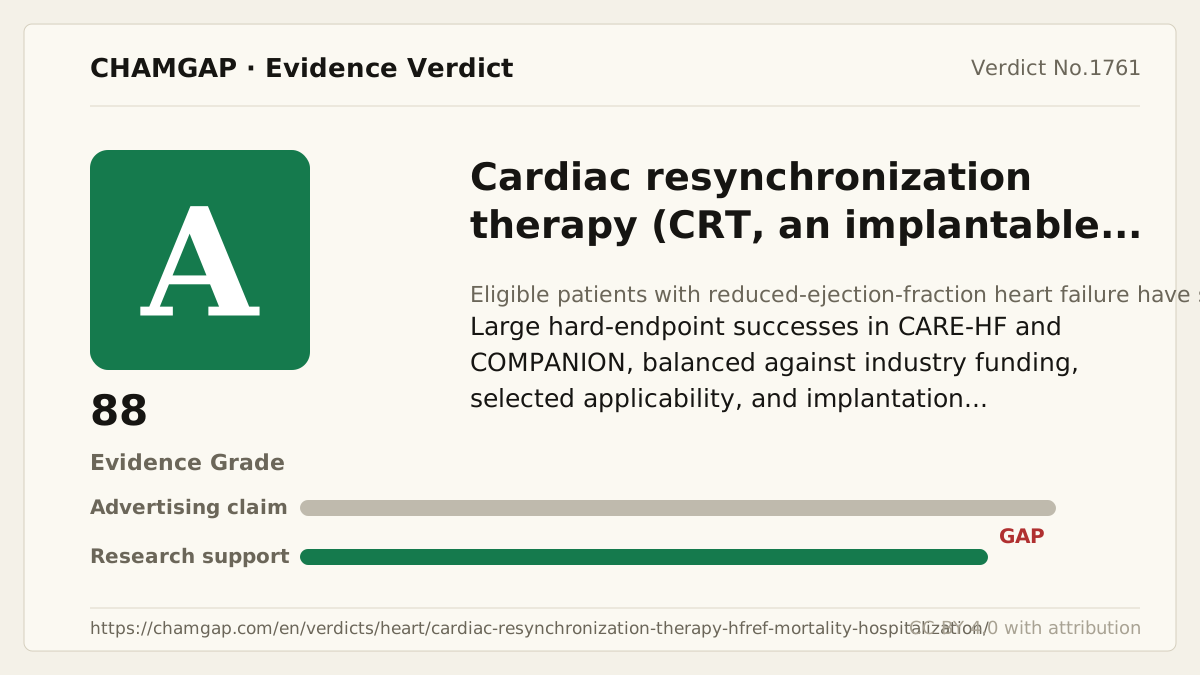
[Chamgap] Cardiac resynchronization therapy x reduced mortality and hospitalization in heart failure with reduced ejection fraction — Evidence Grade A·88. 4 cited sources checked. Source: https://chamgap.com/en/verdicts/heart/cardiac-resynchronization-therapy-hfref-mortality-hospitalization/ · CC BY 4.0CC BY 4.0 — free to use with attribution; do not distort grades, numbers, or verdict meaning.
What this document does and does not do
Chamgap is an information source. It reports what research has and has not confirmed; it does not tell readers what to take or buy. That decision belongs to readers and, when needed, medical or legal professionals. This verdict reflects literature available up to the search date and may change as new research appears. Nothing here is medical advice.