
Canola oil versus a Western fat blend,
does it really help with Lower LDL when replacing an oil blend with a Western fatty-acid profile?
research showsThe grade is C with 46 points. In a crossover feeding trial, 119 of 174 adults with central adiposity or metabolic-syndrome risk completed all periods. Adjusted six-week LDL was 2.64 plus or minus 0.04 mmol/L with canola oil versus 2.83 plus or minus 0.04 with a Western-profile control blend, P<0.0001. The plus-or-minus 0.04 values are standard errors of model-based least-squares means. LDL was a secondary surrogate, and exact standardized magnitude could not be calculated, so the score was lowered within the C band.
ads claimCanola oil's high smoke point is a cooking property, not an LDL result. The comparison depends on replacing a specified Western-profile blend. Verdict 1119 is D with 30 points for virgin coconut oil and LDL; the current question concerns canola replacing a defined control blend.
Useful facts when choosing a product
- Dietary fatty-acid energy percentages were 17.5% monounsaturated, 9.2% polyunsaturated, and 6.6% saturated with conventional canola, versus 10.5%, 10.0%, and 12.3% with the Western-profile control.
- Commodity canola oil typically contains 5% to 8% saturated, 60% to 65% monounsaturated, and 30% to 35% polyunsaturated fatty acids, with an omega-6:omega-3 ratio near 2:1. These are general ranges, not separate measurements of the trial oil.
- Oklahoma State University lists a canola-oil smoke-point range of 220 to 230 degrees Celsius. Refining and free-fatty-acid content matter, and smoke point does not establish cardiovascular benefit.
- At a 3,000-kcal diet level, about 60 g daily of test oil was incorporated into foods as an isocaloric replacement, not added as a supplement.
Chamgap Semantic Classification Code
Candidate index · review held
D.isocaloric-controlled-diet-containing-conventional-canola-oil.dietary.ldl-when-replacing-an-oil-blend-with-a-western-fatty-acid-profile.reduce.UNKDietary patterns and eating practices > isocaloric controlled diet containing conventional canola oil > Dietary regimen > LDL when replacing an oil blend with a Western fatty-acid profile > Reduction claim > Unknown
An automated migration candidate, not an issued permanent code; exact claim scope remains under review. This machine-generated migration candidate helps retrieval but is not a permanent assignment. The original verdict ID and URL remain authoritative.
What the research actually shows
COMIT II was a multicenter double-blind randomized three-period crossover feeding trial. Of 174 participants assessed at baseline, 119 completed all three six-week diets and entered the main analysis, with washouts of at least four weeks. A repeated-measures mixed model accounted for diet-specific baseline, sex, center, and sequence. NCT02029833 focused on body composition and abdominal fat; LDL was a prespecified secondary measurement. Agriculture and Agri-Food Canada, the Canola Council of Canada, provincial canola groups, and Dow AgroSciences jointly funded the program.
Why this is classified as C (46)
Registered-trial secondary LDL was lower than with the Western-profile blend, but exact standardized magnitude could not be calculated and the evidence was a short 119-completer surrogate trial, giving C with 46 points.
Counterpoint. The trial did not show that canola is superior to every oil or directly reduces myocardial infarction or death. Results depend on the replaced fat.
Rejudgment record. Cross-check applied — Checked the original report, registry, and official feeding evidence for comparator composition, randomized and completer counts, adjusted least-squares mean LDL, outcome hierarchy, and funding, then reassessed whether exact standardized magnitude could be reconstructed
| Endpoint | S | Surrogate marker - laboratory or imaging measures |
| Replication | R1 | Single confirmatory trial |
| Independence | I1 | Mixed funding sources |
| Effect size | EX | The clinical size of the effect could not be judged |
Stored derived and displayed grades match; this is not a current recalculation or validity check (C).
Sub-claim grades by effect
This ingredient is marketed for several effects. A single overall grade blends strong and weak claims together, so each effect is graded separately here. The overall grade reflects the strongest disconfirming or core claim.
| Effect (sub-claim) | Grade | Basis |
|---|---|---|
| Replacing a Western-profile oil blend with canola lowers LDL | C | Adjusted six-week LDL was 6.6% lower, but it was a short secondary surrogate. |
Cross-check — AI research and Codex final gate
Evidence Table
| Study | Design | Sample | Funding | Endpoint | Result | Weight |
|---|---|---|---|---|---|---|
| Bowen et al. 2019 COMIT II | Multicenter double-blind randomized three-period crossover controlled-feeding trial | 174 assessed at baseline and 119 completers analyzed across all periods | Joint Canadian government and industry support including the Canola Council, provincial canola groups, and Dow AgroSciences | Adjusted six-week LDL, a secondary lipid result in a body-composition-focused registered trial | Adjusted least-squares mean LDL was 2.64 plus or minus 0.04 with canola versus 2.83 plus or minus 0.04 mmol/L with Western-profile control, 6.6% lower, P<0.0001; 0.04 is the standard error of each least-squares mean | Direct positive surrogate evidence, but exact standardized magnitude could not be calculated |
Receipt — 3 References
All 3 cited sources were verified for existence at the original page (as of 2026-08-03).
Final verification and publication gate: Codex · Evidence date: 2026-08-03 · Corrections: none
Cite this verdict
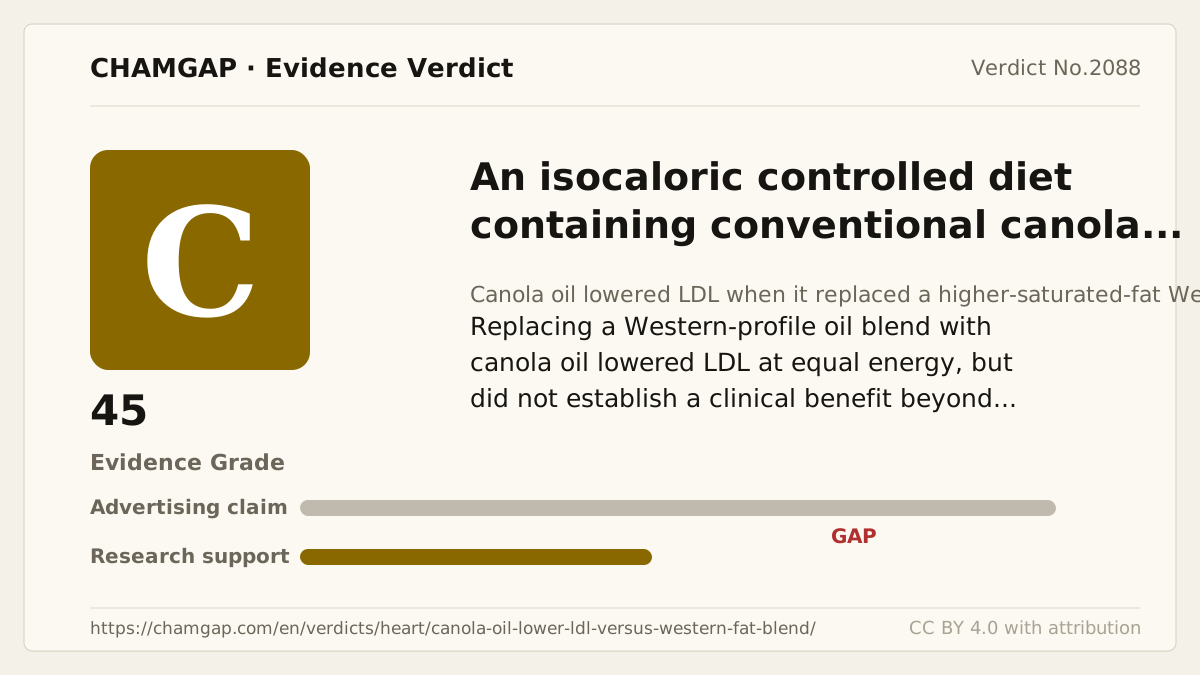
[Chamgap] Canola oil versus a Western fat blend x lower LDL — Evidence Grade C·46. 3 cited sources checked. Source: https://chamgap.com/en/verdicts/heart/canola-oil-lower-ldl-versus-western-fat-blend/ · CC BY 4.0CC BY 4.0 — free to use with attribution; do not distort grades, numbers, or verdict meaning.
What this document does and does not do
Chamgap is an information source. It reports what research has and has not confirmed; it does not tell readers what to take or buy. That decision belongs to readers and, when needed, medical or legal professionals. This verdict reflects literature available up to the search date and may change as new research appears. Nothing here is medical advice.