
Candesartan cilexetil,
does it really help with Reduced cardiovascular death and heart-failure hospitalization in ACE-inhibitor-intolerant heart failure with reduced ejection fraction?
research showsCandesartan is rated B with 72 points. It reduced the direct hard outcome of cardiovascular death or heart-failure hospitalization in patients with heart failure with reduced ejection fraction who could not tolerate an ACE inhibitor: CHARM-Alternative followed 2,028 participants for a median of 33.7 months, and the primary composite occurred in 33% with candesartan and 40% with placebo, with an unadjusted hazard ratio of 0.77 (95% CI 0.67 to 0.89). However, only one trial was cited—the second citation is a resource-use analysis within the same CHARM program—and replication by different investigators and funders has not been confirmed, so axis 2 R1 caps the grade at B. Renal impairment, hyperkalemia, and hypotension remain separate safety considerations.
ads claimPromotion may turn a composite-outcome reduction into a claim of proven mortality reduction alone or the best treatment for every patient with heart failure. The direct evidence instead applies to symptomatic patients with ejection fraction at or below 40% who could not take an ACE inhibitor.
Useful facts when choosing a product
- Candesartan cilexetil is an oral prescription angiotensin-receptor blocker prodrug converted to active candesartan and marketed under names including Atacand.
- CHARM-Alternative started 4 or 8 mg once daily and titrated as tolerated toward 32 mg once daily; prescribing must follow blood pressure, kidney function, potassium, and the local label.
- Blood pressure, serum creatinine or estimated glomerular filtration rate, and potassium should be checked after initiation and titration because renal impairment, hyperkalemia, and symptomatic hypotension can occur.
- Renin-angiotensin-system blockers should not be used during pregnancy because of fetal harm, and prior ACE-inhibitor angioedema or severe kidney disease requires individualized specialist assessment.
Chamgap Semantic Classification Code
Candidate index · review held
M.candesartan-cilexetil.oral.cardiovascular-death-and-heart-failure-hospitalization-in-ace-inhibitor-intolerant-heart-failure-with-reduced-ejection-fraction.reduce.placeboMedicinal interventions > Candesartan cilexetil > Oral > cardiovascular death and heart-failure hospitalization in ACE-inhibitor-intolerant heart failure with reduced ejection fraction > Reduction claim > Placebo
An automated migration candidate, not an issued permanent code; exact claim scope remains under review. This machine-generated migration candidate helps retrieval but is not a permanent assignment. The original verdict ID and URL remain authoritative.
What the research actually shows
Granger and colleagues enrolled 2,028 patients with left-ventricular ejection fraction at or below 40%, NYHA class II to IV symptoms, and prior ACE-inhibitor intolerance in CHARM-Alternative. Candesartan was started at 4 or 8 mg and titrated toward 32 mg once daily against placebo. Cardiovascular death or heart-failure hospitalization occurred in 334 of 1,013 versus 406 of 1,015 participants, producing an unadjusted hazard ratio of 0.77. A prospective CHARM resource-use analysis also found that fewer admissions substantially offset drug costs in the reduced-ejection-fraction trials. This verdict concerns candesartan in the ACE-inhibitor-intolerant group, not sacubitril/valsartan or enalapril evidence.
Why this is classified as B (72)
A large ingredient-specific double-blind placebo-controlled trial of 2,028 participants followed for a median of 33.7 months reduced the direct hard composite of cardiovascular death or heart-failure hospitalization with a hazard ratio of 0.77. However, the citations are repeat reports of a single trial program, and replication by different investigators and funders has not been confirmed, so axis 2 R1 caps the grade at B with 72 points. Manufacturer funding does not invoke the axis-3 cap under the prescription-drug large hard-outcome RCT exception, and mortality alone was not overstated.
Counterpoint. Candesartan is an outcome-improving option for ACE-inhibitor-intolerant HFrEF, but prescribing should still account for the full contemporary regimen, kidney function, potassium, and blood pressure.
Rejudgment record. New verdict — Applied B because, although CHARM-Alternative directly demonstrated an ingredient-specific reduction in the hard composite of cardiovascular death or heart-failure hospitalization in a large double-blind placebo-controlled trial, the citations are repeat reports of one trial and replication by different investigators and funders has not been confirmed, capping axis 2 at R1; manufacturer funding does not invoke the axis-3 cap under the prescription-drug large hard-outcome RCT exception
| Endpoint | H | Hard endpoint - actual events such as death |
| Replication | R1 | Single confirmatory trial |
| Independence | I0 | Evidence comes only from manufacturer studies |
| Effect size | E+ | Meets the clinically important threshold |
Stored derived and displayed grades match; this is not a current recalculation or validity check (B).
Sub-claim grades by effect
This ingredient is marketed for several effects. A single overall grade blends strong and weak claims together, so each effect is graded separately here. The overall grade reflects the strongest disconfirming or core claim.
| Effect (sub-claim) | Grade | Basis |
|---|---|---|
| Reduced composite risk of cardiovascular death or heart-failure hospitalization in ACE-inhibitor-intolerant HFrEF | A | CHARM-Alternative showed a direct hard-outcome benefit of 33% versus 40%, HR 0.77. |
| Reduced heart-failure hospitalization in ACE-inhibitor-intolerant HFrEF | A | This was a major component of the composite and fewer admissions were also documented in the resource-use analysis. |
| Reduced cardiovascular death alone in ACE-inhibitor-intolerant HFrEF | B | The direction favored treatment, but the firmly established result is the composite with heart-failure hospitalization. |
Cross-check — AI research and Codex final gate
Evidence Table
| Study | Design | Sample | Funding | Endpoint | Result | Weight |
|---|---|---|---|---|---|---|
| Granger CB et al. CHARM-Alternative, 2003 | Multicenter randomized double-blind placebo-controlled parallel-group trial | 2,028 patients with ACE-inhibitor intolerance and HFrEF with LVEF at or below 40% | Supported by AstraZeneca | Cardiovascular death or heart-failure hospitalization | 33% versus 40%; unadjusted HR 0.77 (95% CI 0.67 to 0.89) over a median 33.7 months. | Pivotal ingredient-specific hard-outcome trial |
| McMurray JJV et al. CHARM resource-use analysis, 2006 | Prospective resource-use and cost analysis within the CHARM program | Data from 7,599 participants in the three CHARM trials | AstraZeneca-supported CHARM program | Hospitalizations, procedures, drug use, and costs | Reduced admissions substantially offset candesartan costs in the reduced-ejection-fraction trials. | Supportive confirmation of hospitalization effects |
Receipt — 2 References
All 2 cited sources were verified for existence at the original page (as of 2026-08-11).
Final verification and publication gate: Codex · Evidence date: 2026-08-11 · Corrections: 1
Correction log — 1
Corrections applied to this verdict, in chronological order. Changes are logged, not erased.
- 2026-08-11 · Grade correction for unmet independent-replication requirement — Both cited papers were repeat reports of the same CHARM program (CHARM-Alternative, NCT00634400) — the primary report and a resource-use and cost analysis. Chamgap's A requires axis 2 R2 (multiple RCTs by different investigators and funders); the separate SPICE study shares CHARM's first author and Astra funding and was a 12-week tolerability trial with no significant difference in death or heart-failure hospitalization, and the Val-HeFT subgroup not receiving an ACE inhibitor was a subgroup analysis of a different ARB (valsartan), so neither counts as independent replication of the candesartan-specific claim. Axis 2 is R1 and the ceiling is B. The axes were recorded as B·H·R1·I0·E+·B1 and 72 points were assigned. The effect itself (cardiovascular death or heart-failure hospitalization 33% versus 40%, HR 0.77, 95% CI 0.67 to 0.89) is not disputed. Confirmed in the 2026-08-11 internal audit (workflow verification plus concurring Codex cross-check). (grade A→B)
Cite this verdict
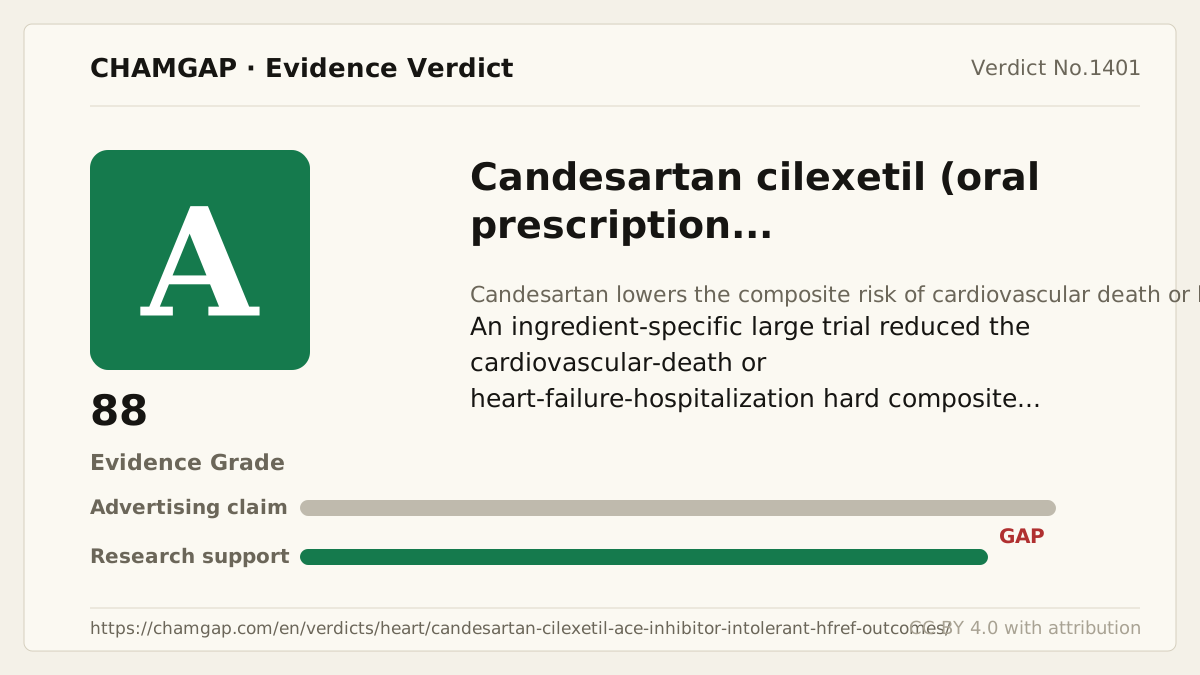
[Chamgap] Candesartan cilexetil x reduced cardiovascular death and heart-failure hospitalization in ACE-inhibitor-intolerant HFrEF — Evidence Grade B·72. 2 cited sources checked. Source: https://chamgap.com/en/verdicts/heart/candesartan-cilexetil-ace-inhibitor-intolerant-hfref-outcomes/ · CC BY 4.0CC BY 4.0 — free to use with attribution; do not distort grades, numbers, or verdict meaning.
What this document does and does not do
Chamgap is an information source. It reports what research has and has not confirmed; it does not tell readers what to take or buy. That decision belongs to readers and, when needed, medical or legal professionals. This verdict reflects literature available up to the search date and may change as new research appears. Nothing here is medical advice.