
Participant-selected caffeinated coffee,
does it really help with Reduced daily premature atrial contractions?
research showsThe grade is D. In a prospectively registered 14-day randomized crossover trial, premature atrial contractions averaged 58/day on coffee days and 53/day on caffeine-avoidance days, rate ratio 1.09 (95% CI 0.98 to 1.20), P=.10. They did not decrease, and the point estimate favored an increase.
ads claimCoffee does contain caffeine, but actual coffee did not reduce premature atrial contractions in this trial.
Useful facts when choosing a product
- Cup volume, brewing method, and caffeine dose were not standardized.
- Control was all-caffeine avoidance, not decaffeinated coffee.
- General caffeine ranges cannot be treated as study-product measurements.
Chamgap Semantic Classification Code
Candidate index · review held
F.participant-selected-caffeinated-coffee.food.daily-premature-atrial-contractions.reduce.UNKFoods and beverages > Participant-selected caffeinated coffee > Food consumption > daily premature atrial contractions > Reduction claim > Unknown
An automated migration candidate, not an issued permanent code; exact claim scope remains under review. This machine-generated migration candidate helps retrieval but is not a permanent assignment. The original verdict ID and URL remain authoritative.
What the research actually shows
The registry enrolled 108, with 100 fitted and included in the core analysis. This was not parallel-group; each person repeatedly crossed between assigned coffee and avoidance days. Control meant avoiding all caffeine, not decaf. Participants chose their usual coffee, so brewing, volume, and caffeine dose were not standardized or measured. UCSF and NIH funding was confirmed.
Why this is classified as D (30)
A prospectively registered direct randomized crossover trial was null on the primary outcome; as a single 100-person 14-day trial, it gives D with 30 points.
Counterpoint. The interval leaves some possibility of a small reduction, so this is not repeated refutation.
Rejudgment record. Cross-check applied — The 24-hour premature-atrial-contraction primary outcome was null in a prospectively registered 14-day repeated N-of-1 crossover trial
| Endpoint | S | Surrogate marker - laboratory or imaging measures |
| Replication | R1 | Single confirmatory trial |
| Independence | I2 | Decisive evidence is publicly or non-profit funded |
| Effect size | E0 | Null |
| Precision | C0 | The confidence interval leaves room for benefit |
Stored derived and displayed grades match; this is not a current recalculation or validity check (D).
Sub-claim grades by effect
This ingredient is marketed for several effects. A single overall grade blends strong and weak claims together, so each effect is graded separately here. The overall grade reflects the strongest disconfirming or core claim.
| Effect (sub-claim) | Grade | Basis |
|---|---|---|
| Reduced premature atrial contractions | D | The registered key outcome was null. |
Cross-check — AI research and Codex final gate
Evidence Table
| Study | Design | Sample | Funding | Endpoint | Result | Weight |
|---|---|---|---|---|---|---|
| Marcus et al. 2023 CRAVE | 14-day randomized repeated N-of-1 crossover trial | 108 enrolled and 100 in the core analysis | UCSF and US NIH | Premature atrial contractions per 24 hours | 58 versus 53/day, RR 1.09 (0.98-1.20), P=.10 | Null registered primary outcome |
Receipt — 2 References
All 2 cited sources were verified for existence at the original page (as of 2026-08-04).
Final verification and publication gate: Codex · Evidence date: 2026-08-04 · Corrections: none
Cite this verdict
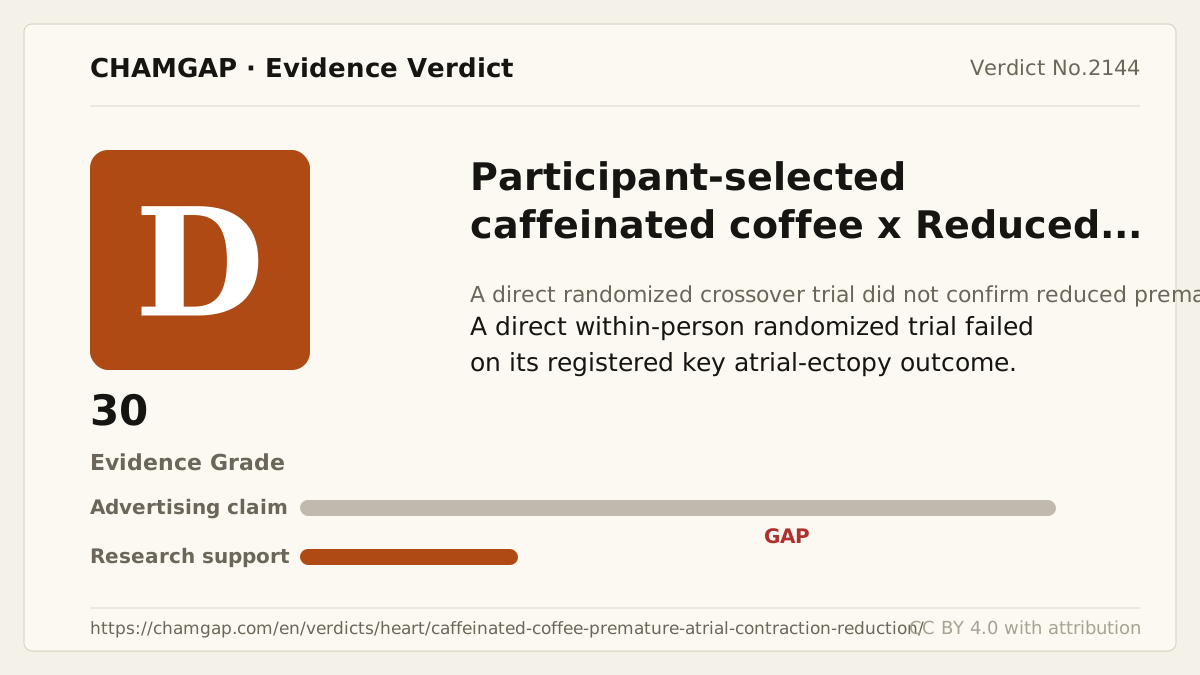
[Chamgap] Participant-selected caffeinated coffee x reduced premature atrial contractions — Evidence Grade D·30. 2 cited sources checked. Source: https://chamgap.com/en/verdicts/heart/caffeinated-coffee-premature-atrial-contraction-reduction/ · CC BY 4.0CC BY 4.0 — free to use with attribution; do not distort grades, numbers, or verdict meaning.
What this document does and does not do
Chamgap is an information source. It reports what research has and has not confirmed; it does not tell readers what to take or buy. That decision belongs to readers and, when needed, medical or legal professionals. This verdict reflects literature available up to the search date and may change as new research appears. Nothing here is medical advice.