
Black tea plus milk,
does it really help with Loss of the tea-associated flow-mediated dilation response?
research showsThe grade is C. In an acute crossover study of 16 healthy women, black tea increased two-hour flow-mediated dilation, but adding 10% skim milk removed that rise. A four-week crossover study of 17 healthy adults reported FMD 1.64 percentage points lower with milk tea than with tea. Both were small, short studies of a vascular ultrasound marker, not myocardial infarction or stroke, giving 52 points.
ads claimCasein-catechin complex formation in vitro and a short-term human vascular response are distinct steps. Neither establishes loss of all long-term cardiovascular prevention or proves that milk tea harms the heart.
Useful facts when choosing a product
- The 2007 trial used 500 mL freshly brewed black tea with 10% skim milk and measured FMD two hours later.
- Cell and isolated-vessel experiments in the same report found casein-catechin complexes and suppression of tea-related vasorelaxation signaling.
- In the 2018 four-week trial, milk tea differed from tea by -1.64±0.19 FMD percentage points, but no myocardial infarction or stroke was measured.
- The 2018 trial had no washout between treatments. Sequence and period were analyzed, but the design did not physically eliminate carryover.
Chamgap Semantic Classification Code
Candidate index · review held
F.black-tea.oral.loss-of-the-tea-associated-flow-mediated-dilation-response.assess.UNKFoods and beverages > Black tea > Oral > Loss of the tea-associated flow-mediated dilation response > Association or change assessment > Unknown
An automated migration candidate, not an issued permanent code; exact claim scope remains under review. This machine-generated migration candidate helps retrieval but is not a permanent assignment. The original verdict ID and URL remain authoritative.
What the research actually shows
Lorenz 2007 crossed 16 healthy women through water, 500 mL black tea, and black tea with 10% skim milk, measuring brachial FMD two hours later. Tea increased FMD versus water, while milk removed the rise. Ahmad 2018 randomized 17 healthy adults through four weeks each of water, tea, and milk tea without washout. Tea was +1.00±0.18 points versus water, and milk tea was -1.64±0.19 versus tea. The teams differed, but funding for the second trial could not be confirmed in the accessible record.
Why this is classified as C (50)
Acute and four-week crossover studies pointed in the same direction, but evidence remains confined to two small short trials and a surrogate ultrasound marker without strict independent replication, giving C with 50 points.
Counterpoint. Taste, nutritional value, and long-term cardiovascular events are not determined by this ultrasound-marker verdict.
Rejudgment record. Cross-check applied — Accepted same-direction signals from two small crossover studies while accounting for differing duration and design, surrogate endpoint, short follow-up, and unconfirmed funding
| Endpoint | S | Surrogate marker - laboratory or imaging measures |
| Replication | R1 | Single confirmatory trial |
| Independence | I1 | Mixed funding sources |
| Effect size | E+ | Meets the clinically important threshold |
Stored derived and displayed grades match; this is not a current recalculation or validity check (C).
Sub-claim grades by effect
This ingredient is marketed for several effects. A single overall grade blends strong and weak claims together, so each effect is graded separately here. The overall grade reflects the strongest disconfirming or core claim.
| Effect (sub-claim) | Grade | Basis |
|---|---|---|
| Milk lowers the short-term FMD response to black tea | C | Two small crossover trials pointed the same way, but the endpoint is surrogate. |
| Milk tea increases myocardial infarction or stroke | ? | No combination trial measured clinical events. |
Cross-check — AI research and Codex final gate
Evidence Table
| Study | Design | Sample | Funding | Endpoint | Result | Weight |
|---|---|---|---|---|---|---|
| Lorenz et al. 2007 | Randomized three-condition acute crossover trial | 16 healthy women | Original funding not confirmed | Brachial flow-mediated dilation two hours after intake | Tea increased FMD versus water; 10% skim milk removed the increase, P<0.01 | Direct acute combination trial |
| Ahmad et al. 2018 | Randomized three-condition four-week crossover trial | 17 healthy adults | Not confirmed in the accessible record | Brachial FMD at the end of each four-week period | Tea plus milk versus tea -1.64±0.19 percentage points, P<0.0001 | Same-direction supporting trial with different duration |
Receipt — 2 References
All 2 cited sources were verified for existence at the original page (as of 2026-08-04).
Final verification and publication gate: Codex · Evidence date: 2026-08-04 · Corrections: none
Cite this verdict
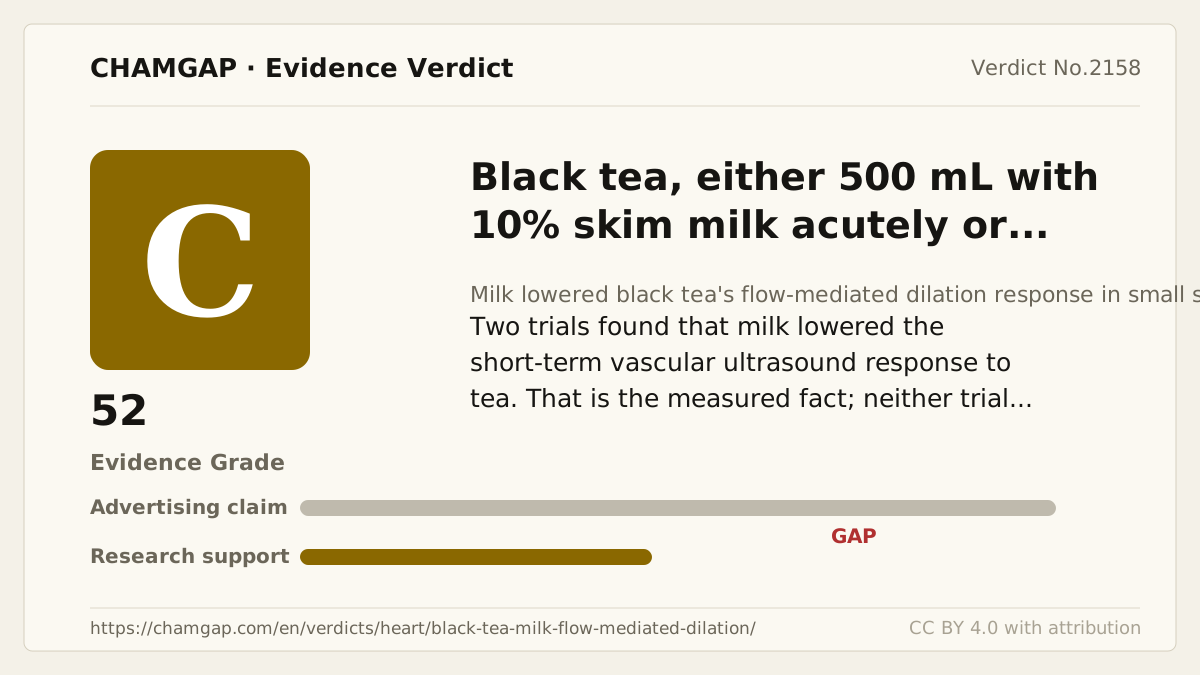
[Chamgap] Black tea plus milk x loss of flow-mediated dilation response — Evidence Grade C·50. 2 cited sources checked. Source: https://chamgap.com/en/verdicts/heart/black-tea-milk-flow-mediated-dilation/ · CC BY 4.0CC BY 4.0 — free to use with attribution; do not distort grades, numbers, or verdict meaning.
What this document does and does not do
Chamgap is an information source. It reports what research has and has not confirmed; it does not tell readers what to take or buy. That decision belongs to readers and, when needed, medical or legal professionals. This verdict reflects literature available up to the search date and may change as new research appears. Nothing here is medical advice.