
Black tea, three cups daily,
does it really help with Lower 24-hour ambulatory blood pressure in adults with normal to high-normal pressure?
research showsThe grade is C with 46 points. In a six-month double-blind trial, black tea lowered 24-hour systolic pressure by 2.0 mmHg and diastolic pressure by 2.1 mmHg versus a flavor- and caffeine-matched control. Because no validated clinical-importance threshold was found for the between-group pressure difference, standardized effects were classified by statistical convention; both were small. Blood pressure is a surrogate for cardiovascular events.
ads claimThe product contained caffeine, but the control received the same amount. The trial establishes a roughly 2-mmHg pressure difference, not prevention of myocardial infarction or stroke.
Useful facts when choosing a product
- Three daily cups supplied 1,493 mg of tea solids, 429 mg of polyphenols, and 96 mg of caffeine, about 32 mg caffeine per cup.
- The control matched flavor and caffeine while omitting tea solids, so caffeine exposure did not differ between groups.
- The circa-760 Classic of Tea records tea as a southern tree, but that historical record is not evidence of modern blood-pressure efficacy.
- Verdict 425 is C with 51 points for heat-treated green-tea extract and cognition, while verdict 939 is C with 40 points for green-tea extract and liver enzymes. Verdict 2021 asks a different question about a black-tea beverage and 24-hour pressure.
Chamgap Semantic Classification Code
Candidate index · review held
F.black-tea-beverage.food.ambulatory-blood-pressure.reduce.placeboFoods and beverages > Black-tea beverage > Food consumption > 24-hour ambulatory blood pressure > Reduction claim > Placebo
An automated migration candidate, not an issued permanent code; exact claim scope remains under review. This machine-generated migration candidate helps retrieval but is not a permanent assignment. The original verdict ID and URL remain authoritative.
What the research actually shows
The trial randomized 111 people but analyzed only the 95 baseline completers, 46 tea and 49 control, as its stated intention-to-treat population. Excluding these 16 people is the one analysis defect counted in the bias assessment. Tea supplied 1,493 mg of tea solids, 429 mg of polyphenols, and 96 mg of caffeine daily. Funding came jointly from Australia’s NHMRC and Unilever R&D, and two authors were affiliated with Unilever R&D. The journal was named Archives of Internal Medicine when published in 2012; the article is now hosted on the JAMA Internal Medicine website.
Why this is classified as C (46)
The primary ambulatory-pressure outcome was positive but was a surrogate, and the standardized effect was small under the statistical convention used because no validated clinical-importance threshold was found. One trial that analyzed 95 of 111 randomized participants and had mixed public and industry funding yields C with 46 points.
Counterpoint. A large independent long-term replication using the same beverage and dose, plus cardiovascular-event data, is needed.
Rejudgment record. Cross-check applied — The paper and registry were cross-checked for primary 24-hour pressure status, the 95-person analysis, three-cup dose, caffeine-matched control, and mixed funding
| Endpoint | S | Surrogate marker - laboratory or imaging measures |
| Replication | R1 | Single confirmatory trial |
| Independence | I1 | Mixed funding sources |
| Effect size | E~ | Statistically positive but below the threshold |
Stored derived and displayed grades match; this is not a current recalculation or validity check (C).
Sub-claim grades by effect
This ingredient is marketed for several effects. A single overall grade blends strong and weak claims together, so each effect is graded separately here. The overall grade reflects the strongest disconfirming or core claim.
| Effect (sub-claim) | Grade | Basis |
|---|---|---|
| The trial beverage contained 96 mg caffeine across three cups | ? | This is a measured composition fact from the paper, not a graded clinical outcome. |
| Three daily cups of black tea lower 24-hour ambulatory blood pressure | C | The primary result was positive in one surrogate-outcome trial and was small by the statistical convention used because no validated clinical-importance threshold was found. |
Cross-check — AI research and Codex final gate
Evidence Table
| Study | Design | Sample | Funding | Endpoint | Result | Weight |
|---|---|---|---|---|---|---|
| Hodgson JM et al., Archives of Internal Medicine, 2012 | Six-month double-blind caffeine-matched randomized parallel trial | 111 randomized; 95 baseline completers analyzed, 46 tea and 49 control | Joint support from Australia's NHMRC and Unilever R&D; two authors were Unilever employees | Primary 24-hour ambulatory systolic and diastolic pressure | At six months, systolic -2.0 mmHg (95% CI -4.0 to -0.0, P=0.05) and diastolic -2.1 (-3.5 to -0.7, P=0.003) | Direct positive evidence from one pivotal trial, with a small effect by statistical convention because no validated clinical-importance threshold was found |
Receipt — 2 References
All 2 cited sources were verified for existence at the original page (as of 2026-08-03).
Final verification and publication gate: Codex · Evidence date: 2026-08-03 · Corrections: none
Cite this verdict
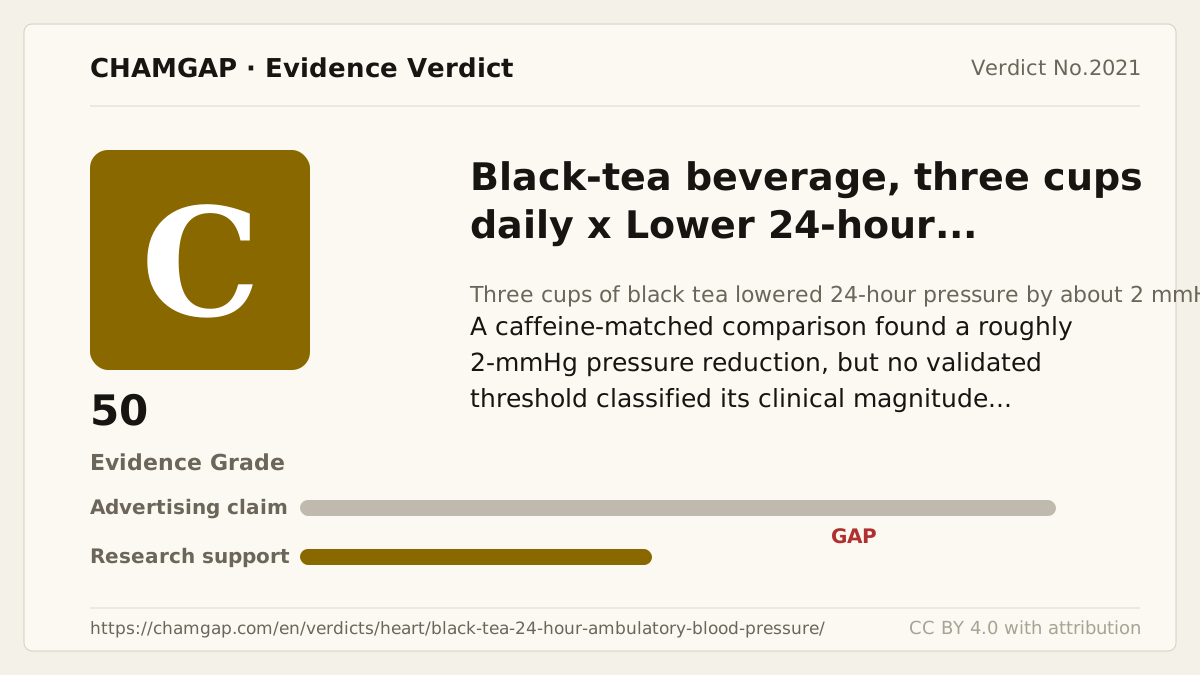
[Chamgap] Black tea, three cups daily x lower 24-hour ambulatory blood pressure — Evidence Grade C·46. 2 cited sources checked. Source: https://chamgap.com/en/verdicts/heart/black-tea-24-hour-ambulatory-blood-pressure/ · CC BY 4.0CC BY 4.0 — free to use with attribution; do not distort grades, numbers, or verdict meaning.
What this document does and does not do
Chamgap is an information source. It reports what research has and has not confirmed; it does not tell readers what to take or buy. That decision belongs to readers and, when needed, medical or legal professionals. This verdict reflects literature available up to the search date and may change as new research appears. Nothing here is medical advice.