
Bisoprolol,
does it really help with Reduced all-cause mortality, sudden death, and heart-failure hospitalization in stable symptomatic HFrEF?
research showsBisoprolol is rated A because it reduces all-cause death, sudden death, and heart-failure hospitalization in stable symptomatic HFrEF. CIBIS-II randomized 2,647 participants under double masking and reduced all-cause mortality from 17.3% to 11.8%, with HR 0.66 (95% CI 0.54 to 0.81); sudden death had HR 0.56, and admission for worsening heart failure fell by about 36%. An individual-data meta-analysis with the earlier CIBIS trial confirmed lower mortality, while the separate MERIT-HF program with metoprolol CR/XL and COPERNICUS program with carvedilol repeated the beta-blocker survival benefit. Treatment should begin at a low dose and be titrated slowly in a stable, euvolemic patient; it is not a drug to initiate during acute decompensation.
ads claimIt is unsafe to reduce this evidence to the idea that anyone with heart failure can start a high dose quickly. Proven use is in stable, euvolemic symptomatic HFrEF, not unsupervised initiation or escalation during acute pulmonary edema, shock, severe bradycardia, or abrupt withdrawal.
Useful facts when choosing a product
- Bisoprolol is a beta-1-selective beta blocker, and HFrEF treatment generally starts at a very low dose followed by titration over weeks toward the target or highest tolerated dose while monitoring pulse, blood pressure, congestion, and symptoms.
- Bradycardia, hypotension, dizziness, fatigue, and early worsening of heart-failure symptoms can occur, and treatment should not be initiated or up-titrated during cardiogenic shock, severe bradycardia or conduction block, or acute decompensated congestion.
- Abrupt withdrawal can cause rebound tachycardia, angina, or worsening heart failure, so dose changes should be gradual and clinician-directed.
- Beta-1 selectivity is not absolute; asthma or bronchospasm, peripheral vascular disease, reduced awareness of hypoglycemia, and combinations with other heart-rate-lowering drugs require caution.
Chamgap Semantic Classification Code
Candidate index · review held
M.bisoprolol.UNK.all-cause-mortality-sudden-death-and-heart-failure-hospitalization-in-stable-symptomatic-hfref.reduce.placeboMedicinal interventions > Bisoprolol > Unknown > all-cause mortality, sudden death, and heart-failure hospitalization in stable symptomatic HFrEF > Reduction claim > Placebo
An automated migration candidate, not an issued permanent code; exact claim scope remains under review. This machine-generated migration candidate helps retrieval but is not a permanent assignment. The original verdict ID and URL remain authoritative.
What the research actually shows
CIBIS-II enrolled 2,647 stable symptomatic HFrEF patients receiving an ACE inhibitor and diuretic, began bisoprolol at 1.25 mg or placebo, titrated to 10 mg, and followed participants for a mean of 1.3 years. It stopped early after large reductions in all-cause and sudden death, and worsening-heart-failure admissions also fell. The Leizorovicz 2002 individual-data meta-analysis combined 3,288 CIBIS and CIBIS-II participants and confirmed benefits for death, sudden death, and hospitalization. MERIT-HF reported all-cause mortality RR 0.66 with metoprolol CR/XL in 3,991 participants, and COPERNICUS reported a 35% mortality-risk reduction with carvedilol in 2,289. Unlike prior verdicts 692 for dapagliflozin and 732 for sacubitril/valsartan, each graded B around a single pivotal manufacturer trial, beta-blocker mortality benefit was repeated across separate large bisoprolol, metoprolol, and carvedilol programs, which justifies A.
Why this is classified as A (92)
Bisoprolol's own CIBIS-II trial showed all-cause mortality HR 0.66, sudden-death HR 0.56, and fewer heart-failure admissions in 2,647 participants. The CIBIS pooled analysis and separate large MERIT-HF and COPERNICUS trials repeated survival benefit with different beta blockers. This strong, consistent, direct hard-outcome evidence gives A with 92 points after a modest score recalibration. Repeated mortality proof across distinct trials and programs still distinguishes this evidence from the single-pivotal-trial B ratings for dapagliflozin verdict 692 and sacubitril/valsartan verdict 732. Bradycardia, hypotension, and acute-decompensation risk remain separate safety matters.
Counterpoint. The scope is long-term foundational therapy for stable HFrEF. Rapid weight gain, worsening breathlessness, syncope, or a very slow pulse calls for prompt clinical advice rather than self-adjustment.
Rejudgment record. Cross-check revision — Retained A because CIBIS-II all-cause mortality HR 0.66 and repeated mortality benefit in the separate large MERIT-HF and COPERNICUS trials provide replication across programs, while modestly recalibrating the score to 92; the distinction from single-pivotal-trial B verdicts 692 and 732 remains valid
Sub-claim grades by effect
This ingredient is marketed for several effects. A single overall grade blends strong and weak claims together, so each effect is graded separately here. The overall grade reflects the strongest disconfirming or core claim.
| Effect (sub-claim) | Grade | Basis |
|---|---|---|
| Reduction in all-cause mortality in stable symptomatic HFrEF | A | CIBIS-II found HR 0.66, reinforced by the pooled CIBIS analysis and large trials of other beta blockers. |
| Reduction in sudden death in stable symptomatic HFrEF | A | CIBIS-II reported sudden-death HR 0.56, and MERIT-HF showed the same direction. |
| Reduction in heart-failure hospitalization in stable symptomatic HFrEF | A | Admission for worsening heart failure fell by about 36%. Treatment should start low and be titrated in stable, euvolemic patients. |
Cross-check — AI research and Codex final gate
Evidence Table
| Study | Design | Sample | Funding | Endpoint | Result | Weight |
|---|---|---|---|---|---|---|
| CIBIS-II trial. 1999 | Multicenter randomized double-blind placebo-controlled trial | 2,647 patients with stable symptomatic heart failure | Multicenter study supported by Merck KGaA | Primary all-cause mortality; secondary sudden death and hospitalization outcomes | All-cause death was 11.8% versus 17.3%, HR 0.66; sudden death HR 0.56; admission for worsening heart failure fell by about 36%. | Key large direct hard-outcome randomized trial |
| Leizorovicz A et al. 2002 | Individual-patient-data meta-analysis of CIBIS and CIBIS-II | Two placebo-controlled trials and 3,288 participants | Pooled original CIBIS trial data | All-cause death, cardiovascular death, sudden death, heart-failure hospitalization, and myocardial infarction | Bisoprolol produced a 29.3% relative reduction in death and an 18.4% relative reduction in hospitalization or death. | Direct pooled bisoprolol evidence |
| MERIT-HF trial. 1999 | Multicenter randomized double-blind placebo-controlled trial | 3,991 patients with stable HFrEF | Separate class research program supported by Astra Hässle | Primary all-cause mortality; sudden and heart-failure death | Metoprolol CR/XL repeated the survival benefit with all-cause mortality RR 0.66 and sudden-death RR 0.59. | Replication across the beta-blocker class |
| Packer M et al.; COPERNICUS Study Group 2001 | Multicenter randomized double-blind placebo-controlled trial | 2,289 patients with severe stable HFrEF | Separate research program supported by Roche and GlaxoSmithKline | All-cause death and death or hospitalization | Carvedilol reduced the risk of death by 35% and death or hospitalization by 24%. | Large hard-outcome replication with a different drug |
Receipt — 4 References
Of 4 cited sources, 2 had limited original-page access (blocked or summary-only) and were verified via index/summary, marked partial; the rest were verified at the original page. As of 2026-07-21.
Final verification and publication gate: Codex · Evidence date: 2026-07-21 · Corrections: none
Cite this verdict
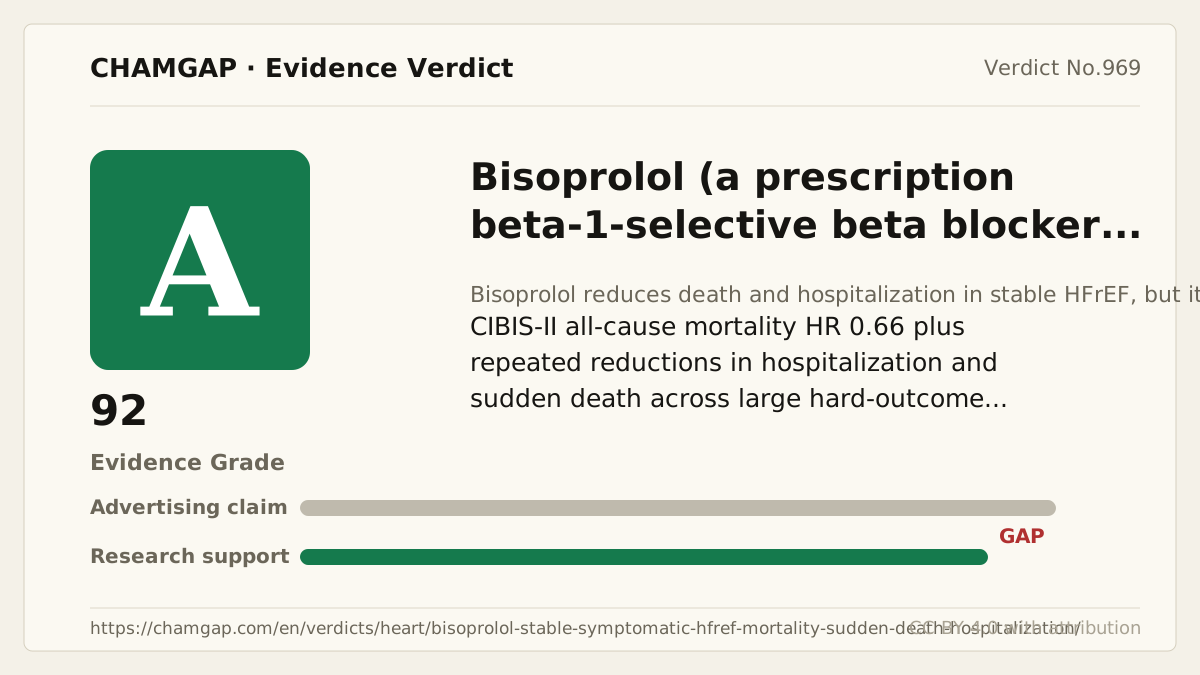
[Chamgap] Bisoprolol x reduced death, sudden death, and hospitalization in stable symptomatic HFrEF — Evidence Grade A·92. 4 cited sources checked. Source: https://chamgap.com/en/verdicts/heart/bisoprolol-stable-symptomatic-hfref-mortality-sudden-death-hospitalization/ · CC BY 4.0CC BY 4.0 — free to use with attribution; do not distort grades, numbers, or verdict meaning.
What this document does and does not do
Chamgap is an information source. It reports what research has and has not confirmed; it does not tell readers what to take or buy. That decision belongs to readers and, when needed, medical or legal professionals. This verdict reflects literature available up to the search date and may change as new research appears. Nothing here is medical advice.