
Beta-blockers,
does it really help with Prevention of death, reinfarction, and heart failure after myocardial infarction when left ventricular ejection fraction is at least 50%?
research showsThe claim that long-term beta-blockers prevent death, reinfarction, or heart failure after myocardial infarction is rated F for survivors with left ventricular ejection fraction of at least 50% and no other beta-blocker indication. A 2026 individual-participant meta-analysis of five contemporary randomized trials and 17,801 patients found composite events in 8.1% versus 8.3%, with a hazard ratio of 0.97 (95% CI 0.87 to 1.07). Large trials including REDUCE-AMI pointed in the same direction, so this is repeated evidence overturning decades of routine practice. The conclusion must not be applied to reduced-ejection-fraction heart failure or to patients with another indication such as arrhythmia or angina, and treatment must not be stopped abruptly.
ads claimThe old shorthand that every myocardial-infarction survivor needs a beta-blocker for life often omits ejection fraction and contemporary reperfusion and prevention. The opposite claim that beta-blockers are useless in all heart disease is also wrong. Evidence-based beta-blockers remain standard therapy in heart failure with reduced ejection fraction, and separate indications such as arrhythmia, angina, or hypertension may remain. This F verdict is limited to ejection fraction of at least 50% with no other indication.
Useful facts when choosing a product
- Beta-blockers such as metoprolol and bisoprolol are prescription medicines that reduce heart rate and blood pressure, with selectivity and dosing varying by product.
- Bradycardia, hypotension, fatigue, dizziness, and reduced exercise tolerance can occur, and additional caution is required with asthma, conduction disease, or peripheral circulatory problems.
- This verdict addresses only long-term prevention after myocardial infarction when ejection fraction is at least 50% and there is no other indication such as arrhythmia, angina, uncontrolled hypertension, or heart failure with reduced ejection fraction.
- Abrupt withdrawal can cause tachycardia, worsening angina, or ischemic events, so current users must discuss any taper or discontinuation plan with the prescriber.
Chamgap Semantic Classification Code
Candidate index · review held
UNK.beta-blockers.oral.death-reinfarction-and-heart-failure-after-myocardial-infarction-when-left-ventricular-ejection-fraction-is-at-least-50-percent.prevent.MULTIUnknown > Beta-blockers > Oral > death, reinfarction, and heart failure after myocardial infarction when left ventricular ejection fraction is at least 50% > Occurrence-prevention claim > Multiple: primary unresolved
An automated migration candidate, not an issued permanent code; exact claim scope remains under review. This machine-generated migration candidate helps retrieval but is not a permanent assignment. The original verdict ID and URL remain authoritative.
What the research actually shows
The 2026 Beta-Blocker Trialists' Collaboration individual-participant meta-analysis followed 17,801 patients with ejection fraction of at least 50% for a median of 3.6 years, drawing from REBOOT with 7,459 participants, REDUCE-AMI with 4,967, BETAMI with 2,441, DANBLOCK with 2,277, and CAPITAL-RCT with 657. Death, myocardial infarction, or heart failure occurred in 8.1% versus 8.3% (hazard ratio 0.97, 95% CI 0.87 to 1.07); hazard ratios were 1.04 for death, 0.89 for myocardial infarction, and 0.87 for heart failure, none statistically significant. In REDUCE-AMI, death or new myocardial infarction occurred in 7.9% versus 8.3% among 5,020 patients (hazard ratio 0.96, 95% CI 0.79 to 1.16). Evidence-based beta-blockers remain standard therapy for heart failure with reduced ejection fraction, so the populations must not be mixed.
Why this is classified as F (10)
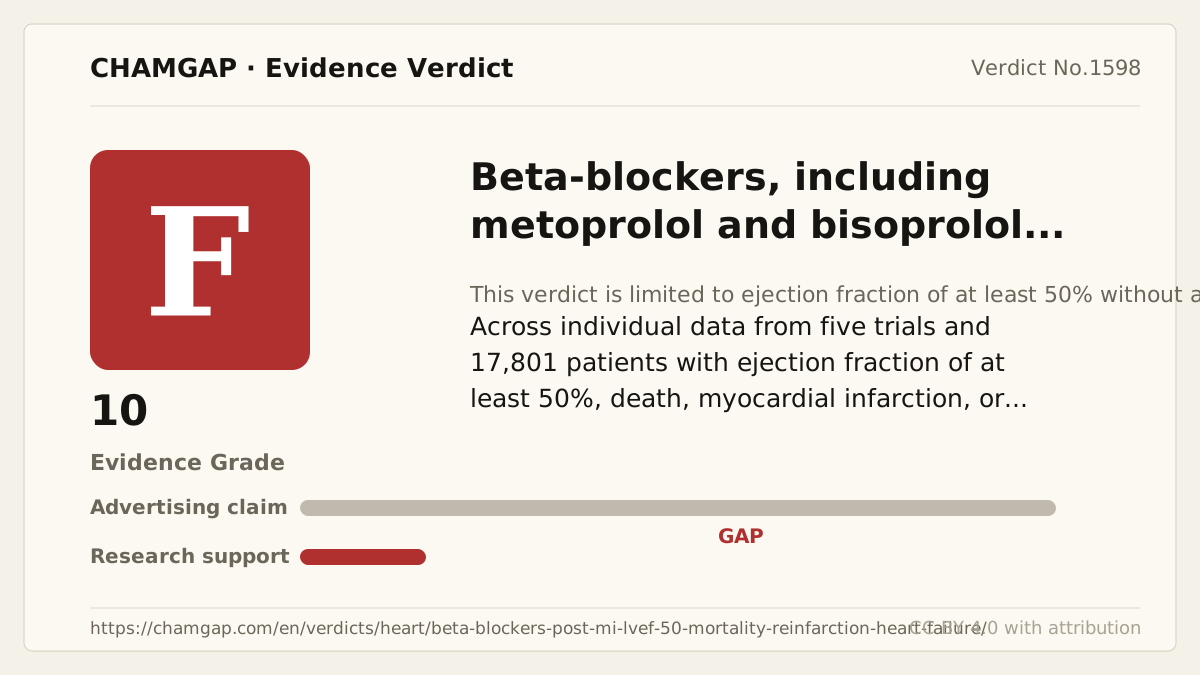
Individual data from five trials and 17,801 patients with ejection fraction of at least 50% found a null hard-outcome hazard ratio of 0.97, and large component trials including REDUCE-AMI repeatedly failed to show benefit. Applying the F rule for repeated large trials overturning longstanding standard practice gives F with 10 points.
Counterpoint. Evidence-based beta-blockers remain standard therapy for heart failure with reduced ejection fraction. A myocardial-infarction survivor may also have a separate indication such as arrhythmia or angina, so no one should stop therapy solely because of this verdict.
Rejudgment record. Cross-check applied — Applied the F standard because individual data from five contemporary trials and 17,801 patients with ejection fraction of at least 50% and large trials including REDUCE-AMI repeatedly refuted benefits for death, reinfarction, or heart failure, overturning longstanding routine practice
Sub-claim grades by effect
This ingredient is marketed for several effects. A single overall grade blends strong and weak claims together, so each effect is graded separately here. The overall grade reflects the strongest disconfirming or core claim.
| Effect (sub-claim) | Grade | Basis |
|---|---|---|
| Prevention of all-cause death after myocardial infarction with ejection fraction of at least 50% | F | The five-trial individual-data meta-analysis found no benefit for death, with a hazard ratio of 1.04; this does not apply to reduced ejection fraction. |
| Prevention of reinfarction after myocardial infarction with ejection fraction of at least 50% | F | The myocardial-infarction hazard ratio was 0.89 with a confidence interval crossing 1, and REDUCE-AMI was also null. |
| Prevention of heart failure after myocardial infarction with ejection fraction of at least 50% | F | The heart-failure hazard ratio was 0.87 and not significant; this must be distinguished from treatment of heart failure with reduced ejection fraction. |
Cross-check — AI research and Codex final gate
Evidence Table
| Study | Design | Sample | Funding | Endpoint | Result | Weight |
|---|---|---|---|---|---|---|
| Kristensen AMD et al.; Beta-Blocker Trialists' Collaboration Study Group. 2026 | Prespecified individual-participant-data meta-analysis of five open-label randomized trials | 17,801 patients with left ventricular ejection fraction of at least 50% | Collaboration of academic trials supported by multiple national public and nonprofit funders | First composite event of death from any cause, new myocardial infarction, or hospitalization for heart failure | Over a median of 3.6 years, events occurred in 8.1% versus 8.3%, with a hazard ratio of 0.97 (95% CI 0.87 to 1.07; P=0.54), showing no benefit. | Decisive refutation integrating repeated large trials |
| Yndigegn T et al.; REDUCE-AMI Investigators. 2024 | Registry-based prospective open-label randomized trial | 5,020 patients with left ventricular ejection fraction of at least 50% | Public and nonprofit support including the Swedish Research Council and Heart-Lung Foundation | Death from any cause or new myocardial infarction | Over a median of 3.5 years, events occurred in 7.9% versus 8.3%, with a hazard ratio of 0.96 (95% CI 0.79 to 1.16; P=0.64). | Key independent large null trial |
| Ibanez B et al.; REBOOT-CNIC Investigators. 2025 | Multinational pragmatic open-label randomized trial | 8,505 myocardial-infarction survivors with left ventricular ejection fraction above 40% | Public and nonprofit support from CNIC and Spanish and European sources | Composite of death from any cause, reinfarction, or hospitalization for heart failure | The composite outcome did not differ between beta-blocker and no-treatment groups (hazard ratio 1.04, 95% CI 0.89 to 1.22; P=0.63). | Additional large null evidence in contemporary care |
Receipt — 4 References
All 4 cited sources were verified for existence at the original page (as of 2026-07-24).
Final verification and publication gate: Codex · Evidence date: 2026-07-24 · Corrections: none
Cite this verdict
[Chamgap] Beta-blockers x prevention of death, reinfarction, and heart failure after myocardial infarction with left ventricular ejection fraction of at least 50% — Evidence Grade F·10. 4 cited sources checked. Source: https://chamgap.com/en/verdicts/heart/beta-blockers-post-mi-lvef-50-mortality-reinfarction-heart-failure/ · CC BY 4.0CC BY 4.0 — free to use with attribution; do not distort grades, numbers, or verdict meaning.
What this document does and does not do
Chamgap is an information source. It reports what research has and has not confirmed; it does not tell readers what to take or buy. That decision belongs to readers and, when needed, medical or legal professionals. This verdict reflects literature available up to the search date and may change as new research appears. Nothing here is medical advice.