
Atorvastatin,
does it really help with Additional reduction of major cardiovascular events with high-intensity dosing in established coronary disease?
research showsHigh-intensity atorvastatin is rated A because it repeatedly reduced direct cardiovascular events in established coronary disease. In the 10,001-participant TNT trial, major events were 8.7% versus 10.9% with 10 mg (HR 0.78); in the 4,162-participant PROVE-IT trial, two-year composite events were 22.4% versus 26.3% with pravastatin 40 mg. A meta-analysis of four intensive-statin trials involving 27,548 participants also found a 16% reduction in coronary death or myocardial infarction. Overall mortality was null in TNT, the principal outcomes were composites, and the key trials had industry sponsorship, so the result is A with 88 points.
ads claimPromotion may generalize lower LDL as automatically better for everyone. The strongest evidence concerns high-intensity secondary prevention in people with coronary disease or recent acute coronary syndrome; extension to low-risk primary prevention requires a separate verdict.
Useful facts when choosing a product
- Atorvastatin is a prescription HMG-CoA reductase inhibitor, and high-intensity dosing is generally 40 to 80 mg once daily with individualized prescribing and interaction review.
- The strongest efficacy evidence applies to secondary prevention after established coronary disease or recent acute coronary syndrome; an LDL value alone does not establish the same absolute benefit in low-risk populations.
- Unexplained severe muscle pain or weakness, dark urine, or jaundice warrants medical review, and atorvastatin should not be used during pregnancy.
- Strong CYP3A4 inhibitors, certain other medicines, and grapefruit can increase exposure and muscle-toxicity risk, so the product label and prescriber's directions take priority.
Chamgap Semantic Classification Code
Candidate index · review held
M.atorvastatin.UNK.major-cardiovascular-events-with-high-intensity-dosing-in-established-coronary-disease.reduce.activeMedicinal interventions > Atorvastatin > Unknown > major cardiovascular events with high-intensity dosing in established coronary disease > Reduction claim > Active comparator
An automated migration candidate, not an issued permanent code; exact claim scope remains under review. This machine-generated migration candidate helps retrieval but is not a permanent assignment. The original verdict ID and URL remain authoritative.
What the research actually shows
TNT assigned patients with stable coronary disease to atorvastatin 10 mg or 80 mg for a median 4.9 years. Major cardiovascular events occurred in 10.9% and 8.7%, respectively, although overall mortality did not differ significantly. PROVE-IT assigned 4,162 patients after acute coronary syndrome to atorvastatin 80 mg or pravastatin 40 mg; two-year composite events were 22.4% and 26.3%. Cannon 2006 synthesized the PROVE-IT, A-to-Z, TNT, and IDEAL trials, totaling 27,548 participants, and found a 16% reduction in coronary death or myocardial infarction with intensive therapy. These studies assessed clinical events rather than LDL alone, while their composite endpoints and industry sponsorship remain limitations.
Why this is classified as A (88)
TNT reported major events of 8.7% versus 10.9% (HR 0.78), PROVE-IT reported two-year composite events of 22.4% versus 26.3%, and the four-trial, 27,548-participant meta-analysis found a 16% reduction in coronary death or myocardial infarction. Repeated direct clinical outcomes support A. Null overall mortality in TNT, composite endpoints, and industry sponsorship lower the result to 88 points, below simvastatin at A with 88 points.
Counterpoint. If high-intensity therapy is not tolerated, the maximally tolerated dose, another statin, or nonstatin combination therapy can be discussed with the prescriber. Unsupervised discontinuation may increase recurrence risk.
Rejudgment record. New verdict — Applied A because TNT, PROVE-IT, and a four-trial meta-analysis of 27,548 participants repeatedly reduced direct cardiovascular events, while assigning 88 points for null overall mortality in TNT, composite endpoints, and industry sponsorship
Sub-claim grades by effect
This ingredient is marketed for several effects. A single overall grade blends strong and weak claims together, so each effect is graded separately here. The overall grade reflects the strongest disconfirming or core claim.
| Effect (sub-claim) | Grade | Basis |
|---|---|---|
| Additional reduction of major cardiovascular events with high-intensity atorvastatin in established coronary disease | A | Large TNT and PROVE-IT trials consistently reduced direct hard outcomes. |
| Extension of the same absolute benefit to primary prevention including low-risk populations | ? | The secondary-prevention trials in this verdict cannot establish the same absolute benefit in low-risk primary prevention. |
| Inferring clinical-event reduction in every population from LDL lowering alone | C | LDL is a surrogate and population-specific clinical-event evidence is required. |
Cross-check — AI research and Codex final gate
Evidence Table
| Study | Design | Sample | Funding | Endpoint | Result | Weight |
|---|---|---|---|---|---|---|
| LaRosa JC et al. TNT 2005 | Multinational randomized double-blind active-controlled trial | 10,001 patients with stable coronary disease | Funded by Pfizer | Coronary death, nonprocedural myocardial infarction, resuscitated cardiac arrest, or fatal or nonfatal stroke | Events occurred in 8.7% with 80 mg and 10.9% with 10 mg; HR 0.78 (95% CI 0.69 to 0.89), an absolute difference of 2.2 percentage points. | Key large direct hard-outcome evidence |
| Cannon CP et al. PROVE-IT TIMI 22 2004 | Randomized active-controlled strategy trial | 4,162 patients with recent acute coronary syndrome | Funded by Bristol-Myers Squibb and Sankyo | Composite of death, myocardial infarction, rehospitalization for unstable angina, revascularization, or stroke | Two-year composite events occurred in 22.4% with atorvastatin 80 mg and 26.3% with pravastatin 40 mg. | Separate large direct clinical-outcome evidence |
| Cannon CP et al. 2006 meta-analysis | Meta-analysis of randomized intensive-versus-moderate statin trials | Four trials and 27,548 participants | Included trials had industry sponsorship | Coronary death or myocardial infarction | Intensive statin therapy reduced coronary death or myocardial infarction by 16%. | Synthesis confirming repeated direct outcomes |
Receipt — 3 References
All 3 cited sources were verified for existence at the original page (as of 2026-07-20).
Final verification and publication gate: Codex · Evidence date: 2026-07-20 · Corrections: none
Cite this verdict
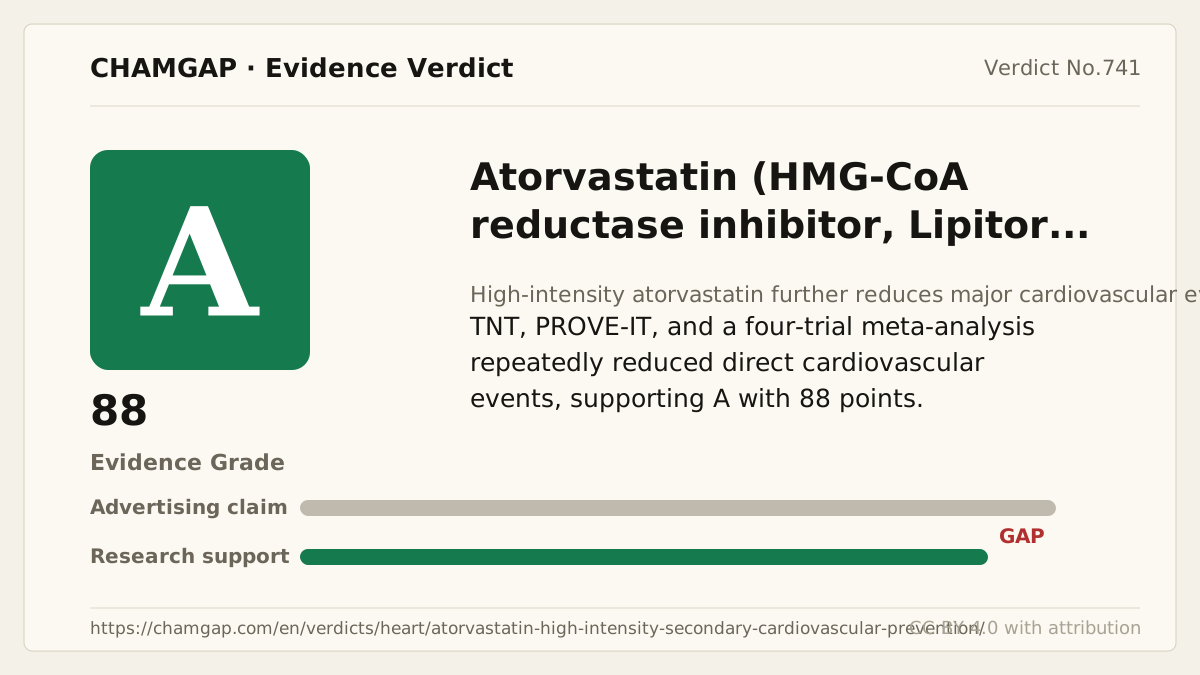
[Chamgap] Atorvastatin x additional reduction of major cardiovascular events in coronary disease — Evidence Grade A·88. 3 cited sources checked. Source: https://chamgap.com/en/verdicts/heart/atorvastatin-high-intensity-secondary-cardiovascular-prevention/ · CC BY 4.0CC BY 4.0 — free to use with attribution; do not distort grades, numbers, or verdict meaning.
What this document does and does not do
Chamgap is an information source. It reports what research has and has not confirmed; it does not tell readers what to take or buy. That decision belongs to readers and, when needed, medical or legal professionals. This verdict reflects literature available up to the search date and may change as new research appears. Nothing here is medical advice.