
Aspirin,
does it really help with Reduced early vascular mortality in acute myocardial infarction?
research showsAspirin given early under medical direction for suspected acute myocardial infarction directly reduced vascular mortality from randomization through day 35, and it is rated B with 72 points on the evidence hierarchy. ISIS-2 randomized and analyzed all 17,187 participants as allocated. In the aspirin comparison, vascular death occurred in 804 of 8,587 patients (9.4%) versus 1,016 of 8,600 (11.8%), meeting the protocol-prespecified primary analysis endpoint with 2P<0.00001. This was a large hard-outcome trial with an absolute reduction of 2.4 percentage points, and nonfatal reinfarction and stroke also decreased. However, ISIS-2 is the only randomized trial cited for this mortality claim, and replication by different investigators with different funding has not been confirmed, so the axis-2 R1 ceiling of B applies.
ads claimMarketing and popular advice can simplify aspirin into a daily heart supplement for everyone. The demonstrated use here is early antiplatelet treatment during suspected acute myocardial infarction, not unsupervised primary prevention or self-treatment before the cause of chest pain is assessed.
Useful facts when choosing a product
- ISIS-2 used aspirin 160 mg daily for one month, with the first dose administered within an acute myocardial infarction care protocol.
- Enteric-coated tablets may absorb more slowly than promptly absorbed formulations, so local emergency guidance and professional direction take priority.
- Aspirin allergy, active bleeding, selected bleeding disorders, and concurrent anticoagulation require immediate clinical assessment.
- Chest pain warrants prompt contact with emergency services rather than delaying care to locate medication; this verdict is not an individualized dosing instruction.
Chamgap Semantic Classification Code
Candidate index · review held
M.acute-aspirin.UNK.early-vascular-mortality-in-acute-myocardial-infarction.reduce.MULTIMedicinal interventions > Acute aspirin > Unknown > early vascular mortality in acute myocardial infarction > Reduction claim > Multiple: primary unresolved
An automated migration candidate, not an issued permanent code; exact claim scope remains under review. This machine-generated migration candidate helps retrieval but is not a permanent assignment. The original verdict ID and URL remain authoritative.
What the research actually shows
ISIS-2 randomized 17,187 patients with suspected acute myocardial infarction within 24 hours of symptom onset in a 2-by-2 factorial comparison of streptokinase and aspirin. In the one-month aspirin 160-mg daily comparison, the protocol-prespecified primary analysis endpoint was vascular mortality from randomization through day 35; it fell from 1,016 of 8,600 to 804 of 8,587, with 2P<0.00001. Nonfatal reinfarction was 1.0% versus 2.0%, and nonfatal stroke was 0.3% versus 0.6%. From day 36 through ten years, the mortality rate ratio was 0.99 (95% CI 0.93 to 1.06), so there was no additional benefit, while the early survival advantage was maintained. Behringwerke/Hoechst provided the main industry funding and the British Heart Foundation supported coordination.
Why this is classified as B (72)
An all-randomized analysis of 17,187 participants reduced the protocol-prespecified day 0-to-35 vascular-mortality endpoint from 11.8% to 9.4%, with 2P<0.00001. There was no additional mortality benefit from day 36 to ten years, but the early survival advantage persisted. However, ISIS-2 is the only randomized trial testing this claim: ATT 2009 is a meta-analysis of long-term prevention rather than a new acute-phase trial, and the separately recruited Elwood 1979 (1,705 patients, no evidence of benefit on early mortality) and Verheugt 1990 (100 patients; three-month mortality 20% versus 24%, p=0.65) were null on mortality. Replication by different investigators with different funding has not been confirmed, so the axis-2 R1 ceiling applies, while rule ②-b (axis 3) does not cap this exceptionally large prescription-drug hard-outcome trial. The result is B with 72 points.
Counterpoint. The strong benefit in acute myocardial infarction does not automatically extend to primary prevention in healthy people. Bleeding risk and contraindications still require medically directed use.
Rejudgment record. Cross-check applied — The day 0-to-35 vascular-mortality primary endpoint succeeded among all 17,187 randomized patients, and the early benefit persisted without additional benefit from day 36 to ten years. ISIS-2 is the only randomized trial testing this claim, and the separately recruited Elwood 1979 and Verheugt 1990 trials were null on mortality, so with no confirmed replication by different investigators and funders the axis-2 R1 ceiling of B was applied; the rule ②-b manufacturer ceiling (axis 3) is not applied to this exceptionally large prescription-drug hard-outcome trial.
| Endpoint | H | Hard endpoint - actual events such as death |
| Replication | R1 | Single confirmatory trial |
| Independence | I1 | Mixed funding sources |
| Effect size | E+ | Meets the clinically important threshold |
Stored derived and displayed grades match; this is not a current recalculation or validity check (B).
Sub-claim grades by effect
This ingredient is marketed for several effects. A single overall grade blends strong and weak claims together, so each effect is graded separately here. The overall grade reflects the strongest disconfirming or core claim.
| Effect (sub-claim) | Grade | Basis |
|---|---|---|
| Reduced five-week vascular mortality in acute myocardial infarction | A | The direct mortality endpoint succeeded in the analysis of all 17,187 randomized patients. |
| Reduced nonfatal reinfarction in acute myocardial infarction | A | ISIS-2 reduced the outcome from 2.0% to 1.0%. |
| Reduced nonfatal stroke in acute myocardial infarction | B | The direct signal was positive at 0.3% versus 0.6%, although event counts were smaller than for mortality. |
Cross-check — AI research and Codex final gate
Evidence Table
| Study | Design | Sample | Funding | Endpoint | Result | Weight |
|---|---|---|---|---|---|---|
| ISIS-2 Collaborative Group. 1988 | Multicenter randomized double-blind placebo-controlled 2-by-2 factorial trial | 17,187 randomized and all analyzed; 8,587 aspirin and 8,600 placebo | Mainly industry funded by Behringwerke/Hoechst, with coordination supported by the British Heart Foundation and aspirin and placebo donated by Sterling Drugs | Protocol-prespecified primary analysis endpoint: vascular mortality from randomization through day 35 | 804 of 8,587 (9.4%) versus 1,016 of 8,600 (11.8%), a 23% odds reduction with 2P<0.00001; successful. | Decisive large direct mortality evidence |
| Antithrombotic Trialists' Collaboration. 2009 | Individual-participant-data meta-analysis of randomized trials | 16 secondary-prevention trials with about 17,000 participants | UK Medical Research Council, British Heart Foundation, Cancer Research UK, and European Community Biomed Programme | Serious vascular events | 6.7% versus 8.2% per year, P<0.0001, reproducing fewer clinical events in secondary prevention. | Large confirmatory synthesis |
Receipt — 2 References
All 2 cited sources were verified for existence at the original page (as of 2026-08-11).
Final verification and publication gate: Codex · Evidence date: 2026-08-11 · Corrections: 1
Correction log — 1
Corrections applied to this verdict, in chronological order. Changes are logged, not erased.
- 2026-08-11 · Grade correction for unmet independent-replication requirement — Of the two cited papers, only ISIS-2 (1988, predating trial registration, no registry number) is a randomized trial; the other, ATT 2009, is an individual-participant meta-analysis rather than a new trial, covering long-term primary and secondary prevention instead of early treatment of acute myocardial infarction. Chamgap's A requires axis-2 R2 (multiple RCTs by different investigators with different funding), and the separately recruited Elwood 1979 (1,705 patients, no evidence of benefit on early mortality) and Verheugt 1990 (100 patients; three-month mortality 20% versus 24%, p=0.65) failed to reproduce the mortality endpoint. Axis 2 is R1, capping the grade at B. The axes were recorded as B-H-R1-I1-E+-B1 and 72 points were assigned (the axis-3 manufacturer ceiling is waived under the exception for exceptionally large hard-endpoint prescription-drug RCTs). The effect itself (day 0-35 vascular mortality 9.4% versus 11.8%, 2P<0.00001) is not denied. Confirmed in the 2026-08-11 internal audit (workflow verification plus concurring Codex cross-check). (grade A→B)
Cite this verdict
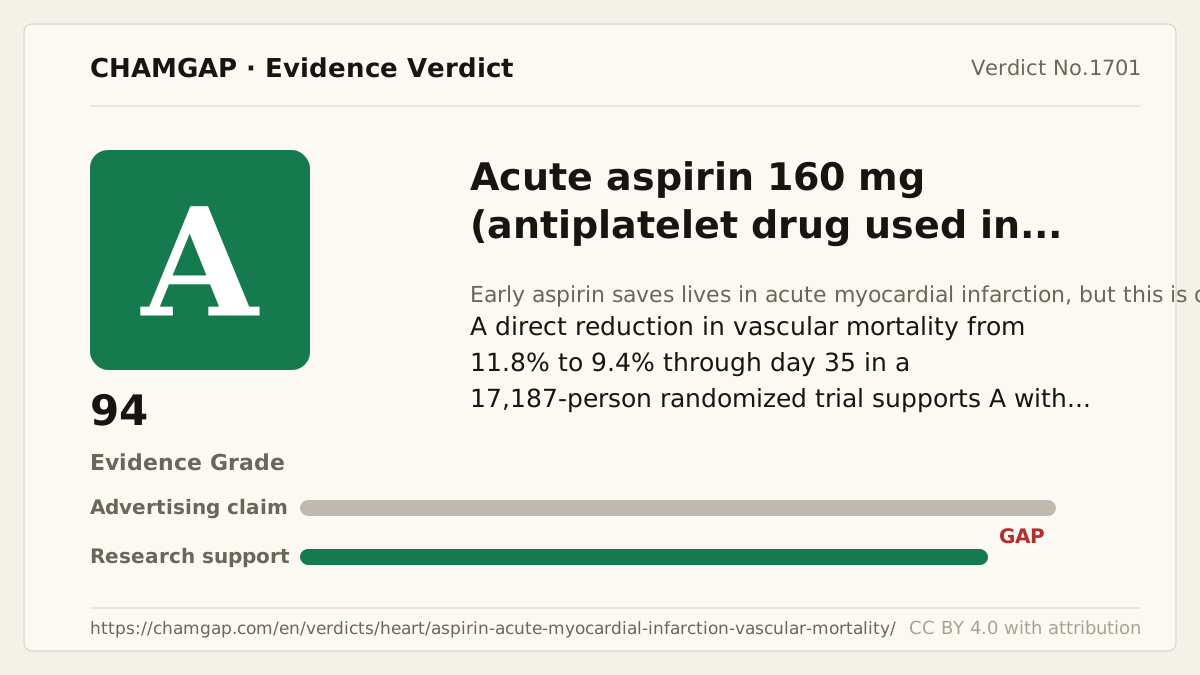
[Chamgap] Aspirin x reduced early vascular mortality in acute myocardial infarction — Evidence Grade B·72. 2 cited sources checked. Source: https://chamgap.com/en/verdicts/heart/aspirin-acute-myocardial-infarction-vascular-mortality/ · CC BY 4.0CC BY 4.0 — free to use with attribution; do not distort grades, numbers, or verdict meaning.
What this document does and does not do
Chamgap is an information source. It reports what research has and has not confirmed; it does not tell readers what to take or buy. That decision belongs to readers and, when needed, medical or legal professionals. This verdict reflects literature available up to the search date and may change as new research appears. Nothing here is medical advice.