
Bedtime versus upon-waking antihypertensive dosing,
does it really help with Reduced major cardiovascular events versus dosing on awakening?
research showsThe grade is D with 34 points. TIME randomized 21,104 adults to evening or morning use. Vascular death or hospitalization for nonfatal myocardial infarction or stroke occurred in 3.4% versus 3.7%, HR 0.95, 95% CI 0.83 to 1.10. Superiority was not shown, but the benefit-side boundary still allowed a 17% relative reduction, so meaningful benefit was not excluded.
ads claimThis verdict does not ask whether antihypertensive drugs work. It asks the separate question of bedtime dosing versus upon-waking dosing of the same usual medicines.
Useful facts when choosing a product
- Both Hygia and TIME used open treatment allocation with blinded endpoint assessment.
- For TIME, the benefit-side boundary was the lower HR limit of 0.83; the upper limit of 1.10 points toward harm.
- Hygia prompted concerns about conduct, monitoring, and source-data verification; misconduct was not documented, but source data were not independently verified.
- Drug labels and guidelines were not used as efficacy evidence.
Chamgap Semantic Classification Code
Candidate index · review held
UNK.taking-the-full-dose-of-usual-antihypertensive-medication-at-bedtime.UNK.major-cardiovascular-events.reduce.UNKUnknown > Taking the full dose of usual antihypertensive medication at bedtime > Unknown > major cardiovascular events > Reduction claim > Unknown
An automated migration candidate, not an issued permanent code; exact claim scope remains under review. This machine-generated migration candidate helps retrieval but is not a permanent assignment. The original verdict ID and URL remain authoritative.
What the research actually shows
Hygia assigned 19,084 participants to bedtime, 9,552, or upon-waking dosing, 9,532, in a PROBE design. Over a median 6.3 years its composite of cardiovascular death, myocardial infarction, coronary revascularization, heart failure, or stroke produced HR 0.55, 95% CI 0.50 to 0.61. TIME randomized 21,104 participants to evening, 10,503, or morning, 10,601, dosing and followed them for a median 5.2 years. Its composite of vascular death or hospitalization for nonfatal myocardial infarction or stroke occurred in 362 versus 390 participants, HR 0.95, 0.83 to 1.10. Hygia had Spanish public funding and TIME was funded by the British Heart Foundation.
Why this is classified as D (34)
The large publicly funded TIME trial was null, but this was not precise repeated refutation and its lower HR limit of 0.83 retained possible benefit, giving D with 34 points.
Counterpoint. Individual drug adverse effects, nocturnal blood pressure, shift work, and orthostatic symptoms can justify individualized timing. This verdict does not replace prescriber instructions.
Rejudgment record. Cross-check applied — Design, sample size, primary endpoint, estimates and confidence intervals from Hygia and TIME, composite differences, Hygia source-data limitations, and TIME's benefit-side interval were applied
| Endpoint | H | Hard endpoint - actual events such as death |
| Replication | R1 | Single confirmatory trial |
| Independence | I2 | Decisive evidence is publicly or non-profit funded |
| Effect size | E0 | Null |
| Precision | C0 | The confidence interval leaves room for benefit |
Stored derived and displayed grades match; this is not a current recalculation or validity check (D).
Sub-claim grades by effect
This ingredient is marketed for several effects. A single overall grade blends strong and weak claims together, so each effect is graded separately here. The overall grade reflects the strongest disconfirming or core claim.
| Effect (sub-claim) | Grade | Basis |
|---|---|---|
| Bedtime dosing reduces major cardiovascular events versus upon-waking dosing | D | TIME was null at HR 0.95, 0.83 to 1.10, and did not exclude benefit. |
| Bedtime dosing is safer for every patient | ? | Safety depends on the medicine and individual hypotension, nocturia, and adherence. |
Cross-check — AI research and Codex final gate
Evidence Table
| Study | Design | Sample | Funding | Endpoint | Result | Weight |
|---|---|---|---|---|---|---|
| Hermida RC et al. 2020 Hygia Chronotherapy Trial | Multicenter prospective randomized open-label blinded-endpoint trial | 19,084 assigned: 9,552 bedtime and 9,532 upon waking | Public Spanish national and Galician funding plus the European Regional Development Fund | First cardiovascular death, myocardial infarction, coronary revascularization, heart failure, or stroke | Median 6.3 years, 1,752 primary events; adjusted HR 0.55, 95% CI 0.50 to 0.61, P<.001. | Large positive trial with reliability limitations from conduct, reporting, and source-data verification concerns |
| Mackenzie IS et al. 2022 TIME | Prospective pragmatic randomized open-label blinded-endpoint trial | 21,104 in intention-to-treat analysis: 10,503 evening and 10,601 morning | British Heart Foundation | First vascular death or hospitalization for nonfatal myocardial infarction or stroke | Median 5.2 years, 362/10,503 (3.4%) versus 390/10,601 (3.7%); HR 0.95, 95% CI 0.83 to 1.10, P=.53. | Pivotal large independent hard-outcome trial |
Receipt — 3 References
All 3 cited sources were verified for existence at the original page (as of 2026-08-05).
Final verification and publication gate: Codex · Evidence date: 2026-08-05 · Corrections: none
Cite this verdict
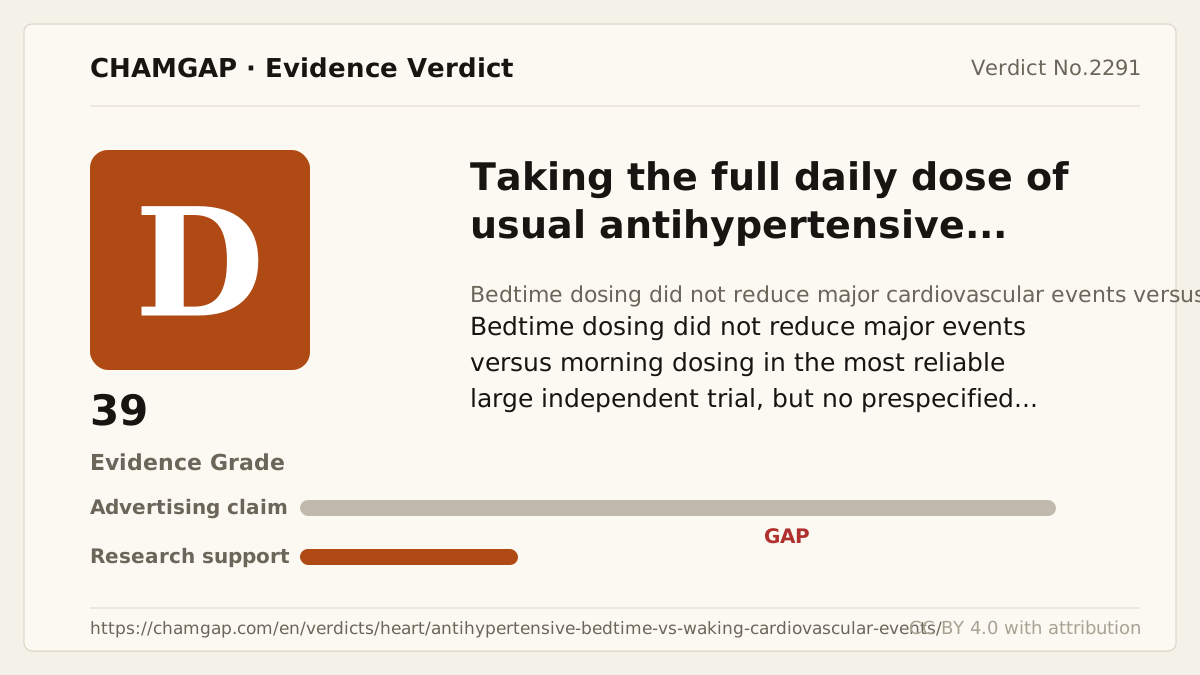
[Chamgap] Bedtime versus upon-waking antihypertensive dosing x major cardiovascular events — Evidence Grade D·34. 3 cited sources checked. Source: https://chamgap.com/en/verdicts/heart/antihypertensive-bedtime-vs-waking-cardiovascular-events/ · CC BY 4.0CC BY 4.0 — free to use with attribution; do not distort grades, numbers, or verdict meaning.
What this document does and does not do
Chamgap is an information source. It reports what research has and has not confirmed; it does not tell readers what to take or buy. That decision belongs to readers and, when needed, medical or legal professionals. This verdict reflects literature available up to the search date and may change as new research appears. Nothing here is medical advice.