
Amlodipine,
does it really help with Sustained blood-pressure reduction and cardiovascular-risk reduction in adults with hypertension?
research showsAmlodipine is rated A because once-daily treatment produces sustained 24-hour blood-pressure reduction and large long-term hard-endpoint trials establish cardiovascular-event prevention through blood-pressure lowering. In a placebo-controlled trial, blood pressure remained about 13/10 mm Hg lower 24 hours after dosing. In the 33,357-participant ALLHAT trial, six-year fatal coronary disease or nonfatal myocardial infarction was equivalent to chlorthalidone (RR 0.98, 95% CI 0.90 to 1.07), while heart failure was more frequent with amlodipine. In 19,257 ASCOT-BPLA participants, an amlodipine-based regimen reduced stroke, total cardiovascular events, and mortality compared with an atenolol-based regimen. Amlodipine was therefore not superior to other first-line drugs across every endpoint, but large, independent, direct hard-endpoint evidence supports A with 84 points.
ads claimMarketing may imply that one tablet completely prevents heart disease or that amlodipine is superior to every other antihypertensive. In practice, it is one of several first-line agents used to reach a blood-pressure target and manage total cardiovascular risk, many patients need combination therapy, and comorbid heart failure or kidney disease can change the preferred regimen.
Useful facts when choosing a product
- Amlodipine has a long half-life and is usually taken once daily; adult hypertension treatment commonly starts at 2.5 to 5 mg and may be titrated to 10 mg according to response and tolerability, but the prescribed dose should not be changed without medical advice.
- A normal blood-pressure reading may reflect effective treatment, so the medicine should not be stopped on one's own, and home and office readings should be reviewed with the prescriber.
- Dose-related ankle and leg edema is common, and flushing, headache, palpitations, dizziness, and, rarely, gingival overgrowth can occur.
- Its gradual onset makes it a maintenance medicine rather than an immediate treatment for hypertensive emergencies, and very high pressure with chest pain, neurologic symptoms, or organ-injury symptoms requires emergency assessment.
Chamgap Semantic Classification Code
Candidate index · review held
M.amlodipine.UNK.sustained-blood-pressure-reduction-and-cardiovascular-risk-reduction-with-hypertension.reduce.MULTIMedicinal interventions > Amlodipine > Unknown > Sustained blood-pressure reduction and cardiovascular-risk reduction with hypertension > Reduction claim > Multiple: primary unresolved
An automated migration candidate, not an issued permanent code; exact claim scope remains under review. This machine-generated migration candidate helps retrieval but is not a permanent assignment. The original verdict ID and URL remain authoritative.
What the research actually shows
The 1992 Johnson trial randomized 125 patients with mild-to-moderate hypertension to amlodipine, atenolol, or placebo. Amlodipine lowered blood pressure by about 13/10 mm Hg 24 hours after dosing and achieved a 61.1% response rate. ALLHAT double-blind randomized 33,357 participants to chlorthalidone, amlodipine, or lisinopril for a mean 4.9 years. Six-year fatal-coronary-disease or nonfatal-myocardial-infarction rates were 11.3% with amlodipine and 11.5% with chlorthalidone, but heart failure was 10.2% versus 7.7%. ASCOT-BPLA randomized 19,257 patients to amlodipine-based or atenolol-based strategies; the amlodipine strategy reduced stroke with a hazard ratio of 0.77 and reduced total cardiovascular events and procedures, while the primary coronary endpoint was not significant. In VALUE, 15,245 patients receiving an amlodipine-based strategy had faster early blood-pressure reduction than those receiving valsartan, with similar primary cardiac-composite outcomes. Direct assessment across different comparators and add-on strategies supports A for blood-pressure and cardiovascular-risk control.
Why this is classified as A (84)
A placebo-controlled trial of sustained 24-hour blood-pressure lowering plus direct cardiovascular hard endpoints in the NHLBI-led 33,357-patient ALLHAT trial, 19,257-patient ASCOT-BPLA trial, and 15,245-patient VALUE trial supports A with 84 points. In ALLHAT, six-year fatal coronary disease or nonfatal myocardial infarction was equivalent to chlorthalidone (RR 0.98, 95% CI 0.90 to 1.07), while heart failure was more frequent with amlodipine. The hard-endpoint trials tested amlodipine-based strategies with add-on therapy, and the primary ASCOT coronary endpoint was nonsignificant, further reducing the score. Stroke, coronary disease, and major cardiovascular events were nevertheless assessed directly in large independent trials, so A is retained. Peripheral edema and other harms remain separate safety issues.
Counterpoint. Cardiovascular prevention in hypertension depends on achieved blood pressure, adherence, smoking cessation, lipid and diabetes management, and not merely the selected drug. Heart failure, proteinuric kidney disease, pregnancy, or severe edema may make a different class or combination strategy more appropriate.
Rejudgment record. Cross-check revision — Combined a placebo-controlled trial of 24-hour blood-pressure reduction with large long-term hard endpoints from ALLHAT, ASCOT-BPLA, and VALUE, avoided the surrogate-only ceiling, and deducted for strategy-level add-on treatment, nonsignificant primary endpoints in some comparisons, and the heart-failure difference
Sub-claim grades by effect
This ingredient is marketed for several effects. A single overall grade blends strong and weak claims together, so each effect is graded separately here. The overall grade reflects the strongest disconfirming or core claim.
| Effect (sub-claim) | Grade | Basis |
|---|---|---|
| Sustained 24-hour blood-pressure reduction with once-daily dosing | A | Placebo-controlled and multiple active-comparator trials repeatedly confirmed blood-pressure reduction through the end of the dosing interval. |
| Reduced stroke and major cardiovascular-event risk in hypertension treatment | A | Large direct hard endpoints in ASCOT and ALLHAT establish cardiovascular-event reduction through blood-pressure lowering, but not superiority over every first-line drug on every endpoint; results apply at the regimen level. |
| Prevention of major coronary events in high-risk hypertension | A | In ALLHAT, six-year fatal coronary disease or nonfatal myocardial infarction was equivalent to chlorthalidone (RR 0.98, 95% CI 0.90 to 1.07), although heart failure was more frequent with amlodipine. |
Cross-check — AI research and Codex final gate
Evidence Table
| Study | Design | Sample | Funding | Endpoint | Result | Weight |
|---|---|---|---|---|---|---|
| Johnson BF et al. 1992 | Randomized double-blind placebo- and active-controlled trial | 125 patients; 41 amlodipine, 43 atenolol, and 41 placebo | Funding not reported in the PubMed abstract; early product-efficacy trial | Supine and standing blood pressure 24 hours after dosing and across the dosing interval | Amlodipine reduced supine blood pressure by 12.8/10.1 mm Hg at 24 hours and produced a 61.1% response rate. | Direct placebo-controlled sustained blood-pressure evidence |
| ALLHAT Officers and Coordinators for the ALLHAT Collaborative Research Group. 2002 | Large randomized double-blind active-controlled hard-endpoint trial | 33,357 participants; 9,048 amlodipine, 15,255 chlorthalidone, and 9,054 lisinopril | Led and funded by the United States NHLBI; Pfizer supplied drugs and some financial support | Fatal coronary disease or nonfatal myocardial infarction; mortality, stroke, heart failure, and composite cardiovascular disease | Six-year fatal coronary disease or nonfatal myocardial infarction was equivalent to chlorthalidone (RR 0.98, 95% CI 0.90 to 1.07), while heart failure was more frequent with amlodipine, 10.2% versus 7.7%. | Key independently led large hard-endpoint evidence |
| Dahlöf B et al.; ASCOT Investigators. 2005 | Large multicenter randomized treatment-strategy hard-endpoint trial | 19,257 participants; 9,639 amlodipine-based and 9,618 atenolol-based | Mainly funded by Pfizer, with additional support from Servier | Nonfatal myocardial infarction or fatal coronary disease; stroke, total cardiovascular events, and mortality | The primary coronary endpoint was nonsignificant, but the amlodipine-based regimen reduced stroke with a hazard ratio of 0.77 and reduced total cardiovascular events. | Large direct stroke and cardiovascular-event evidence |
| Julius S et al.; VALUE Trial Group. 2004 | Large randomized double-blind active-controlled hard-endpoint trial | 15,245 patients with high-risk hypertension | Novartis-supported treatment-strategy comparison | Composite cardiac mortality and morbidity and blood-pressure control | Amlodipine-based treatment lowered blood pressure faster early, with no difference in the primary cardiac composite versus valsartan-based treatment. | Confirmation across another active comparator |
Receipt — 4 References
All 4 cited sources were verified for existence at the original page (as of 2026-07-21).
Final verification and publication gate: Codex · Evidence date: 2026-07-21 · Corrections: none
Cite this verdict
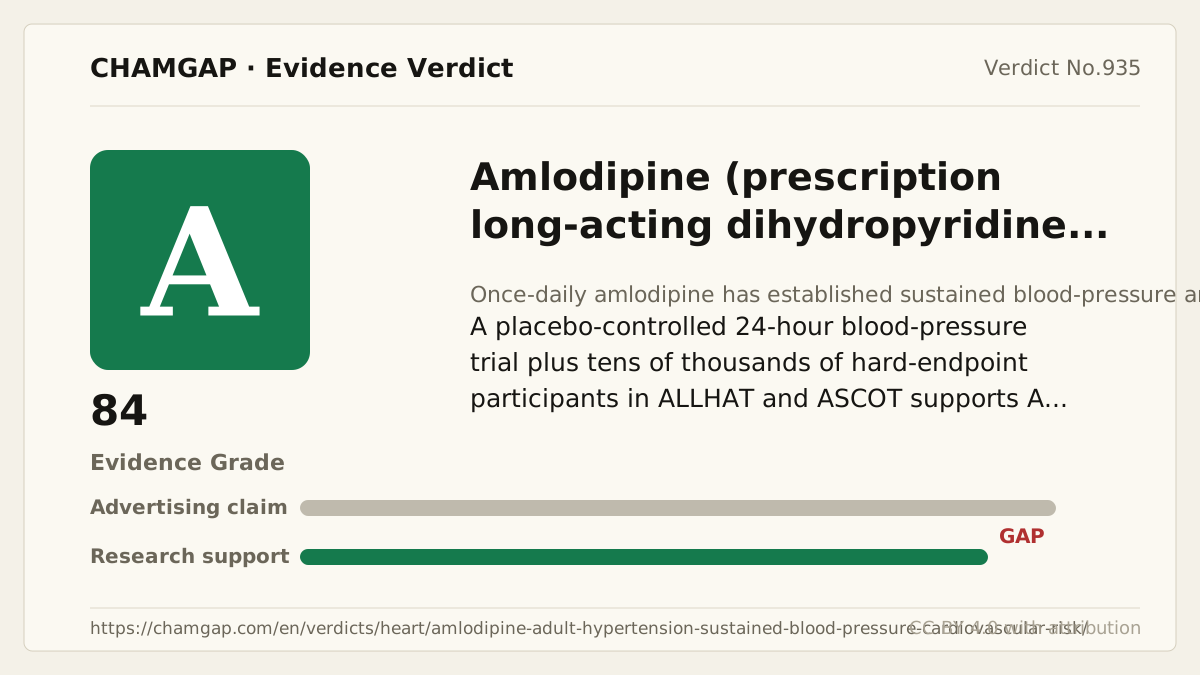
[Chamgap] Amlodipine x sustained blood-pressure and cardiovascular-risk reduction in adult hypertension — Evidence Grade A·84. 4 cited sources checked. Source: https://chamgap.com/en/verdicts/heart/amlodipine-adult-hypertension-sustained-blood-pressure-cardiovascular-risk/ · CC BY 4.0CC BY 4.0 — free to use with attribution; do not distort grades, numbers, or verdict meaning.
What this document does and does not do
Chamgap is an information source. It reports what research has and has not confirmed; it does not tell readers what to take or buy. That decision belongs to readers and, when needed, medical or legal professionals. This verdict reflects literature available up to the search date and may change as new research appears. Nothing here is medical advice.