
Alirocumab,
does it really help with Reduction of recurrent major cardiovascular events after a recent acute coronary syndrome?
research showsAlirocumab is rated B because it reduces recurrent major cardiovascular events in patients with a recent acute coronary syndrome who remain above lipid thresholds despite high-intensity or maximally tolerated statin therapy. In the 18,924-participant ODYSSEY OUTCOMES trial, the composite of coronary death, nonfatal myocardial infarction, ischemic stroke, or hospitalization for unstable angina occurred in 9.5% versus 11.1%, with a hazard ratio of 0.85. The benefit extends beyond the LDL-C surrogate to direct clinical events, but the pivotal event evidence is concentrated in one large program funded by Sanofi and Regeneron, warranting B in parity with evolocumab.
ads claimClaims that lowering LDL completely prevents heart disease or that this is a cardiovascular injection for anyone without statins overreach. The established scope is add-on treatment for high-risk patients after a recent acute coronary syndrome whose lipids remain elevated despite appropriate statin therapy.
Useful facts when choosing a product
- Praluent is a prescription subcutaneous injection, commonly given every two or four weeks with the regimen adjusted to the indication, LDL-C response, and product label.
- The post-acute-coronary-syndrome event reduction was demonstrated as an addition to high-intensity or maximally tolerated statin therapy. Statin intolerance and other lipid-lowering combinations require individual assessment.
- Cost, repeated self-injection, refrigeration, and insurance criteria affect persistence. Lower baseline LDL-C and absolute cardiovascular risk can mean a smaller absolute benefit.
- Injection-site reactions were slightly more common than with placebo, while overall adverse events were generally similar. Hypersensitivity and lipid monitoring require separate management.
Chamgap Semantic Classification Code
Candidate index · review held
M.alirocumab.UNK.recurrent-major-cardiovascular-events-after-a-recent-acute-coronary-syndrome.reduce.placeboMedicinal interventions > Alirocumab > Unknown > recurrent major cardiovascular events after a recent acute coronary syndrome > Reduction claim > Placebo
An automated migration candidate, not an issued permanent code; exact claim scope remains under review. This machine-generated migration candidate helps retrieval but is not a permanent assignment. The original verdict ID and URL remain authoritative.
What the research actually shows
Schwartz and colleagues randomized 18,924 patients one to 12 months after an acute coronary syndrome to alirocumab 75 mg or placebo every two weeks, with blinded dose adjustment targeting LDL-C of 25 to 50 mg/dL. Over a median 2.8 years, the primary composite occurred in 903 patients (9.5%) versus 1,052 (11.1%), hazard ratio 0.85 (95% CI 0.78 to 0.93). In the prespecified analysis by Szarek and colleagues, total nonfatal cardiovascular events including recurrences were reduced with a hazard ratio of 0.87 (95% CI 0.82 to 0.93). These analyses use the same large trial population and are not counted as two independent confirmatory trials.
Why this is classified as B (78)
In 18,924 ODYSSEY OUTCOMES participants, the direct ischemic-event composite fell from 11.1% to 9.5%, hazard ratio 0.85, and the total-events analysis was directionally consistent. This is large hard-endpoint evidence beyond a surrogate, but the pivotal evidence is concentrated in one jointly manufacturer-funded outcomes trial and the absolute difference is limited. In parity with evolocumab, this supports B with 78 points.
Counterpoint. For appropriately selected high-risk patients after a recent acute coronary syndrome whose lipids remain above threshold on statins, the modest absolute reduction can still be clinically meaningful.
Rejudgment record. New verdict — Prioritized the reduction in direct cardiovascular events in a randomized double-blind trial of 18,924 patients while accounting for concentration of pivotal confirmation in one Sanofi and Regeneron-funded outcomes program and applying parity with the B grade for evolocumab
Sub-claim grades by effect
This ingredient is marketed for several effects. A single overall grade blends strong and weak claims together, so each effect is graded separately here. The overall grade reflects the strongest disconfirming or core claim.
| Effect (sub-claim) | Grade | Basis |
|---|---|---|
| Reduction of recurrent major cardiovascular events after a recent acute coronary syndrome | B | A trial of 18,924 participants showed a significant reduction in direct ischemic events when added to statins. |
| LDL-C lowering | A | PCSK9 inhibition markedly lowers LDL-C, but the event verdict was not based on this surrogate alone. |
| Equal absolute benefit in every patient | D | Absolute benefit varied with baseline LDL-C and cardiovascular risk and was greater at LDL-C of at least 100 mg/dL. |
Cross-check — AI research and Codex final gate
Evidence Table
| Study | Design | Sample | Funding | Endpoint | Result | Weight |
|---|---|---|---|---|---|---|
| Schwartz GG et al. 2018, ODYSSEY OUTCOMES | Multicenter randomized double-blind placebo-controlled cardiovascular outcomes trial | 18,924 patients with a recent acute coronary syndrome | Sanofi and Regeneron Pharmaceuticals | Composite of coronary death, nonfatal myocardial infarction, ischemic stroke, or hospitalization for unstable angina | Over a median 2.8 years, events fell from 11.1% to 9.5%, hazard ratio 0.85 (95% CI 0.78 to 0.93). | Core large randomized trial with direct hard endpoints |
| Szarek M et al. 2019 | Prespecified total-events analysis of ODYSSEY OUTCOMES | The same 18,924 participants, including first and subsequent events | Sanofi and Regeneron Pharmaceuticals | Total nonfatal cardiovascular events and death | Total nonfatal cardiovascular events were reduced with a hazard ratio of 0.87 (95% CI 0.82 to 0.93). | Consistency analysis for recurrences, not an independent trial |
Receipt — 2 References
All 2 cited sources were verified for existence at the original page (as of 2026-07-20).
Final verification and publication gate: Codex · Evidence date: 2026-07-20 · Corrections: none
Cite this verdict
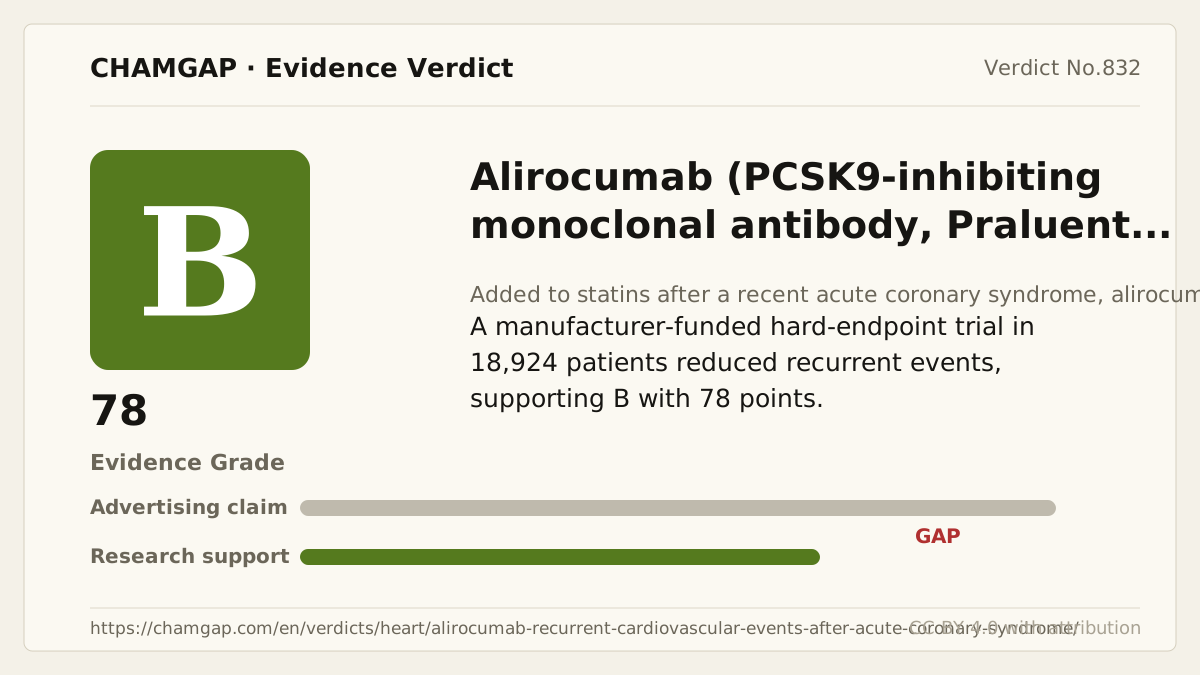
[Chamgap] Alirocumab x reduction of recurrent major cardiovascular events after acute coronary syndrome — Evidence Grade B·78. 2 cited sources checked. Source: https://chamgap.com/en/verdicts/heart/alirocumab-recurrent-cardiovascular-events-after-acute-coronary-syndrome/ · CC BY 4.0CC BY 4.0 — free to use with attribution; do not distort grades, numbers, or verdict meaning.
What this document does and does not do
Chamgap is an information source. It reports what research has and has not confirmed; it does not tell readers what to take or buy. That decision belongs to readers and, when needed, medical or legal professionals. This verdict reflects literature available up to the search date and may change as new research appears. Nothing here is medical advice.