
Lifelong exposure differences from European-ancestry ADH1B,
does it really help with Prevention of coronary heart disease?
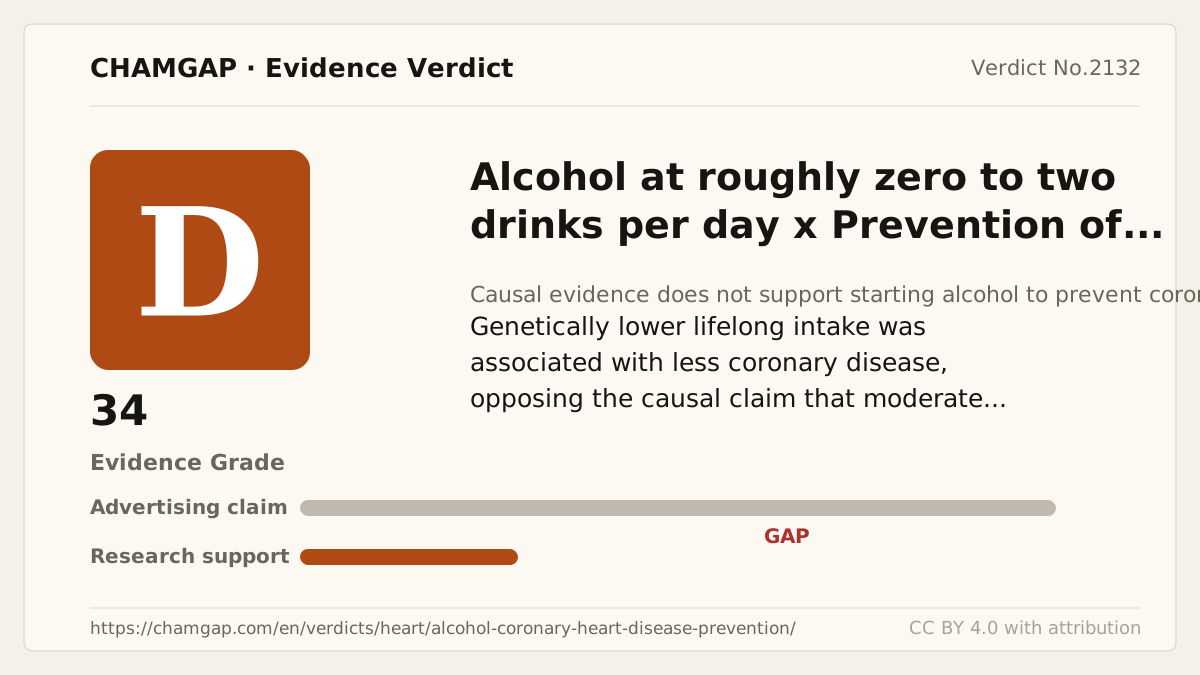
research showsThe grade is D. This was not a fixed-dose intervention but an analysis of lifelong exposure differences from ADH1B rs1229984 in people of European ancestry. Across 56 studies and 261,991 people, carriers who drank 17.2% less had 10% lower coronary-disease odds, opposite to the observational J curve.
ads claimAlcohol concentration and grams can be measured, but those quantities do not establish prevention. A U.S. standard drink is 14 g, a U.K. unit 8 g, and common Korean or Japanese conventions about 10 g, so grams from the actual study matter more than the phrase one drink.
Useful facts when choosing a product
- Mendelian randomization uses lifelong exposure differences created by genotype; it did not administer alcohol.
- The allele changed bingeing and abstention as well as average intake.
- Observational and causal estimates diverge, and neither is a short-term low-dose prescription trial.
Chamgap Semantic Classification Code
Candidate index · review held
UNK.alcohol-at-roughly-zero-to-two-drinks.UNK.coronary-heart-disease.prevent.UNKUnknown > Alcohol at roughly zero to two drinks > Unknown > coronary heart disease > Occurrence-prevention claim > Unknown
An automated migration candidate, not an issued permanent code; exact claim scope remains under review. This machine-generated migration candidate helps retrieval but is not a permanent assignment. The original verdict ID and URL remain authoritative.
What the research actually shows
The individual-participant meta-analysis covered 261,991 people of European ancestry from 56 studies, including 20,259 coronary cases and 10,164 strokes. It compared genotypes associated with differences in intake, bingeing, and abstention rather than drinkers with abstainers. Lower coronary odds appeared across intake categories, with no evidence of a protected low-intake window. The collaboration drew on multiple publicly funded cohorts and grants.
Why this is classified as D (34)
The large publicly funded causal estimate runs opposite to prevention, but it did not directly randomize a fixed low dose, giving D with 34 points.
Counterpoint. D does not mean every cardiovascular endpoint has the same relationship with alcohol. It applies to drinking for coronary-disease prevention.
Rejudgment record. Cross-check applied — A large publicly funded Mendelian-randomization analysis found lower coronary odds with genetically lower lifelong alcohol exposure and no protected low-intake window
| Endpoint | H | Hard endpoint - actual events such as death |
| Replication | R1 | Single confirmatory trial |
| Independence | I2 | Decisive evidence is publicly or non-profit funded |
| Effect size | E- | Harm increased in the trials |
| Precision | C0 | The confidence interval leaves room for benefit |
Stored derived and displayed grades match; this is not a current recalculation or validity check (D).
Sub-claim grades by effect
This ingredient is marketed for several effects. A single overall grade blends strong and weak claims together, so each effect is graded separately here. The overall grade reflects the strongest disconfirming or core claim.
| Effect (sub-claim) | Grade | Basis |
|---|---|---|
| Lower lifelong alcohol exposure reduces coronary disease | B | The genetic-instrument analysis found a hard-event signal in that direction. |
| Starting one drink per day prevents coronary disease | D | This was not a direct dosing trial, and observational and causal estimates diverge. |
Cross-check — AI research and Codex final gate
Evidence Table
| Study | Design | Sample | Funding | Endpoint | Result | Weight |
|---|---|---|---|---|---|---|
| Holmes MV et al. 2014 | Individual-participant Mendelian-randomization meta-analysis of 56 studies | 261,991 participants and 20,259 coronary cases | Multiple public funders including the UK MRC | Coronary heart disease events | The genotype linked to 17.2% lower intake had OR 0.90 (95% CI 0.84-0.96). | Lifelong causal estimate opposing the prevention claim |
Receipt — 1 References
All 1 cited sources were verified for existence at the original page (as of 2026-08-04).
Final verification and publication gate: Codex · Evidence date: 2026-08-04 · Corrections: none
Cite this verdict
[Chamgap] Lifelong exposure differences from European-ancestry ADH1B x coronary heart disease prevention — Evidence Grade D·34. 1 cited sources checked. Source: https://chamgap.com/en/verdicts/heart/alcohol-coronary-heart-disease-prevention/ · CC BY 4.0CC BY 4.0 — free to use with attribution; do not distort grades, numbers, or verdict meaning.
What this document does and does not do
Chamgap is an information source. It reports what research has and has not confirmed; it does not tell readers what to take or buy. That decision belongs to readers and, when needed, medical or legal professionals. This verdict reflects literature available up to the search date and may change as new research appears. Nothing here is medical advice.