
Atrial fibrillation catheter ablation,
does it really help with Lower all-cause death or worsening-heart-failure hospitalization in atrial fibrillation with HFrEF?
research showsCatheter ablation is rated B in selected patients with atrial fibrillation and HFrEF. CASTLE-AF enrolled 398 people, randomized and analyzed 363 after a five-week run-in, and met its primary endpoint: death or worsening-heart-failure hospitalization occurred in 28.5% versus 44.6%, HR 0.62 (95% CI 0.43 to 0.87), P=.007. Participants had LVEF no greater than 35% and an ICD or CRT-D, while the publicly funded broader RAFT-AF trial missed its primary endpoint at P=.066.
ads claimClaims of a survival advantage for every person with atrial fibrillation overstate a selected HFrEF device population.
Useful facts when choosing a product
- CASTLE-AF enrolled 398 people but randomized 363 after run-in.
- Eligibility required symptomatic atrial fibrillation, LVEF no greater than 35%, and an ICD or CRT-D.
Chamgap Semantic Classification Code
Candidate index · review held
P.catheter-ablation-of-atrial-fibrillation.procedural.all-cause-death-or-worsening-heart-failure-hospitalization-in-atrial-fibrillation-with-hfref.reduce.UNKProcedures, devices and tests > Catheter ablation of atrial fibrillation > Procedural > all-cause death or worsening-heart-failure hospitalization in atrial fibrillation with HFrEF > Reduction claim > Unknown
An automated migration candidate, not an issued permanent code; exact claim scope remains under review. This machine-generated migration candidate helps retrieval but is not a permanent assignment. The original verdict ID and URL remain authoritative.
What the research actually shows
CASTLE-AF enrolled 398 people and randomized 363 after a five-week run-in; the primary composite was 28.5% versus 44.6%, HR 0.62 (0.43 to 0.87), P=.007. Biotronik funded the trial. CASTLE-HTx randomized 194 participants, 97 per group; death, LVAD implantation, or urgent heart transplantation occurred in 8% versus 30%, HR 0.24 (0.11 to 0.52), P<.001. Its Else Kroener-Fresenius Foundation funding was separate, but CASTLE-AF first author Nassir F. Marrouche was a CASTLE-HTx coauthor, so the investigator teams overlap. Publicly funded RAFT-AF had independent investigators and randomized 411 people, but HR 0.71 (0.49 to 1.03), P=.066, was not significant and the trial stopped early. Drug verdict 1311, which is A with 94 points, and drug verdict 1171, which is B with 68 points, concern enalapril and vericiguat; this verdict concerns a procedure.
Why this is classified as B (76)
The H, R1, I1, E+, and B0 profile gives B with 76 points.
Counterpoint. Symptoms, optimized heart-failure therapy, procedural risk, and center expertise all affect selection.
Rejudgment record. Cross-check applied — One large positive hard-endpoint trial in a selected HFrEF population
| Endpoint | H | Hard endpoint - actual events such as death |
| Replication | R1 | Single confirmatory trial |
| Independence | I1 | Mixed funding sources |
| Effect size | E+ | Meets the clinically important threshold |
Stored derived and displayed grades match; this is not a current recalculation or validity check (B).
Sub-claim grades by effect
This ingredient is marketed for several effects. A single overall grade blends strong and weak claims together, so each effect is graded separately here. The overall grade reflects the strongest disconfirming or core claim.
| Effect (sub-claim) | Grade | Basis |
|---|---|---|
| Lower composite of death or heart-failure hospitalization | B | CASTLE-AF met its primary endpoint. |
| Lower all-cause mortality | B | CASTLE-AF reported HR 0.53. |
| Lower worsening-heart-failure hospitalization | B | CASTLE-AF reported HR 0.56. |
Cross-check — AI research and Codex final gate
Evidence Table
| Study | Design | Sample | Funding | Endpoint | Result | Weight |
|---|---|---|---|---|---|---|
| Marrouche NF et al. 2018 | Randomized open-label procedural trial | 398 enrolled, 363 randomized, and 363 analyzed | Funded by Biotronik | All-cause death or worsening-heart-failure hospitalization | HR 0.62 (0.43 to 0.87), P=.007; primary endpoint met | Decisive trial |
| Parkash R et al. 2022 | Randomized open-label ablation-based rhythm-control trial | 411 randomized and analyzed | Public funding from the Canadian Institutes of Health Research | All-cause death or all heart-failure events | HR 0.71 (0.49 to 1.03), P=.066; primary endpoint missed and trial stopped early | Independent boundary evidence |
| Sohns C et al. 2023 CASTLE-HTx | Single-center randomized open-label ablation-versus-medical-therapy trial | 194 randomized (97/97) | Else Kroener-Fresenius Foundation; independent of Biotronik | Composite of all-cause death, LVAD implantation, or urgent heart transplantation | 8% versus 30%, HR 0.24 (95% CI 0.11 to 0.52), P<.001 | Funding was independent, but Marrouche participated in both CASTLE trials, so this does not satisfy R2 investigator independence |
Receipt — 3 References
All 3 cited sources were verified for existence at the original page (as of 2026-07-24).
Final verification and publication gate: Codex · Evidence date: 2026-07-24 · Corrections: none
Cite this verdict
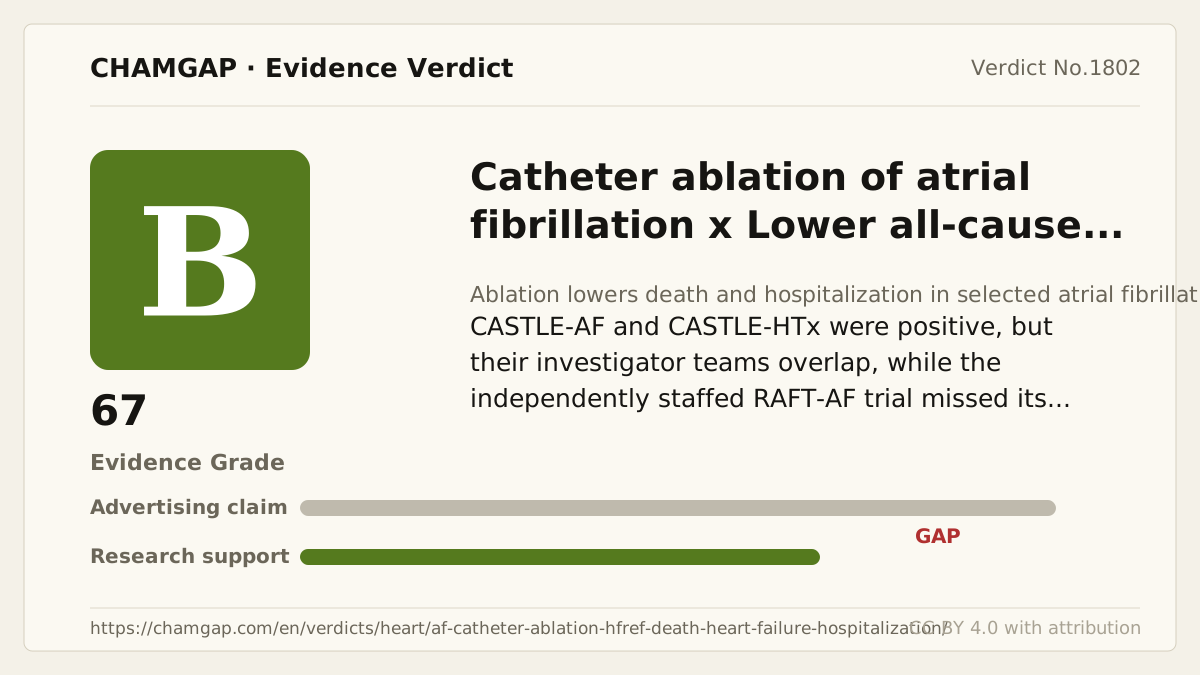
[Chamgap] Atrial fibrillation catheter ablation x fewer deaths and heart-failure hospitalizations in HFrEF — Evidence Grade B·76. 3 cited sources checked. Source: https://chamgap.com/en/verdicts/heart/af-catheter-ablation-hfref-death-heart-failure-hospitalization/ · CC BY 4.0CC BY 4.0 — free to use with attribution; do not distort grades, numbers, or verdict meaning.
What this document does and does not do
Chamgap is an information source. It reports what research has and has not confirmed; it does not tell readers what to take or buy. That decision belongs to readers and, when needed, medical or legal professionals. This verdict reflects literature available up to the search date and may change as new research appears. Nothing here is medical advice.