
Acute heart failure risk stratification and rapid follow-up,
does it really help with Reduced all-cause death or cardiovascular hospitalization after an emergency visit?
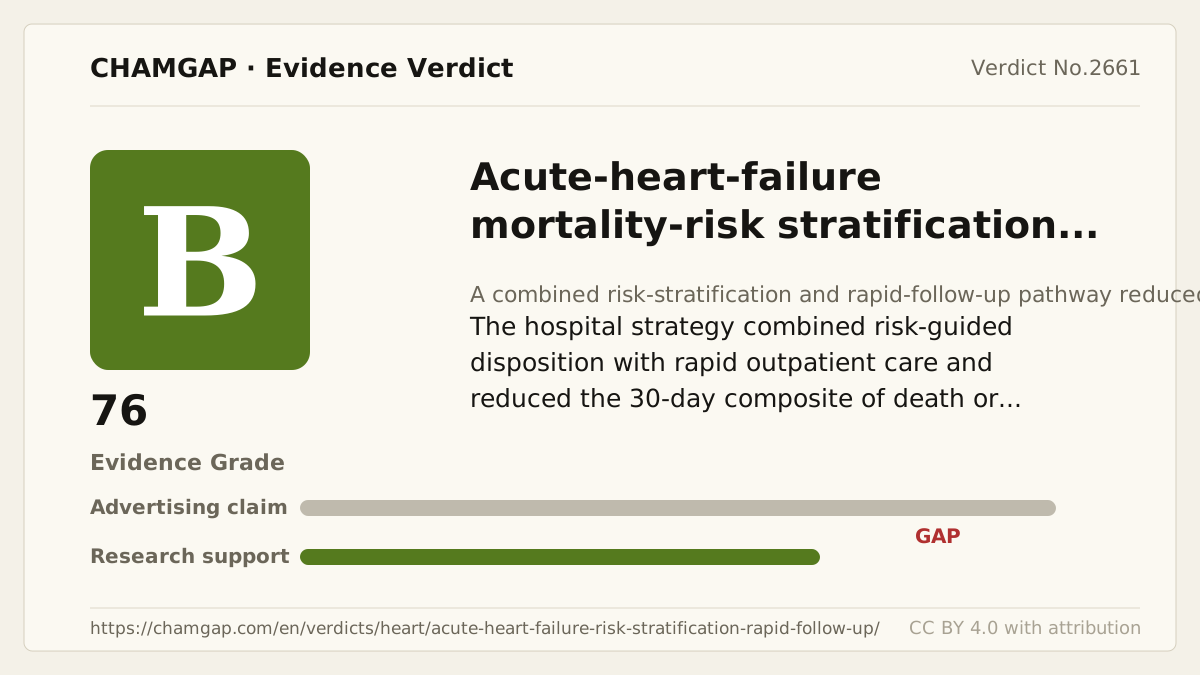
research showsThe grade is B with 76 points. COACH randomized the transition timing of 10 Ontario hospitals and analyzed all 5,452 patients. The 30-day coprimary endpoint was nominally significant: 301/2,480 (12.1%) during intervention versus 430/2,972 (14.5%) during usual care, adjusted HR 0.88 (95% CI 0.78 to 0.99), P=.04. The 20-month estimate was in the same direction, HR 0.95 (0.92 to 0.99), but the statistical analysis plan did not control type I error across the two coprimary outcomes. This was a large publicly and noncommercially funded trial, but there is only one independent confirmation.
ads claimThis does not show that a mortality score alone improves outcomes. It supports the complete pathway that linked a validated score to disposition and rapid specialist follow-up. Verdict 1143 is C with 52 points for intravenous iron and heart-failure readmission; that drug question differs from this service strategy.
Useful facts when choosing a product
- EHMRG30-ST stratified 7- and 30-day mortality risk to support admission or early-discharge decisions.
- RAPID-HF aimed to assess eligible discharged patients within 48 to 72 hours and provide 30 days of transitional care.
- The 30-day rates were 12.1% versus 14.5%, but effects of individual pathway components were not isolated.
Chamgap Semantic Classification Code
Candidate index · review held
UNK.acute-heart-failure-mortality-risk-stratification-plus-rapid-specialist-transitional-care.UNK.all-cause-death-or-cardiovascular-hospitalization-after-an-emergency-visit.reduce.UNKUnknown > Acute-heart-failure mortality-risk stratification plus rapid specialist transitional care > Unknown > all-cause death or cardiovascular hospitalization after an emergency visit > Reduction claim > Unknown
An automated migration candidate, not an issued permanent code; exact claim scope remains under review. This machine-generated migration candidate helps retrieval but is not a permanent assignment. The original verdict ID and URL remain authoritative.
What the research actually shows
The 2023 stepped-wedge cluster trial by Lee DS, Straus SE, Farkouh ME, Austin PC, Taljaard M, Chong A, Fahim C, Poon S, Cram P, Smith S, McKelvie RS, Porepa L, Hartleib M, Mitoff P, Iwanochko RM, MacDougall A, Shadowitz S, Abrams H, Elbarasi E, Fang J, Udell JA, Schull MJ, Mak S, Ross HJ, and the COACH Trial Investigators enrolled and analyzed 5,452 patients at 10 hospitals: 2,480 during intervention and 2,972 during control. The 30-day coprimary result was nominally significant at 12.1% versus 14.5%, adjusted HR 0.88 (0.78 to 0.99), P=.04. The 20-month estimate was in the same direction at 54.4% versus 56.2%, HR 0.95 (0.92 to 0.99). The statistical analysis plan did not control type I error across the two coprimary outcomes. Funding from Ontario SPOR, CIHR, Ontario ministries, and nonprofit cardiac centers was confirmed.
Why this is classified as B (76)
In a large publicly and noncommercially funded cluster-randomized trial, the 30-day coprimary endpoint was nominally significant and the 20-month estimate was in the same direction. Type I error was not controlled across the two coprimary outcomes; single confirmation and residual period effects still give B with 76 points.
Counterpoint. Risk-guided discharge requires clinician judgment, rapid follow-up capacity, and immediate reassessment if symptoms worsen.
Rejudgment record. Cross-check applied — Cross-checked the NEJM report and NCT02674438 for coprimary endpoints, analysis count, stepped-wedge design, adjusted hazard ratios, and public or nonprofit funding
| Endpoint | H | Hard endpoint - actual events such as death |
| Replication | R1 | Single confirmatory trial |
| Independence | I2 | Decisive evidence is publicly or non-profit funded |
| Effect size | E+ | Meets the clinically important threshold |
Stored derived and displayed grades match; this is not a current recalculation or validity check (B).
Sub-claim grades by effect
This ingredient is marketed for several effects. A single overall grade blends strong and weak claims together, so each effect is graded separately here. The overall grade reflects the strongest disconfirming or core claim.
| Effect (sub-claim) | Grade | Basis |
|---|---|---|
| Reduced all-cause death or cardiovascular hospitalization within 30 days | B | 12.1% versus 14.5%, adjusted HR 0.88 (0.78 to 0.99), nominal P=.04. |
| Reduced all-cause death or cardiovascular hospitalization within 20 months | B | Cumulative incidence was 54.4% versus 56.2%, adjusted HR 0.95 (0.92 to 0.99), in the same direction, with no type I error control across coprimary outcomes. |
Cross-check — AI research and Codex final gate
Evidence Table
| Study | Design | Sample | Funding | Endpoint | Result | Weight |
|---|---|---|---|---|---|---|
| Lee DS, Straus SE, Farkouh ME, Austin PC, Taljaard M, Chong A, Fahim C, Poon S, Cram P, Smith S, McKelvie RS, Porepa L, Hartleib M, Mitoff P, Iwanochko RM, MacDougall A, Shadowitz S, Abrams H, Elbarasi E, Fang J, Udell JA, Schull MJ, Mak S, Ross HJ, COACH Trial Investigators. 2023 | Ten-hospital stepped-wedge cluster-randomized trial | All 5,452 analyzed, 2,480 intervention-period and 2,972 control-period | Ontario SPOR, CIHR, Ontario ministries, and nonprofit cardiac centers | Coprimary composites of all-cause death or cardiovascular hospitalization at 30 days and 20 months | At 30 days, 12.1% versus 14.5%, HR 0.88 (0.78 to 0.99), nominal P=.04; 20-month HR 0.95 (0.92 to 0.99) in the same direction; type I error not controlled across coprimary outcomes | Large hard-outcome trial with unadjusted coprimary multiplicity |
Receipt — 1 References
All 1 cited sources were verified for existence at the original page (as of 2026-08-15).
Final verification and publication gate: Codex · Evidence date: 2026-08-15 · Corrections: none
Cite this verdict
[Chamgap] Acute heart failure risk stratification and rapid follow-up x death or cardiovascular hospitalization — Evidence Grade B·76. 1 cited sources checked. Source: https://chamgap.com/en/verdicts/heart/acute-heart-failure-risk-stratification-rapid-follow-up/ · CC BY 4.0CC BY 4.0 — free to use with attribution; do not distort grades, numbers, or verdict meaning.
What this document does and does not do
Chamgap is an information source. It reports what research has and has not confirmed; it does not tell readers what to take or buy. That decision belongs to readers and, when needed, medical or legal professionals. This verdict reflects literature available up to the search date and may change as new research appears. Nothing here is medical advice.