
Whole Korean melon with seeds and placenta,
does it really help with Constipation relief and more frequent bowel movements?
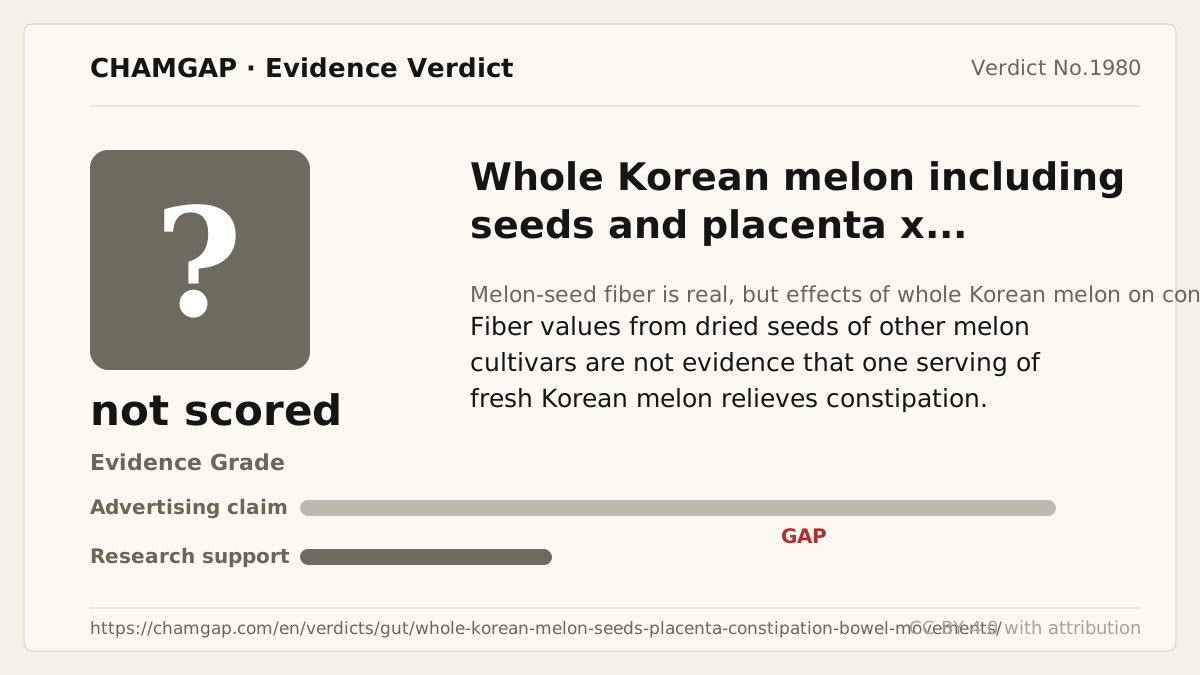
research showsThe grade is ?. Dietary fiber has been measured in Cucumis melo seeds and by-products. No human study was found, however, that fed whole Korean melon with seeds and placenta to people with constipation and measured bowel frequency, complete spontaneous bowel movements, or colonic transit, so there is no score.
ads claimKorean health articles repeatedly claim that fiber in melon seeds or placenta promotes bowel movement and relieves constipation. Moving from composition to improved patient bowel outcomes requires human evidence for the whole Korean melon itself.
Useful facts when choosing a product
- A 2025 composition study measured total dietary fiber of 39.0 and 39.7 g per 100 g dry weight in seeds of yellow and green melons sold in Portugal. These were not Korean melons, and the denominator was 100 g dried seeds.
- Whole dried seed powder including seed coat from the Chinese netted-melon hybrid ChunLi contained 19.52% crude fiber. Its large difference from values near 39% illustrates cultivar and method variation.
- Neither value measures the seeds and placenta in one fresh Korean-melon serving. Dry-weight figures cannot be applied without conversion to the fresh edible portion and its moisture content.
- Korean melon is an Old World crop corresponding to the East Asian name 「甛瓜」, but primary classical text was not checked for this verdict. 「甛瓜」, 「西瓜」, 「冬瓜」, and 「南瓜」 refer to different species.
- The PubMed concepts searched on 2026-08-02 combined oriental melon, Korean melon, or Cucumis melo with constipation, bowel movement, complete spontaneous bowel movement, or colonic transit and humans. Eligible whole-Korean-melon studies numbered zero across multilingual literature and registry searches after excluding kiwifruit, probiotics, and extracts.
Chamgap Semantic Classification Code
Candidate index · review held
F.whole-korean-melon-including-seeds-and-placenta.food.constipation-relief-and-more-frequent-bowel-movements.relieve.UNKFoods and beverages > Whole Korean melon including seeds and placenta > Food consumption > Constipation relief and more frequent bowel movements > Symptom-relief claim > Unknown
An automated migration candidate, not an issued permanent code; exact claim scope remains under review. This machine-generated migration candidate helps retrieval but is not a permanent assignment. The original verdict ID and URL remain authoritative.
What the research actually shows
On 2026-08-02, PubMed, the Cochrane Library, ClinicalTrials.gov, WHO ICTRP, and Korean and Japanese databases were searched by combining oriental melon, Korean melon, Cucumis melo, constipation, bowel movement, complete spontaneous bowel movement, and colonic-transit concepts. Zero eligible human studies fed whole Korean melon including seeds and placenta and measured these outcomes. Kiwifruit and probiotic trials, melon-seed-extract patents, animals, laboratory studies, and composition analyses were excluded as different interventions. No eligible registered trial was identified.
Why this is classified as ?
No human study fed whole Korean melon with seeds and placenta to patients with constipation and directly measured bowel outcomes. The repeated search yielded zero eligible studies, so the grade is ? with no score.
Counterpoint. Fiber composition is established, but actual content per Korean-melon serving and clinical efficacy remain unknown.
Rejudgment record. Cross-check applied — Multilingual literature and trial-registry searches found no eligible human study feeding whole Korean melon with seeds and placenta and measuring bowel frequency, complete spontaneous bowel movements, or colonic transit
Sub-claim grades by effect
This ingredient is marketed for several effects. A single overall grade blends strong and weak claims together, so each effect is graded separately here. The overall grade reflects the strongest disconfirming or core claim.
| Effect (sub-claim) | Grade | Basis |
|---|---|---|
| Cucumis melo seeds contain dietary fiber | ? | This is a measured composition fact, not a graded clinical endpoint. |
| Whole Korean melon with seeds and placenta improves constipation and bowel frequency | ? | No direct human trial exists. |
Cross-check — AI research and Codex final gate
Evidence Table
| Study | Design | Sample | Funding | Endpoint | Result | Weight |
|---|---|---|---|---|---|---|
| Multilingual literature and trial-registry search on 2026-08-02 | Screening for constipation and bowel outcomes after whole Korean melon with seeds and placenta | 0 eligible human studies | Not applicable | Bowel frequency, complete spontaneous bowel movements, and colonic transit | No eligible whole-Korean-melon study; kiwifruit, probiotics, and extracts excluded | Search record documenting absence of direct human evidence |
Receipt — 3 References
All 3 cited sources were verified for existence at the original page (as of 2026-08-02).
Final verification and publication gate: Codex · Evidence date: 2026-08-02 · Corrections: none
Cite this verdict
[Chamgap] Whole Korean melon with seeds and placenta x constipation and bowel movements — Evidence Grade ?. 3 cited sources checked. Source: https://chamgap.com/en/verdicts/gut/whole-korean-melon-seeds-placenta-constipation-bowel-movements/ · CC BY 4.0CC BY 4.0 — free to use with attribution; do not distort grades, numbers, or verdict meaning.
What this document does and does not do
Chamgap is an information source. It reports what research has and has not confirmed; it does not tell readers what to take or buy. That decision belongs to readers and, when needed, medical or legal professionals. This verdict reflects literature available up to the search date and may change as new research appears. Nothing here is medical advice.