
Whole-grain provided diet,
does it really help with Increased bowel-movement frequency?
research showsThe grade is C. Replacing a nutrient-matched refined-grain provided diet with a weight-maintenance whole-grain diet increased bowel movements by about 2.1 per week over six weeks. Participants were healthy adults rather than patients with constipation, and bowel frequency was an exploratory result absent from the registered primary and explicit secondary outcomes.
ads claimThis fully provided mixed-grain diet cannot be attributed to one grain or an isolated fiber. Increased frequency in healthy adults is not the same claim as successful constipation treatment.
Useful facts when choosing a product
- Product-specific gluten and inorganic arsenic measurements were not reported. Unreported does not mean absent.
- The diet was predominantly wheat-based and should not be transferred directly to people with celiac disease or wheat allergy.
- The intervention replaced refined grains with whole grains while providing weight-maintenance diets matched for major nutrients.
- General Mills' Bell Institute and USDA-ARS supported the study, and several coauthors were affiliated with Bell Institute. Public and manufacturer support were both present.
- The mixed-grain intervention does not correspond to one classical food, and no specific classical record was verified.
- Verdict 107 is A with 88 points for oat beta-glucan and cholesterol; verdict 063 is C with 46 points for soy isoflavones and menopausal symptoms; verdict 513 is C with 58 points for soy protein and LDL; verdict 431 is C with 40 points for black-soybean seed-coat extract and eye fatigue. Their ingredient forms or outcomes differ.
Chamgap Semantic Classification Code
Candidate index · review held
D.whole-grain-provided-diet.dietary.bowel-movement-frequency.increase.UNKDietary patterns and eating practices > Whole-grain provided diet > Dietary regimen > bowel-movement frequency > Increase claim > Unknown
An automated migration candidate, not an issued permanent code; exact claim scope remains under review. This machine-generated migration candidate helps retrieval but is not a permanent assignment. The original verdict ID and URL remain authoritative.
What the research actually shows
The Vanegas paper, NCT01902394, and the AHRQ evidence table were cross-checked. Registration occurred after study start but before recruitment and intervention completion. Registered primary outcomes were delayed-type hypersensitivity, lymphocyte proliferation, natural-killer-cell function, cytokines, and salivary IgA, and most were null. Bowel frequency appeared in neither the registered primary outcomes nor the explicit public secondary outcomes, making it exploratory.
Why this is classified as C (50)
After most registered primary outcomes failed, an unregistered exploratory endpoint was positive. The bowel-frequency magnitude and interval are clear, but this was one 81-person, six-week trial with mixed public and manufacturer support, yielding C with 50 points.
Counterpoint. An independent longer trial in patients with constipation, with bowel outcomes prospectively primary, is needed.
Rejudgment record. Cross-check applied — Cross-checked the immune-primary registry structure, exploratory status of bowel frequency, and AHRQ-derived confidence interval
| Endpoint | P | Symptom or function itself is the target - including patient reports and performance tests |
| Replication | R1 | Single confirmatory trial |
| Independence | I1 | Mixed funding sources |
| Effect size | E+ | Meets the clinically important threshold |
Stored derived and displayed grades match; this is not a current recalculation or validity check (C).
Sub-claim grades by effect
This ingredient is marketed for several effects. A single overall grade blends strong and weak claims together, so each effect is graded separately here. The overall grade reflects the strongest disconfirming or core claim.
| Effect (sub-claim) | Grade | Basis |
|---|---|---|
| Replacing a refined-grain provided diet with whole grains increases bowel frequency in healthy adults | C | An exploratory six-week result in 81 adults found about 2.1 more bowel movements per week. |
| This whole-grain provided diet treats constipation | C | Participants had normal bowel function rather than constipation. |
Cross-check — AI research and Codex final gate
Evidence Table
| Study | Design | Sample | Funding | Endpoint | Result | Weight |
|---|---|---|---|---|---|---|
| Vanegas SM et al., 2017, American Journal of Clinical Nutrition | Parallel randomized trial after a two-week refined-grain run-in, with fully provided whole-grain or refined-grain diets for six weeks | About 90 randomized; 81 analyzed | General Mills Bell Institute and USDA-ARS; several coauthors were Bell Institute employees | Weekly bowel-movement frequency | AHRQ-derived mean difference 2.1 per week, 95% CI 1.7 to 2.4 | Clear positive magnitude, but an exploratory outcome absent from the registry |
Receipt — 5 References
All 5 cited sources were verified for existence at the original page (as of 2026-08-03).
Final verification and publication gate: Codex · Evidence date: 2026-08-03 · Corrections: none
Cite this verdict
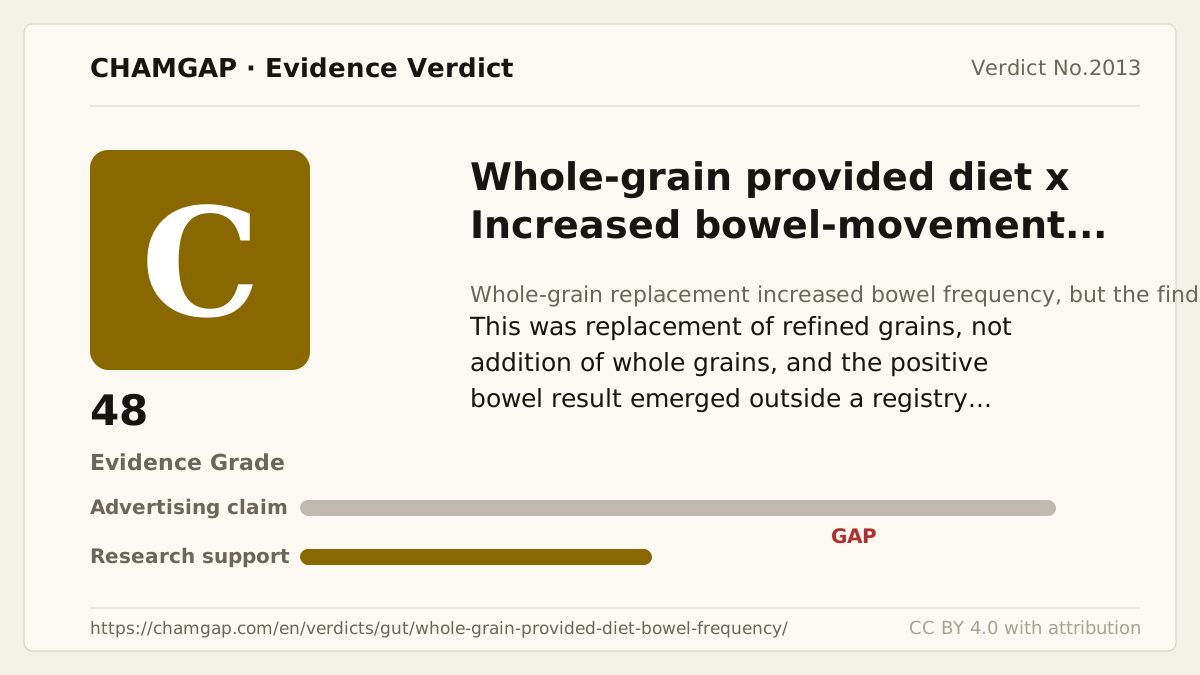
[Chamgap] Whole-grain provided diet x increased bowel-movement frequency — Evidence Grade C·50. 5 cited sources checked. Source: https://chamgap.com/en/verdicts/gut/whole-grain-provided-diet-bowel-frequency/ · CC BY 4.0CC BY 4.0 — free to use with attribution; do not distort grades, numbers, or verdict meaning.
What this document does and does not do
Chamgap is an information source. It reports what research has and has not confirmed; it does not tell readers what to take or buy. That decision belongs to readers and, when needed, medical or legal professionals. This verdict reflects literature available up to the search date and may change as new research appears. Nothing here is medical advice.